
By Harshit
CARACAS, Dec. 6, 2025 —
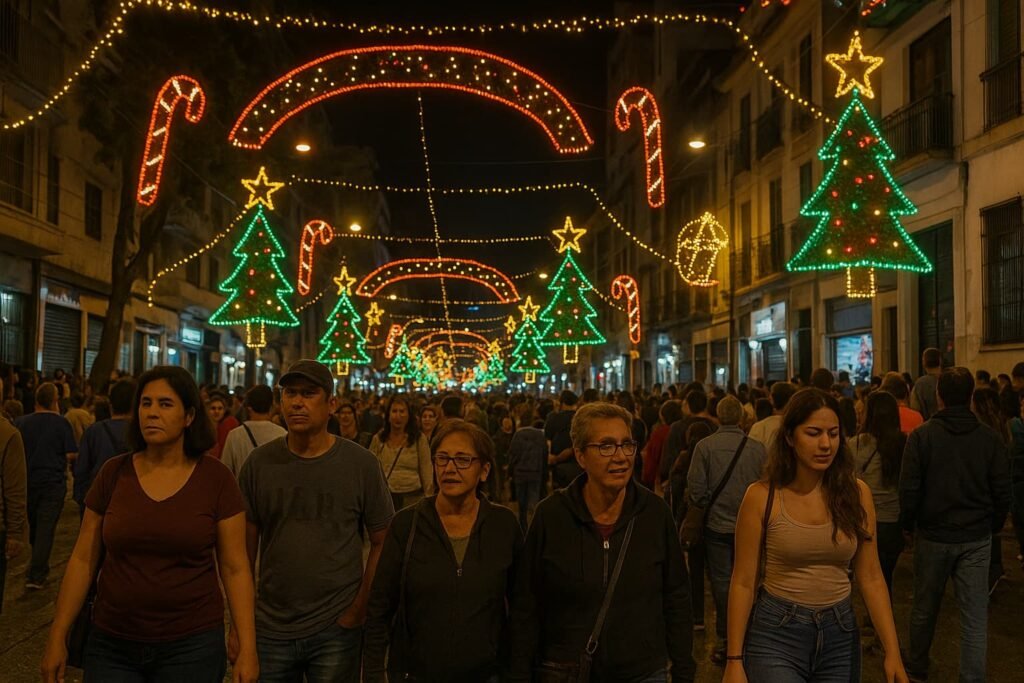
The streets of Caracas are lit with Christmas decorations. Traditional Venezuelan holiday music drifts from shops and homes. Children attend school, adults go to work, and vendors open their businesses as usual.
On the surface, daily life appears undisturbed. Beneath it, however, anxiety, fear and frustration have quietly settled in, as tensions between Venezuela and the United States intensify and uncertainty weighs heavily on the population.
For many Venezuelans, the normal rhythm of December now exists alongside constant vigilance.
Victoria, who lives alone in western Caracas and works in commerce, says her routine has been marked by unease for months. She asked to be identified only by her first name out of fear of reprisals.
Her two children have left the country, like millions of other Venezuelans in recent years. Though she continues working and completing daily tasks, she says the stress of unpredictability has deeply affected her well-being.
“Every day brings something new that makes you nervous,” Victoria said. “You try to keep going, but the uncertainty is always there.”
She says the tension has disrupted her sleep. Some nights she wakes up and scrolls through news on her phone, despite knowing it will only make it harder to fall asleep again.
“There’s a confrontation in which ordinary citizens have nothing to do,” she said, referring to the standoff between Washington and Caracas. “But it affects us anyway. We try to live normally, but everything is interrupted by what’s happening.”
Victoria says she now takes natural sleep aids, avoids socializing, and has experienced physical discomfort from prolonged stress. “Only those of us who live like this understand it,” she said.
Mental Health Under Pressure
According to Yorelis Acosta, a clinical and social psychologist at the Central University of Venezuela, prolonged political tension has had a clear impact on mental health across the country.
“There is no single way people process what is happening,” Acosta said. “It depends on where they live, how connected they are to information, and whether they have family abroad.”
She notes that residents near border regions experience the situation differently than those in the capital. Meanwhile, Venezuelans outside the country often perceive the nation as fully militarized, even when daily life inside appears outwardly calm.
Acosta says anxiety is especially pronounced among those who are constantly consuming news or social media, often from unreliable sources.
“Staying informed is important,” she said. “But being hyperconnected all day creates anxiety, insomnia and emotional exhaustion. People need limits, breaks, and space to care for their mental health.”
Contrasting Experiences of Normalcy
Not everyone shares the same sense of unease. Some Venezuelans say the country remains stable.
During a government demonstration in early December, marcher Yanitza Albarrán said life continued peacefully under President Nicolás Maduro’s leadership.
“Mothers are taking children to school, people are working, farmers are planting, merchants are selling,” she said. “The country is at peace because the president and armed forces guarantee it.”
For others, however, December compounds existing hardship.
“The holiday season makes emotions more intense,” Acosta said. “It highlights absences. Many people are missing children, parents, or loved ones who are abroad.”
Nearly eight million Venezuelans now live outside the country, turning what is traditionally a family-centered season into a reminder of separation.
Preventive Measures and Quiet Preparations
Fear has also led to precautionary steps.
CNN reviewed notices from private schools in Caracas requesting that parents prepare individual emergency kits for students. These include water, non-perishable food, hygiene items, flashlights and medications if needed.
While schools cite preparedness for earthquakes or emergencies, some parents believe the guidance reflects broader concerns tied to geopolitical tensions.
Businesses have also taken measures. Several owners, speaking anonymously, said they are closely monitoring road access and rehearsing internal communication plans to respond quickly to extraordinary situations.
This cautious atmosphere follows repeated statements by US President Donald Trump suggesting possible operations against Venezuelan drug trafficking, including actions near Venezuelan territory.
Isolation Deepens Anxiety
Uncertainty increased further when several airlines suspended flights to Venezuela after the US Federal Aviation Administration warned of a potentially hazardous flying environment over the country and the southern Caribbean.
Venezuelan authorities later revoked flight permits for carriers that did not resume service.
For Victoria, the news was devastating.
“I felt like everything collapsed,” she said. “It felt like the country was becoming completely isolated.”
She had hoped to visit her daughter in France, whom she has not seen in two years. Now she is weighing complicated travel routes through neighboring countries, unsure whether it is safe.
The same uncertainty affected Luis Rosas, an engineer living in Brazil. He had planned to visit Venezuela in December to celebrate his mother’s 80th birthday.
Instead of excitement, he felt anxiety.
“Family is the main reason to return,” Rosas said. “But situations like this create frustration and unease. They are beyond your control, but they affect everything.”
After considering the risks, Rosas decided not to travel this Christmas.
An Uneasy Season
In Caracas, Christmas lights continue to glow, music plays, and routines persist. Yet behind the decorations, many Venezuelans are grappling with sleepless nights, emotional strain, and difficult decisions shaped by forces far beyond their control.
Normal life continues — but so does the quiet fear.