
By Harshit
NEW YORK, FEB. 5, 2026 — U.S. MARKETS
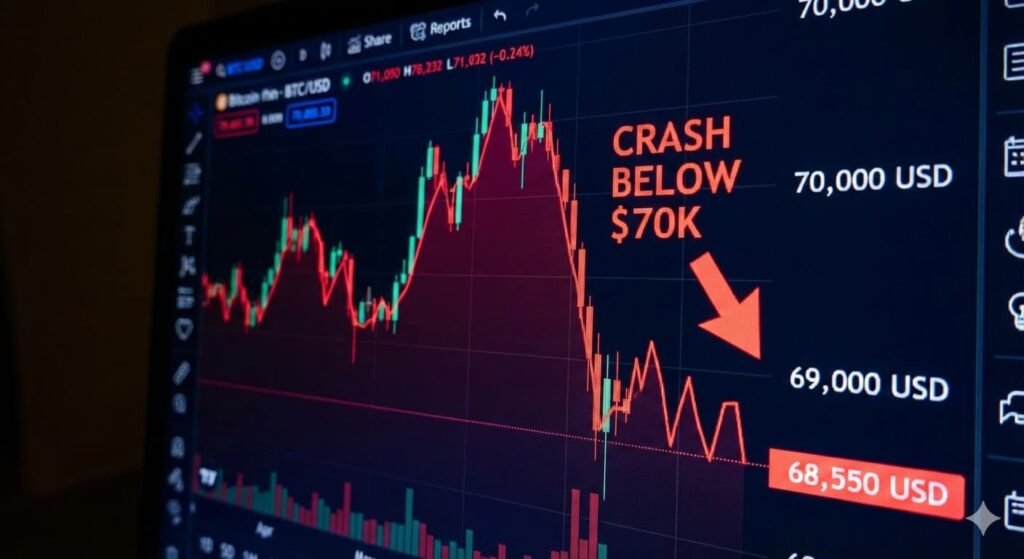
Bitcoin slid sharply in early U.S. trading on Thursday, breaking below the $70,000 mark for the first time since November 2024, as investor unease grew over President Donald Trump’s reported pick of Kevin Warsh as the next Federal Reserve chair.
The world’s largest cryptocurrency was last trading around $69,300 by mid-morning in New York, down more than 5% on the day, after fluctuating between roughly $70,098 and $76,130 earlier in the session. Ether fell about 6%, hovering near $2,080, according to CoinMetrics data.
The sell-off comes as traders reassess the outlook for U.S. liquidity, a key driver of risk-sensitive assets such as cryptocurrencies.
Fed Leadership Uncertainty Pressures Risk Assets
Market participants linked the move to concerns that a Warsh-led Federal Reserve could accelerate balance-sheet reduction, draining liquidity from the financial system.
“The market fears a hawk with him,” said Manuel Villegas Franceschi, analyst at Julius Baer, referring to Warsh’s historically conservative stance on monetary policy.
A shrinking Fed balance sheet has typically acted as a headwind for speculative assets, as it signals tighter financial conditions and reduced excess liquidity.
Warsh’s nomination is still under review in Washington, adding to uncertainty. Reuters also reported this week that an ongoing probe involving current Fed Chair Jerome Powell has further complicated the confirmation process.
ETF Outflows Add to Downward Pressure
The downturn has also refocused attention on U.S. spot bitcoin exchange-traded funds, which have become a key barometer of institutional sentiment.
Analysts at Deutsche Bank noted “massive withdrawals from institutional ETFs,” estimating that U.S. spot bitcoin ETFs saw more than $3 billion in net outflows during January, following heavy redemptions late last year.
Bitcoin is now down more than 7% this week and nearly 20% year-to-date, Deutsche Bank said.
James Butterfill, head of research at CoinShares, described $70,000 as a “key psychological level.”
“If we fail to hold it, a move toward the $60,000 to $65,000 range becomes quite likely,” Butterfill said.
Liquidity, Not Hype, Driving the Market
The broader risk-off mood has been reinforced by weakness in U.S. equities, particularly technology stocks, which sold off on Wednesday. That pressure spilled into crypto markets alongside continued liquidations.
More than $2 billion worth of long and short crypto positions have been liquidated this week alone, according to Coinglass data, amplifying volatility as automated sell orders were triggered.
Bitcoin has now fallen roughly 40% from its all-time high above $126,000 reached in October.
“The straight-line bull run that a lot of people expected hasn’t really materialized,” said Maja Vujinovic, CEO of digital assets at FG Nexus, speaking to CNBC. “Bitcoin isn’t trading on hype anymore — it’s trading on pure liquidity and capital flows.”
A report from CryptoQuant echoed that view, noting that institutional demand has “reversed materially” in 2026. The firm said U.S. ETFs, which were net buyers of roughly 46,000 bitcoin at this time last year, have become net sellers.
CryptoQuant also highlighted a key technical signal: bitcoin has broken below its 365-day moving average for the first time since March 2022, a move that historically coincided with deeper drawdowns.
Key Data Ahead Could Shift Sentiment
Investors are now looking to upcoming U.S. economic data for clues on interest rates and liquidity conditions. Job openings data is due later Thursday, followed by the January employment report on Feb. 11 and the CPI inflation report on Feb. 13, according to the Bureau of Labor Statistics.
Should inflation come in hotter than expected, traders fear further downside for crypto. Conversely, any sign that ETF outflows are slowing or that Fed balance-sheet tightening could proceed more gradually may help stabilize prices.
For now, the break below $70,000 underscores how tightly bitcoin remains tied to macroeconomic forces — particularly U.S. monetary policy — as institutional participation continues to shape the market’s direction.