
By Harshit
PROVIDENCE, DECEMBER 19, 2025
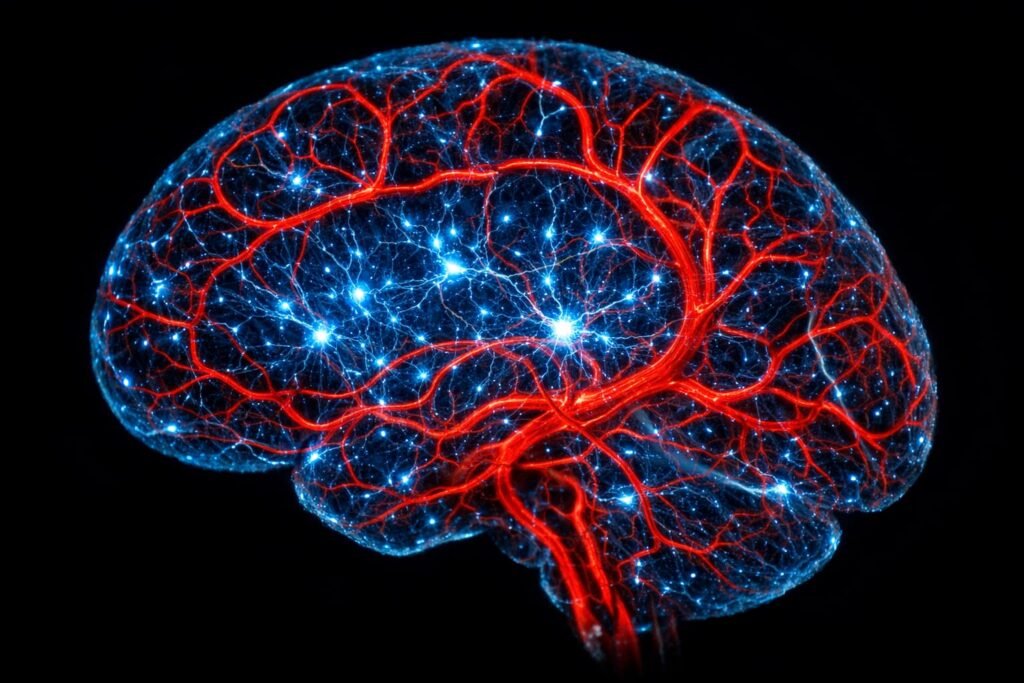
For decades, neuroscientists have relied on powerful external light sources—lasers, microscopes, and fiber-optic probes—to observe activity inside the living brain. Now, researchers at Brown University have demonstrated a fundamentally different approach: making neurons generate their own light.
In a study published in Nature Methods, scientists describe a new bioluminescent imaging system that allows brain cells to glow from within, revealing neural activity in real time without the need for external illumination. The technique offers a safer, cleaner, and longer-lasting way to observe how the brain functions during behavior, learning, and movement.
Lighting the Brain From the Inside
The idea behind the work dates back about a decade, when researchers began questioning whether the brain really needed to be illuminated from the outside at all.
“We started asking ourselves, what if we could light up the brain from the inside?” said Christopher Moore, a professor of brain science at Brown University and a leader of the project. Traditional optical methods rely on shining light into brain tissue, but those approaches come with significant limitations, including tissue damage, signal distortion, and short recording windows.
Bioluminescence—light produced by a chemical reaction inside cells—offered a promising alternative. Unlike fluorescence, it does not require lasers or strong illumination. Instead, light is generated when an enzyme breaks down a small molecule, producing a glow that can be detected externally.
The Birth of the Bioluminescence Hub
This concept led to the creation of the Bioluminescence Hub at Brown University’s Carney Institute for Brain Science in 2017. Supported by a major grant from the National Science Foundation, the hub brought together researchers from multiple institutions, including Brown University, Central Michigan University, the University of California San Diego, UCLA, and New York University.
The team’s goal was ambitious: engineer biological tools that allow neurons not only to emit light, but to use that light as a signal of their internal activity.
Introducing CaBLAM: A New Way to See Neural Activity
The result is a molecular tool called CaBLAM, short for Calcium BioLuminescence Activity Monitor. CaBLAM is designed to glow in response to calcium ions, which play a central role in neuron firing and communication.
Calcium levels rise when neurons become active. By linking bioluminescence directly to calcium signaling, CaBLAM allows researchers to visualize when and where individual neurons are firing—without lasers, optical fibers, or invasive hardware.
The molecular design was led by Nathan Shaner, a neuroscientist and pharmacologist at UC San Diego, who engineered the sensor to be bright enough for detailed imaging inside living animals.
Why Bioluminescence Matters for Brain Research
Most modern brain imaging relies on fluorescent indicators, which glow when struck by external light. While powerful, these methods have drawbacks.
Extended light exposure can damage brain cells, alter their behavior, and degrade fluorescent molecules over time—a problem known as photobleaching. In addition, brain tissue scatters incoming light, creating background noise and limiting how deeply scientists can see.
Bioluminescence avoids these issues entirely.
“The brain does not naturally produce bioluminescent light,” Shaner explained. “So when engineered neurons glow on their own, they stand out clearly against a dark background. There’s far less noise, and scattering becomes much less of a problem.”
Because there is no external illumination, recordings can continue for hours without harming tissue or losing signal strength.
Watching Neurons in Action for Hours
Using CaBLAM, the research team successfully recorded neural activity in mice and zebrafish, capturing signals from individual cells and even smaller cellular compartments. In one experiment, they recorded continuous brain activity for more than five hours—far longer than is typically possible with fluorescence-based methods.
The tool also worked while animals were awake and moving, including during behaviors such as running on a wheel. This capability is critical for studying learning, decision-making, and complex behavior, which unfold over long timescales.
“It’s like having a highly sensitive movie camera that records brain activity as it naturally happens,” Moore said.
Beyond Imaging: Rewriting Neural Communication
The CaBLAM system is part of a broader effort at the Bioluminescence Hub to develop tools that both observe and influence neural activity. In some experiments, researchers are exploring ways for one neuron to emit light that another neuron can detect, effectively allowing cells to communicate through light-based signaling.
The team is also investigating how calcium-regulated bioluminescent systems could be used to control cellular activity, not just monitor it.
As these projects progressed, researchers realized that brighter, more reliable calcium sensors were essential—a need that directly led to CaBLAM’s development.
A Platform With Wide Applications
While the current work focuses on neuroscience, the implications extend far beyond the brain. Moore believes bioluminescent sensors could eventually be used to track activity in other organs, including the heart, muscles, and immune system.
“This opens the door to observing biological processes across the body in ways that were previously impractical,” he said.
The project involved at least 34 scientists and was supported by funding from the National Institutes of Health, the National Science Foundation, and the Paul G. Allen Family Foundation—highlighting the scale and collaborative nature of the effort.