
By Harshit
LOS ANGELES, FEB. 6, 2026 —
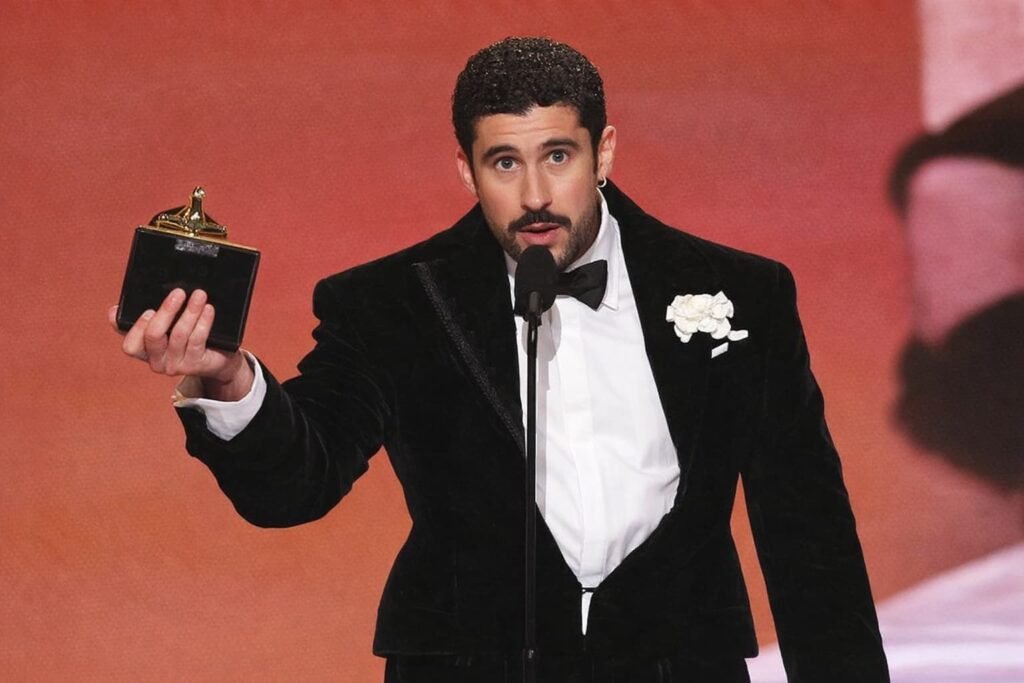
When Bad Bunny stepped onto the Grammy stage to accept Album of the Year for Debí Tirar Más Fotos, the moment marked more than a personal triumph. It rewrote the history of American music’s most powerful institution.
For the first time in the Recording Academy’s history, a Spanish-language album claimed its most prestigious award — a seismic shift in an industry that has long celebrated Latino music in separate categories rather than at its center.
For millions of Latinos across the United States, Bad Bunny’s win resonated as cultural validation, visibility, and belonging — especially at a time when many feel politically and socially targeted.
A Groundbreaking Grammy Moment

Bad Bunny’s victory came during the Grammy Awards, where the Puerto Rico-born superstar took home three trophies, including Best Global Music Performance. His Album of the Year acceptance speech was delivered largely in Spanish — a deliberate, defiant choice that underscored the night’s significance.
“This wasn’t just a Grammy win,” said Jeffrey Vargas, a Nuyorican from Bushwick, Brooklyn. “It was validating and ground-shifting in a moment when it feels like we’re all under attack. The album wasn’t just music — it was healing.”
The recognition arrives just weeks before Bad Bunny is set to headline the Super Bowl halftime show, further cementing his role as one of the most influential artists in the world.
Refusing to Translate Himself
Unlike many artists before him, Bad Bunny never reshaped his identity to fit mainstream expectations. He didn’t switch languages, dilute cultural references, or soften political edges to “cross over.”
“Instead of watering himself down, he added more sofrito to the pot,” said Liz Arreola, a Mexican-American creator from Houston, referencing the Caribbean seasoning used as a metaphor for cultural richness.
Debí Tirar Más Fotos is deeply rooted in Caribbean rhythms, Puerto Rican history, street slang, and political consciousness. Its success challenges decades of industry assumptions that Spanish-language music must be categorized separately to succeed.
A Win That Carries Political Weight

Bad Bunny’s Grammy success arrives amid heightened immigration debates and cultural backlash facing Latino communities nationwide. That context made his acceptance speeches feel especially urgent.
While accepting Best Música Urbana Album, he delivered a pointed message:
“ICE out! We’re not savage, we’re not animals, we’re not aliens. We are humans and we are Americans.”
He followed with a call for unity rooted in compassion, not anger — a sentiment echoed widely across Latino communities.
“This was about dignity,” said Lucria Ortiz, a Puerto Rican community leader from Massachusetts. “We needed a reminder that centering love is not weakness — it’s power.”
Redefining What Belongs at the Center
For decades, Latino artists were told mainstream success required subtraction: less Spanish, fewer regional sounds, more “universal” themes. Bad Bunny proved the opposite — that authenticity itself can be universal.
Luis Miranda, a longtime political consultant and Broadway producer, called the win a recognition of reality rather than an exception.
“Our language, our music, our people have always been part of this country’s fabric,” he said. “This just finally acknowledges it.”
More Than an Award
Bad Bunny’s Album of the Year win is not just about streams, charts, or trophies. It represents a cultural turning point — one where Latino music is no longer positioned as an alternative lane, but as a central force shaping American culture.
For fans watching across the country and beyond, the moment felt historic because it was honest. A Spanish album won because it connected — not in spite of its roots, but because of them.