
CAPE CANAVERAL, MARCH 29, 2026 —
What You Need To Know
- NASA’s Artemis II countdown begins Monday — liftoff is targeted for 6:24 PM Eastern Time on Wednesday, April 1 from Launch Complex 39B at Kennedy Space Center in Florida
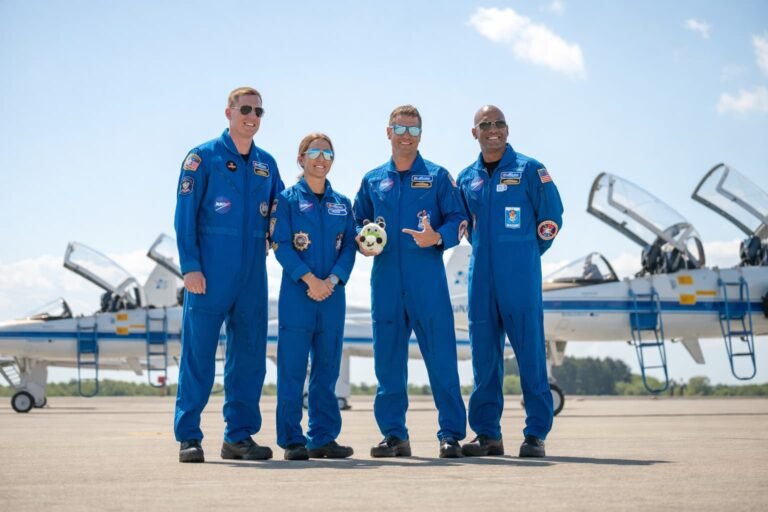
- The four crew members — Commander Reid Wiseman, Pilot Victor Glover, Mission Specialist Christina Koch, and Canadian astronaut Jeremy Hansen — arrived at Kennedy Space Center Friday after two weeks in quarantine and are now in their final pre-launch preparations
- If the launch proceeds as planned, it will be the first human mission beyond low Earth orbit since Apollo 17 in December 1972 — 54 years and 100 days ago
Three days from now, assuming everything continues to go as planned, four human beings will leave Earth and travel toward the Moon. The countdown clock has not started yet. The launch window does not open for 72 hours. But at Kennedy Space Center in Florida on Sunday, the 322-foot Space Launch System rocket stands on Launch Complex 39B, fueled and ready, and the four astronauts who will ride it are 4 miles away — in quarantine, going through final medical checks, and preparing for the most consequential journey any human being has taken since the last Apollo crew splashed down in the Pacific Ocean in 1972.
What Is Happening Right Now
The Artemis II rocket completed its rollout from Kennedy Space Center’s Vehicle Assembly Building to Launch Pad 39B on March 20 — a 4-mile, 10-hour overnight journey that took the 322-foot stack along the same path that Saturn V rockets traveled during the Apollo era. It is, by a significant margin, the most powerful rocket NASA has ever launched with a crew aboard.
The crew — Commander Reid Wiseman of Maryland, Pilot Victor Glover of California, Mission Specialist Christina Koch of North Carolina, and Canadian Space Agency astronaut Jeremy Hansen — entered quarantine the same day the rocket rolled to the pad. On Friday, March 27, they emerged from quarantine in Houston and flew to Kennedy Space Center, landing at the Launch and Landing Facility to applause from NASA ground crews. They brought with them their mission mascot: a small plush figure that will float free of its harness at the moment of zero gravity to confirm the spacecraft’s successful exit from Earth’s gravitational pull — a tradition dating to the early days of human spaceflight.
The Countdown — Hour by Hour
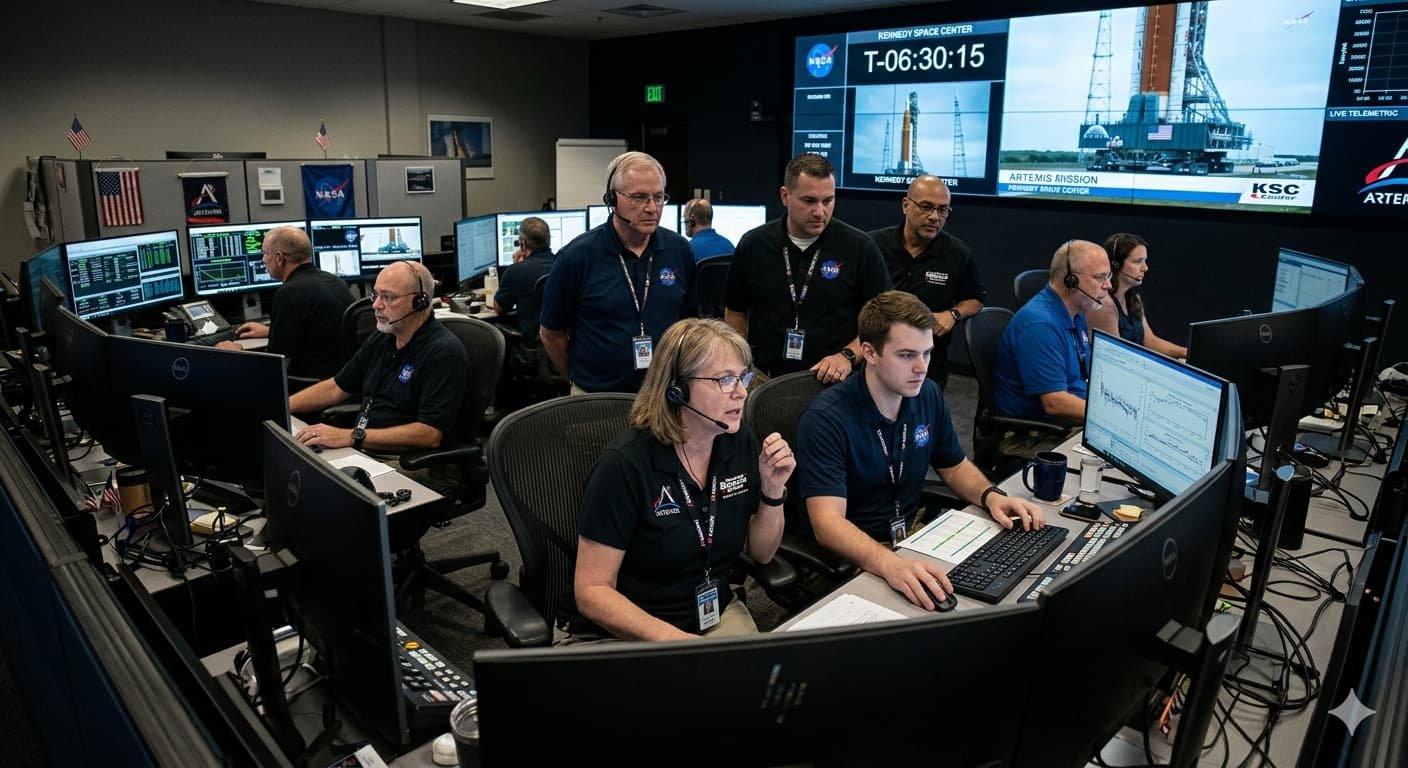
NASA will begin the formal launch countdown Monday, approximately two days before the scheduled Wednesday liftoff. The countdown contains built-in holds — planned pauses that give launch controllers time to catch and resolve issues without scrubbing the mission entirely.
| Launch Day Timeline — April 1 | Event |
|---|---|
| 7:45 AM EDT | Fueling of SLS begins — liquid hydrogen and liquid oxygen |
| Early afternoon | Crew suit-up at Neil Armstrong Operations and Checkout Facility |
| Mid-afternoon | Crew transport to Launch Complex 39B |
| 6:24 PM EDT | Launch window opens — two hours available |
| 6:24 PM — 8:24 PM EDT | Launch must occur within this window |
| T+3 days | Crew reaches lunar vicinity |
| T+4 days | Lunar far side flyby — farthest from Earth since 1972 |
| T+10 days | Pacific Ocean splashdown |
If NASA cannot launch on April 1, backup windows exist on April 2, 3, 4, 5, and 6. Miss all of those and the next window does not open until April 30.
The Journey — What Actually Happens
Artemis II will follow what engineers call a free-return trajectory — a path carefully calculated so that if the Orion spacecraft’s main engine fails at any point during the lunar portion of the flight, the spacecraft will automatically be slung back toward Earth by the Moon’s gravity without any engine burn required. It is the same fundamental trajectory used by Apollo 13 after its oxygen tank explosion — the path that brought three astronauts home from a crippled spacecraft 56 years ago.
The crew will spend approximately three days traveling to the Moon, pass within roughly 4,700 miles of its far side — the side that faces permanently away from Earth, never visible from the ground — and spend one day in lunar observation before beginning their return journey. The Orion spacecraft will reenter Earth’s atmosphere at approximately 25,000 miles per hour — the fastest reentry speed ever attempted by a crewed spacecraft. The heat shield, which represents one of the mission’s primary test objectives, must withstand temperatures approaching 5,000 degrees Fahrenheit during that reentry.
The Records That Will Fall on Wednesday
If Artemis II launches and completes its mission, four historical records fall simultaneously:
| Record | Person | Significance |
|---|---|---|
| Furthest human from Earth since 1972 | All four crew | ~400,000 km from Earth |
| First person of color in deep space | Victor Glover | Historic milestone |
| First woman beyond low Earth orbit | Christina Koch | 54 years in the making |
| First non-American beyond LEO | Jeremy Hansen | First for any non-U.S. citizen |
Three of those four records involve people who were excluded from the original space race entirely. The Apollo program flew 24 people to the Moon between 1968 and 1972. All 24 were white American men. On Wednesday, if everything holds, that changes.
The Long Road to April 1
This launch has been a long time coming — and not just in the 54-year sense. Artemis II was originally targeted for February 2026. A hydrogen leak during a wet dress rehearsal in February pushed it back. A helium flow problem triggered a full rollback to the Vehicle Assembly Building and cost another month. A second wet dress rehearsal on February 19 was successful. A Flight Readiness Review last week returned a unanimous go from all teams.
Every delay that did not break the mission made the team that fixed it more confident the one they were flying was ready. That confidence is visible in the language NASA officials have used since the second wet dress rehearsal. “No fooling — NASA moving full-speed toward an April 1 launch,” the agency posted on its official channels Saturday.
The Moon has been waiting 54 years. Wednesday, it gets visitors.