
By Harshit, SEATTLE, Oct. 29, 2025
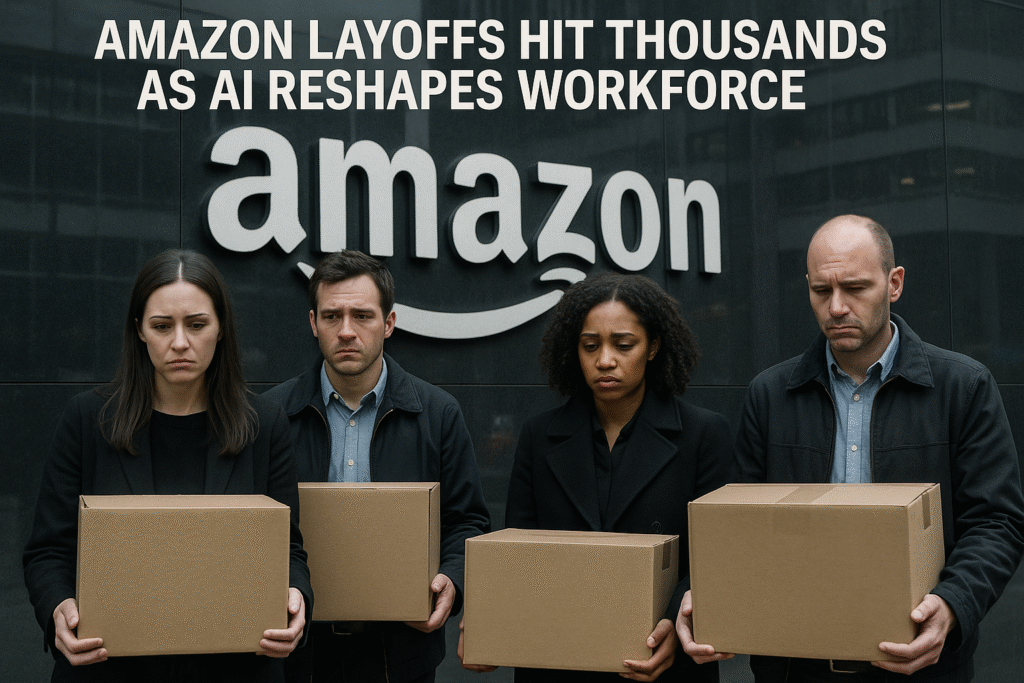
In a move that underscores the accelerating impact of artificial intelligence on corporate labor structures, Amazon has announced another round of job cuts affecting thousands of employees across its corporate, retail, and logistics divisions. The layoffs, confirmed Friday, mark one of the company’s most significant workforce reductions since 2022, as automation and AI-driven tools continue to reshape business operations.
AI and Automation Drive Structural Shifts
Amazon executives said the layoffs are part of a “strategic restructuring” aimed at integrating advanced AI systems into core functions, including customer service, supply chain optimization, and marketing analytics. While the company emphasized that the shift would “enhance efficiency and reduce operational redundancy,” industry analysts say the move highlights a growing divide between human labor and machine intelligence.
Over the past year, Amazon has rolled out AI tools capable of automating product listings, inventory management, and even portions of warehouse operations. These innovations have allowed the company to cut costs substantially but have also led to redundancies among mid-level managerial and support staff.
“AI is changing the fabric of employment faster than anyone anticipated,” said Julia Reynolds, a labor economist at the Brookings Institution. “We’re witnessing a technological transition that is redefining white-collar work just as automation transformed blue-collar labor in the 2000s.”
Affected Divisions and Employee Response
The layoffs primarily affect roles within Amazon’s advertising, human resources, and customer support divisions. Internal documents reviewed by Reuters indicate that several hundred corporate roles have been consolidated under new AI-supported frameworks.
Warehouse operations — long a focus of automation — will see expanded deployment of autonomous robots that handle sorting, packaging, and last-mile coordination. The company said these systems improve accuracy and reduce accidents, but labor advocates argue that they also reduce job availability and limit upward mobility for existing employees.
Some workers expressed frustration over the abrupt nature of the cuts. “It’s ironic that we built the data pipelines feeding these AI systems, and now those same systems are replacing us,” said a former senior analyst from Amazon’s Seattle headquarters.
Amazon’s AI Vision and Economic Outlook
CEO Andy Jassy defended the layoffs as a necessary evolution, saying the company must “adapt to the realities of AI-driven efficiency” to remain globally competitive. “This is not about cutting people; it’s about scaling innovation,” Jassy stated in an internal memo.
Amazon is investing billions into proprietary large language models to compete with OpenAI, Google, and Microsoft in the generative AI space. Its recently launched “Bedrock” and “Titan” AI platforms are being positioned as enterprise-grade tools to power e-commerce personalization, logistics forecasting, and digital advertising.
However, economists caution that while these technologies boost profits, they could deepen inequality. “The productivity surge from AI could widen the income gap if displaced workers aren’t retrained or redeployed,” said economist Aaron Chen of the Wharton School.
Wider Industry Implications
Amazon’s move follows similar restructuring by major tech firms. Google, Meta, and Microsoft have each reduced staff this year while ramping up AI investments. The U.S. Bureau of Labor Statistics recently reported that AI-driven automation could impact up to 30% of white-collar roles by 2030.
Experts warn that the current wave of layoffs may be only the beginning. “What we’re seeing is the first major correction in how corporations balance human capital with machine intelligence,” said tech futurist Dr. Rachel Lerman. “The long-term challenge will be redefining work, not just replacing it.”
Government and Policy Reaction
Lawmakers have begun calling for stronger worker protections amid rising AI-driven unemployment. Senator Elizabeth Warren renewed her push for federal legislation requiring companies to disclose AI-related job impacts before large-scale layoffs.
Meanwhile, the Department of Labor announced plans to investigate whether AI displacement could trigger broader economic instability. “We can’t allow efficiency to come at the cost of livelihoods,” said Labor Secretary Julie Su.
Conclusion: A Turning Point for the Digital Economy
The latest Amazon layoffs represent a broader reckoning across the global tech industry — one where the speed of AI innovation is outpacing the evolution of labor policy. As companies embrace machine learning for efficiency, questions remain about the social and ethical responsibilities tied to automation.
For Amazon, the challenge will be proving that AI can enhance both productivity and people — not just one at the expense of the other.