
By Harshit, New York | October 23, 2025 11 AM EDT
Tech Titans Take Command of the S&P 500
Artificial intelligence has redefined the American stock market — and now, a handful of tech giants control nearly a third of it.
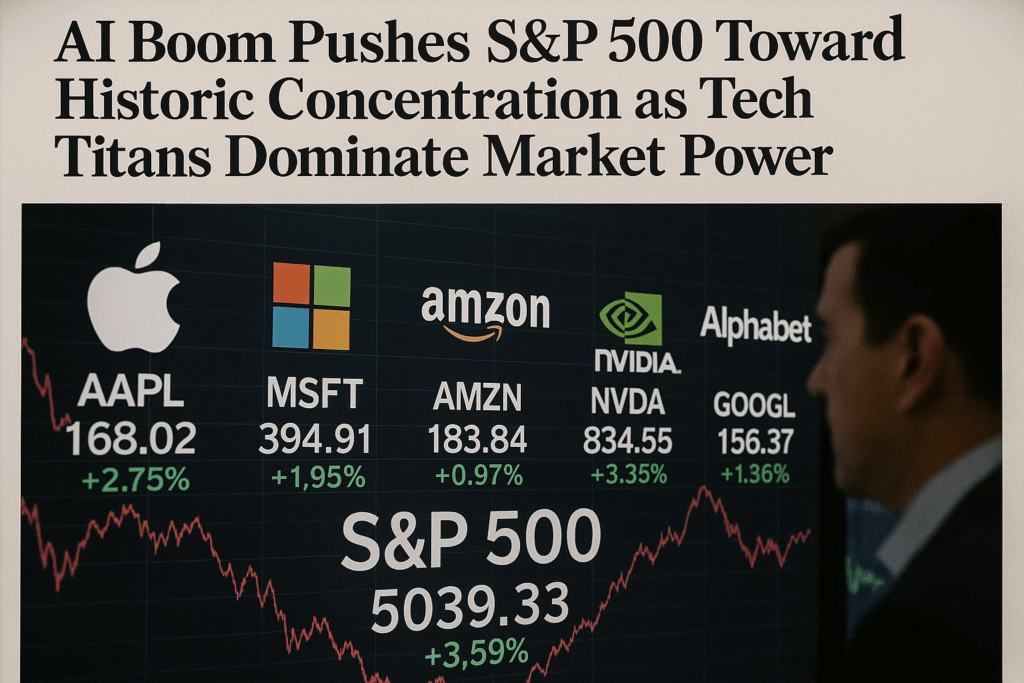
Nvidia, Microsoft, Apple, Google parent Alphabet, and Amazon — the five largest companies in the S&P 500 — collectively account for almost 30% of the entire index’s market value, according to recent data. This unprecedented concentration is sparking debate among investors over whether the once-reliable S&P 500 index fund remains a truly diversified investment.
Once considered a balanced reflection of America’s corporate landscape, the index has increasingly come to mirror the explosive growth of AI-linked mega-cap firms. These companies have not only driven the market’s gains in recent years but also concentrated risk in ways that some financial experts say could leave investors exposed.
AI Dominance Raises Diversification Concerns
For millions of Americans with retirement or investment accounts tied to S&P 500 index funds, artificial intelligence is already at the heart of their portfolio — whether they realize it or not.
“Many people aren’t aware how their retirement portfolio performance or taxable account portfolio performance is really dependent upon the success of these five companies,” said Kamila Elliott, certified financial planner and CEO of Collective Wealth Partners in Atlanta.
Elliott, who also serves on the CNBC Financial Advisor Council, warned that the traditional “set-it-and-forget-it” investing strategy may no longer apply. “If your entire portfolio for retirement is in the S&P 500, regardless of what’s happening in the AI market, it really isn’t well diversified,” she said.
How the Index Became So Concentrated
The growing imbalance stems from how the S&P 500 is structured. It is a market-cap-weighted index, meaning companies with higher valuations exert more influence on the index’s performance.
As the stock prices of AI-driven firms have surged — thanks to booming demand for cloud computing, chips, and automation — their market caps have ballooned. Nvidia’s meteoric rise, fueled by its dominance in AI chipmaking, and Microsoft’s early bets on generative AI have propelled both companies to record valuations.
“The S&P 500 is still diverse for sure,” said John Mullen, president and CEO of Parsons Capital Management in Providence, Rhode Island. “You still have 500 names that make up the index. It is, however, much more concentrated than it has been throughout most of its history.”
Opportunity or Overexposure?
Opinions remain divided among analysts about whether the AI concentration represents a risk or a once-in-a-generation opportunity.
“I think tech continues to lead the market higher and that ultimately has really changed the game for investors,” said Dan Ives, managing director at Wedbush Securities. “We’re living in a fourth industrial revolution, and I think the market is starting to reflect that. It’s an exciting time to be an investor in U.S. tech.”
However, not everyone shares that optimism. Critics warn that when so much of the market’s performance depends on so few companies, even a modest correction in the tech sector could trigger volatility across the entire index.
Elliott and other financial advisors recommend investors diversify beyond large-cap U.S. tech stocks — including smaller companies, international markets, and other asset classes like bonds or commodities — to reduce exposure to concentrated risk.
Rethinking the “Set-It-and-Forget-It” Era
For decades, S&P 500 index funds were seen as the gold standard of low-risk, long-term investing — a strategy championed by market icons like Warren Buffett and Vanguard founder Jack Bogle.
But with nearly one-third of the index now dominated by just five tech giants, the assumptions underpinning that strategy may be due for a rethink.
“‘Set it and forget it’ is no longer as applicable,” Elliott said. “Investors need to be more intentional about diversification now than they were even a decade ago.”
As the AI revolution accelerates, the challenge for investors will be balancing the enormous potential of technology with the timeless rule of investing — don’t put all your eggs in one basket.