
By Harshit, December 7, 2025 —
Artificial intelligence has entered a new phase.
What began as Generative AI — tools capable of drafting text, writing code, or creating images — is rapidly evolving into something far more consequential. Across the U.S. tech landscape, AI is shifting from an assistive role to an autonomous one, acting independently, executing complex tasks, and increasingly functioning as a virtual workforce.
This transition is defined by three tightly connected forces: Agentic AI, Micro Large Language Models (Micro LLMs), and AI Trust, Risk, and Security Management (AI TRiSM). Together, they mark a structural change in how AI is built, deployed, and governed.
I. Agentic AI: The Rise of Autonomous Systems
Agentic AI represents the most significant leap in artificial intelligence since the emergence of large language models. Unlike traditional generative systems that respond to prompts in isolation, Agentic AI systems are goal-driven, autonomous entities capable of planning, adapting, and executing multi-step tasks with minimal human involvement.
A New AI Architecture
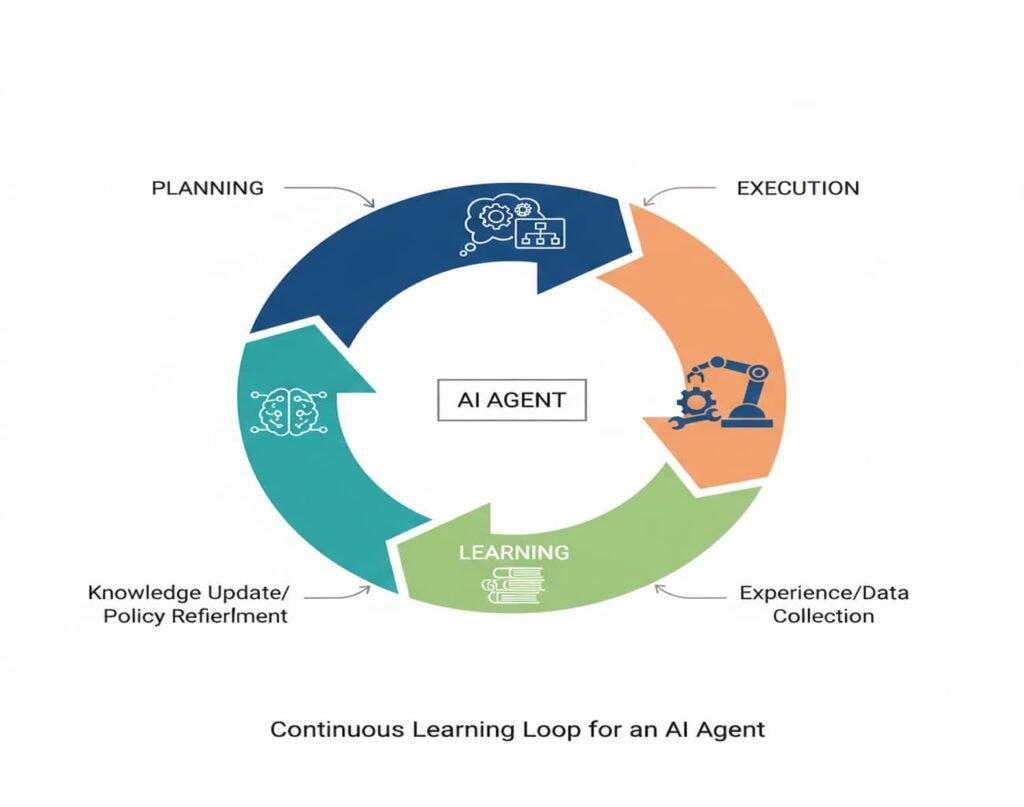
At the core of Agentic AI is a continuous decision loop that mirrors human problem-solving:
- Perception: The agent gathers information from its environment, such as APIs, databases, user inputs, or real-time signals.
- Reasoning and Planning: Using an underlying LLM, the agent decomposes a high-level objective into a structured plan and anticipates obstacles.
- Execution: The agent interacts autonomously with tools — running code, querying systems, sending emails, or triggering workflows.
- Learning and Adaptation: Outcomes are evaluated in real time, and future actions are adjusted accordingly.
This architecture enables AI systems to operate independently, rather than waiting for repeated human prompts.
II. Transforming Business Operations Through Virtual Workforces
The commercial value of Agentic AI lies in its ability to perform continuous, repeatable knowledge work at scale. U.S. enterprises are increasingly deploying AI agents as virtual employees, operating around the clock without fatigue.
Key Deployment Areas
- Software Development and IT Operations: AI agents can convert natural-language requirements into production code, manage pull requests, resolve low-level incidents, and update issue trackers. Early enterprise deployments report development cycle acceleration of 30–50%.
- Customer Service and Sales: Agents are evolving beyond reactive chatbots. Sales agents can monitor prospect activity, draft tailored outreach, send communications, track engagement, and schedule follow-ups without human intervention.
- Research and Knowledge Management: Autonomous research agents synthesize data from multiple sources, generate structured reports, and alert analysts to material changes in real time.
These applications effectively convert AI from a productivity booster into a self-directed operational layer within organizations.
III. Governing Autonomy: Oversight in an Agent-Driven World
With autonomy comes risk. Enterprises deploying Agentic AI are confronting new governance challenges that extend far beyond traditional model supervision.
Human Control Frameworks
Leading organizations are implementing structured oversight mechanisms, including:
- Risk Tiering: Agents are classified by operational impact. Low-risk agents operate freely, while high-impact agents — such as those authorized to approve refunds or execute trades — require human sign-off beyond set thresholds.
- Auditability and Traceability: Every action taken by an AI agent must be logged, explainable, and attributable to a responsible team. This is critical for compliance in regulated sectors like finance and healthcare.
The emphasis has shifted from trusting the model to holding humans accountable for its deployment and supervision.
IV. Micro LLMs: Decentralizing Intelligence
The rise of Agentic AI depends on a parallel transformation in infrastructure. Massive cloud-based models, while powerful, are costly and introduce latency. The solution is Micro LLMs, also called Small Language Models (SLMs).
Why Smaller Models Matter
Micro LLMs are compact, specialized models trained on domain-specific data and optimized for deployment on edge devices, including smartphones, industrial sensors, robots, and vehicles.
Their advantages include:
- Ultra-Low Latency: Critical for real-time decisions in manufacturing, robotics, and autonomous systems.
- Improved Data Privacy: Sensitive data can be processed locally instead of transmitted to the cloud.
- Lower Operating Costs: Shifting inference away from cloud GPUs drastically reduces deployment expenses, making AI accessible to smaller organizations.
V. The Technology Enabling Micro LLMs
Several breakthroughs are accelerating the adoption of decentralized intelligence:
- Quantization: Reducing numerical precision to shrink model size without major performance loss.
- Pruning: Eliminating redundant neural connections.
- Knowledge Distillation: Training smaller models to replicate the behavior of larger systems.
- Specialized Hardware: AI-optimized chips and ASICs are enabling high-performance inference on low-power devices.
The result is industry-specific AI, running locally, optimized for narrow, high-value use cases.
VI. AI TRiSM: The Foundation of Responsible AI at Scale
As autonomous systems proliferate, the risks of bias, security breaches, and opaque decision-making grow. AI Trust, Risk, and Security Management (AI TRiSM) has become the core framework governing safe AI deployment.
Key Pillars of AI TRiSM
- Trust Management: Ensuring model explainability and detecting algorithmic bias. Transparency is increasingly mandated for high-risk AI systems.
- Risk Assessment: Ongoing evaluation of model performance, data quality, and exposure to adversarial attacks.
- Security Management: Protecting against data poisoning, model inversion attacks, and unauthorized tool usage by AI agents.
- Continuous Monitoring (ModelOps): Detecting performance drift as real-world data diverges from training data and triggering retraining or recalibration.
AI TRiSM reframes governance as a continuous operational discipline, not a one-time compliance checklist.
VII. The Regulatory Landscape Takes Shape
The regulatory environment surrounding AI is solidifying rapidly.
- United States: Regulation remains sector-specific, with states and federal agencies issuing rules on hiring algorithms, insurance, healthcare, and consumer protection. Enforcement increasingly follows a risk-based approach.
- Global Pressure: The EU’s AI Act, while not U.S. law, sets global expectations. U.S. multinationals are effectively adopting similar governance standards to remain compliant internationally.
In practice, AI TRiSM is becoming a de facto global requirement.
Conclusion: From Assistive AI to Autonomous Intelligence
The shift from Generative AI to Agentic AI marks a fundamental change in how technology shapes work and decision-making. Powered by efficient Micro LLMs and governed through AI TRiSM frameworks, AI is evolving into an autonomous, scalable operational force.
For the U.S. tech sector, the focus has moved decisively toward safe autonomy, decentralized intelligence, and accountable governance. AI is no longer just a tool — it is becoming infrastructure.