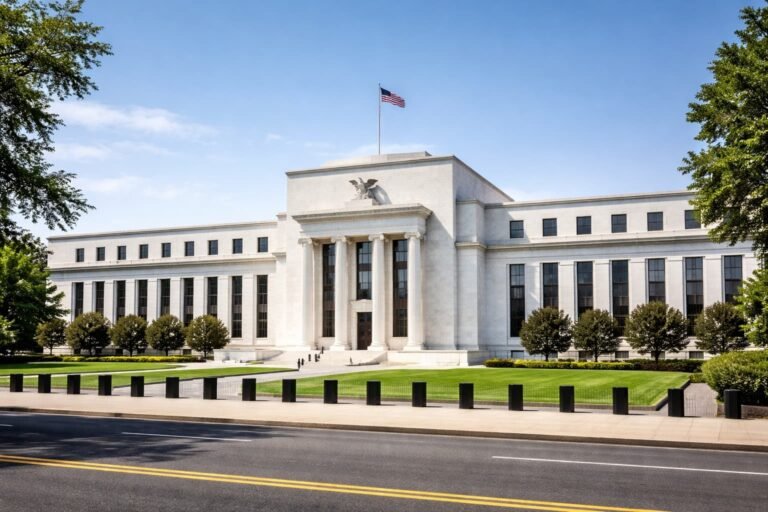
Photo by Nicholas Cappello on Unsplash
The world economy is set to grow faster than previously expected this year, even after disruption from the Iran war, an international economic policy organization said Wednesday. The OECD raised its 2026 global growth forecast to 2.9%, according to its latest Interim Economic Outlook, published on Wednesday 23 September 2026. The report contains fresh analysis and projections for the world economy and all G20 countries.
The upgraded outlook comes at a moment when energy markets are already reacting to signs that tensions between Washington and Tehran may be easing, a shift that could further support growth if it holds.
Spain Leads, Germany and France Lag
Within the eurozone, Spain is expected to outperform its peers. The OECD projects Spain will grow by 2.6% in 2026 and 1.8% in 2027, putting it ahead of other eurozone countries covered in the update.
Other major European economies are expected to grow far more slowly. Forecasts include:
- Germany: 1.1% in 2026 and 1.1% in 2027
- Italy: 0.9% in 2026 and 0.6% in 2027
- France: 0.4% in 2026 and 0.7% in 2027
The gap between Spain and the rest of the bloc underscores how unevenly the recovery is spreading across Europe, even as the overall global figure moves higher.
Oil Slides on Signs of US-Iran Progress
Oil markets moved sharply lower Wednesday as investors weighed the prospect of diplomatic progress between the United States and Iran. Brent crude fell around 1.2% to near $98 a barrel, marking its longest losing streak in a year, a market strategy analyst at a financial trading firm said.
The drop followed comments from President Trump, who said U.S. officials held a three-hour meeting with Iranian officials. He described the discussion as a “very good” three-hour conversation, language that traders took as an encouraging signal after months of war-related disruption to energy markets.
The retreat in crude rippled through fixed-income markets as well. The US 10-year Treasury yield hovered around 4.93% after crude oil moved lower again, the analyst said. Government bonds in Australia and New Zealand rallied as Asian bonds and Treasury futures caught a bid on the retreat in oil prices, reflecting how closely global rate markets are now tracking the geopolitical backdrop in the Middle East.
Falling oil prices typically ease inflationary pressure, which in turn can lower the yields investors demand on government debt. The rally across Asia-Pacific bond markets suggests traders are betting that any de-escalation between Washington and Tehran would remove one of the biggest wildcards weighing on the 2026 economic outlook.
Mortgage Rates Edge Down, But Jumbo Loans Rise
The softer rate environment also showed up in the US housing market. The average 30-year fixed mortgage rate on September 23, 2026 was 6.92%, down 11 basis points from the previous day, a personal finance market data report said.
Other loan categories moved in mixed directions. The 15-year fixed mortgage rate was 6.48%, 2 basis points lower than the previous day, while the 5/1 ARM rate was 6.99%, up 5 basis points, the report said.
Not every category cooled. The 30-year fixed-rate jumbo mortgage average climbed 0.08 percentage points from the prior week to 7.28%, according to the same report, a reminder that borrowing costs for larger loans have not moved in lockstep with the broader market.
The mortgage moves come against the backdrop of recent Federal Reserve policy. In September 2026, the Federal Reserve raised its target range by 0.25 percentage points to 3.75% to 4.00%, the central bank’s rate-setting committee said. That hike had already pushed borrowing costs higher across the economy before this week’s oil-driven shift in Treasury yields began to filter through to mortgage pricing.
Why It Matters
Taken together, the OECD’s upgraded growth forecast and the sudden drop in oil prices paint a picture of a global economy that may be more resilient than feared just months ago, when the Iran war first threatened to choke off energy supplies and derail growth. Should the diplomatic opening between the US and Iran continue, energy costs could stay lower for longer, offering relief to consumers and businesses still adjusting to the Fed’s higher rate range.
For now, the divergence within Europe, the volatility in oil markets, and the mixed signals in mortgage rates all point to an economy still working through the aftershocks of geopolitical conflict, even as headline growth numbers improve. Households watching mortgage costs, investors tracking Treasury yields, and policymakers in Washington and Tehran are all, in different ways, waiting to see whether Wednesday’s signs of progress hold.