
MOUNTAIN HOME, Idaho, May 18, 2026 —
Two United States Navy EA-18G Growler jets collided in midair Sunday afternoon during an aerial demonstration at the Gunfighter Skies Air Show at Mountain Home Air Force Base in Idaho, destroying both aircraft and sending a massive plume of black smoke into the sky visible for miles. All four crew members ejected before impact and landed safely.
The crash happened at approximately 12:10 p.m. Mountain Time on the second and final day of the air show, 50 miles south of Boise. The base was placed on lockdown. Idaho state highway SH-167 was closed from Simco Road to SH-67 near the base, a closure officials said could last several days.
What the Video Shows — and How Close It Came to Catastrophe
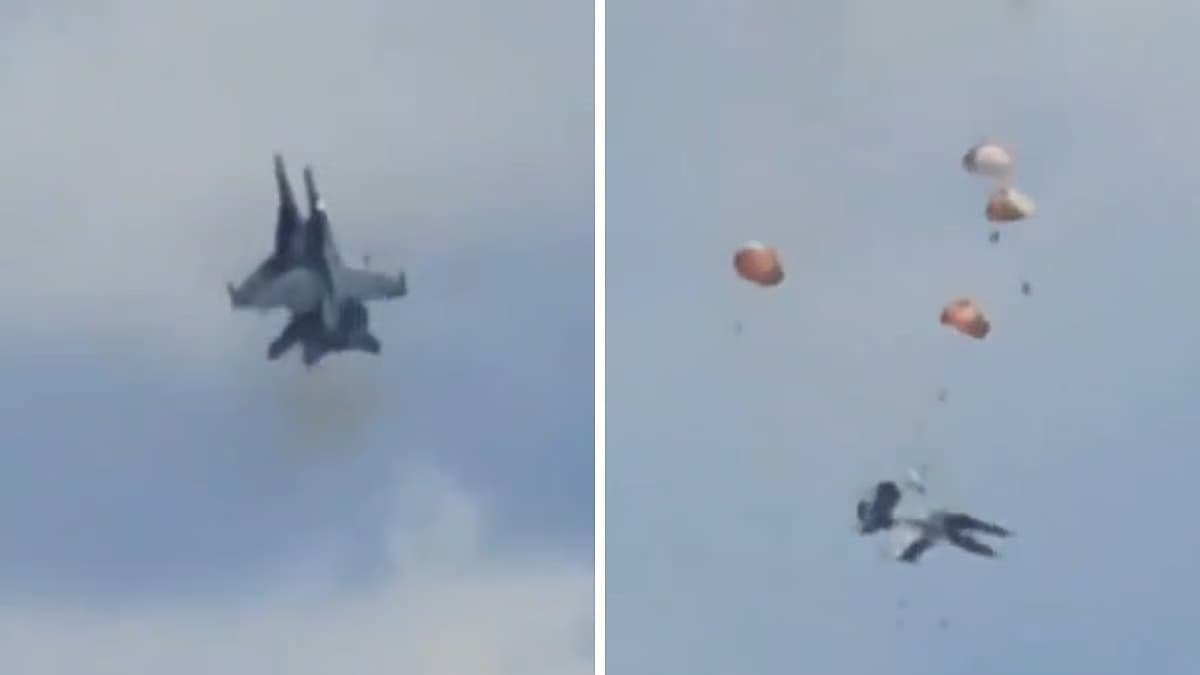
Witnesses at the air show captured the entire sequence on video, and the footage spread across social media within minutes. The two Growlers are seen flying in close formation during their demonstration when they converge. One aircraft appears to rotate and make contact with the other. Both jets immediately pitch upward and stall. For roughly five seconds — five extraordinary seconds — the two aircraft remained partially entangled, locked together as they began to lose altitude and cartwheel toward the ground.
Then the crews ejected. Four parachutes deployed in rapid succession, visible to every spectator on the grounds below. The two aircraft, still partially locked together, struck the ground approximately two miles northwest of the base and exploded, sending a column of thick black smoke into the Idaho sky. Emergency crews reached the scene within minutes.
The air show announcer confirmed the ejections over the public address system almost immediately. “We had four good parachutes,” the announcer said. “The crews were able to eject.” The crowd, which had watched in stunned silence, absorbed the news that no one had died.
Who the Crews Were and What Aircraft Were Lost
The two jets belonged to the Navy’s EA-18G Growler Demonstration Team, assigned to Electronic Attack Squadron VAQ-129, known as the Vikings, based at Naval Air Station Whidbey Island in Washington state. Each Growler carries two crew members — a pilot and an electronic warfare officer — making four personnel total across the two aircraft.
The EA-18G Growler is a specialized electronic warfare variant of the F/A-18 Super Hornet family, designed to suppress and destroy enemy radar and air defense systems. It is one of the most capable electronic attack aircraft in any military inventory in the world. The two aircraft lost — identified as Bureau Numbers 168895 and 168252 — represent a combined replacement cost of roughly $68 million at current procurement prices.
All four crew members were evaluated by medical personnel at the scene. Air St. Luke’s, a regional air medical service, confirmed it supported first responders and reported that injuries were not life-threatening. The 366th Fighter Wing commander, Colonel David R. Gunter, issued a statement praising the emergency response. “First and foremost, we are incredibly thankful that everyone involved in today’s incident is safe,” Gunter said.
An Air Show Industry That Has Spent a Decade Improving Safety
Sunday’s crash occurred against a backdrop of genuine safety improvement across the U.S. air show industry. The last fatal air show crash in the United States came in 2022, when two vintage military aircraft collided at a Dallas event and killed six people. There were no air show deaths in either 2024 or 2025 — an unprecedented two-year stretch of zero fatalities in an industry that runs roughly 200 events per year.
The Gunfighter Skies Air Show itself had been on hiatus since 2018, when a hang glider pilot died during a crash at the same event. This year’s show was the first held in eight years. That context — a newly revived show, a Navy demonstration team, a tight formation maneuver — will form the framework of the Naval Air Forces investigation now underway.
The Naval Air Forces investigation is standard procedure after any aircraft accident. It will examine the sequence of events that led to the collision, the crew’s decision-making in the five seconds between contact and ejection, and whether any mechanical failure or procedural deviation contributed to the incident. No preliminary findings have been released.
| Gunfighter Skies Midair Collision — Key Facts | Detail |
|---|---|
| Date and time | May 17, 2026, approx. 12:10 p.m. MDT |
| Location | Mountain Home AFB, Idaho (2 miles NW of base) |
| Aircraft type | EA-18G Growler (electronic warfare jet) |
| Squadron | VAQ-129 Vikings, NAS Whidbey Island, WA |
| Crew members involved | 4 (2 pilots, 2 electronic warfare officers) |
| Ejections confirmed | All 4 — all safe |
| Injuries | Non-life-threatening |
| Aircraft lost | 2 (BuNo 168895 and 168252) |
| Estimated replacement cost | ~$68 million combined |
| Base status | Locked down; SH-167 closed |
| Investigation | Naval Air Forces — underway |
| Last U.S. air show fatality | 2022 (Dallas collision — 6 killed) |
| Last Gunfighter Skies fatality | 2018 (hang glider crash) |
The Investigation Begins — and the Questions That Follow
The Navy has not speculated publicly about cause. The video evidence available to investigators — including footage taken by aviation photographer Henk Zuurbier, who was present at the show — provides an unusually detailed record of the collision sequence from multiple angles. That footage will be central to the accident investigation board’s analysis.
What is already apparent from the footage: the collision happened fast. Five seconds elapsed between initial contact and crew ejection. The fact that all four aircrew recognized the emergency, executed their ejection procedures correctly, and cleared the aircraft in a compressed and disorienting timeframe is itself a testament to the training that naval aviators undergo for exactly this eventuality. Sunday was as close to the worst outcome as an air show crowd has witnessed in years. The result — four survivors, zero spectator injuries — is, against that backdrop, something close to remarkable.