
NEW YORK / WASHINGTON, May 4, 2026 —
Key Takeaways
- Private employers added an average of just 46,000 jobs per month through the first quarter of 2026 — the weakest sustained hiring pace since 2010 — and Friday’s April report is expected to show continued deterioration, with forecasters projecting a number below 75,000.
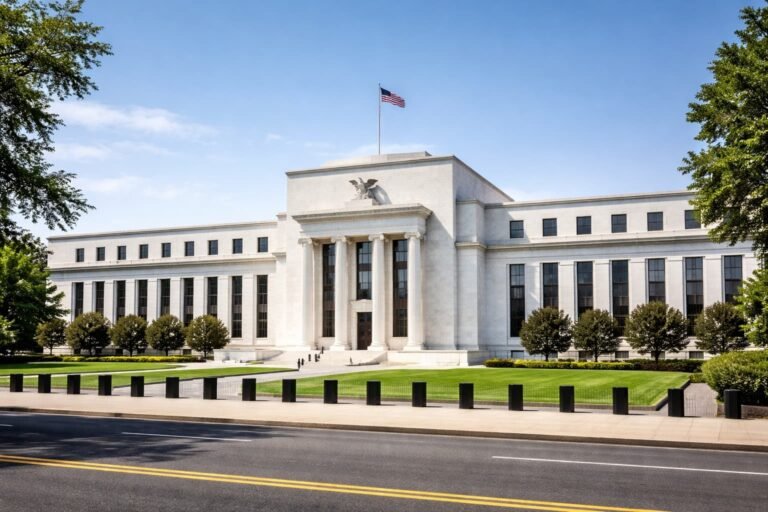
- Kevin Warsh is confirmed as the next Federal Reserve Chair and takes the chair May 15 — 11 days from now — inheriting a central bank that has held rates at 3.50%–3.75% for five months, a labor market softening faster than the Fed has acknowledged publicly, and inflation still running at 3.0% core PCE.
- If Friday’s jobs number comes in below 50,000, Wall Street’s probability of a June rate cut under Warsh will spike immediately — and mortgage rates, which have already fallen below 6%, could drop another 0.25 to 0.40 percentage points within days.
Why This Jobs Report Is Different From Every Other This Year
The Bureau of Labor Statistics releases the April nonfarm payrolls report at 8:30 AM Eastern on Friday. Every month, that release moves markets. This Friday, it moves something more significant — the incoming monetary policy philosophy of the man who will run the Federal Reserve for the next four years.
Kevin Warsh takes the chair May 15. He has spent the weeks since his Senate Banking Committee confirmation carefully saying nothing that would constitute forward guidance. He called for a “methodical” approach. He declined to signal rate timing. He let the markets guess. That posture ends the moment he reads Friday’s jobs number, because every investor, mortgage originator, bond trader, and pension manager in the country will immediately ask: what does this mean for Warsh’s first FOMC meeting?
The current consensus — before Friday — is that Warsh holds rates at the June meeting and signals a possible cut in July or September, depending on how inflation and the Iran war situation evolve. A jobs number significantly below 50,000 would pressure that consensus immediately. A number above 100,000 — which some optimists argue is possible given a March retail sales surge — would push the first cut expectation back to late 2026 or early 2027.
The Labor Market Data That Has Been Building All Year
The headline unemployment rate of 4.3% in March sounds manageable. The composition of that number is considerably less reassuring.
Private employers added an average of 46,000 jobs per month through the first quarter of 2026. For context: the U.S. labor force grows by approximately 100,000 workers per month simply from population growth and immigration. An economy adding 46,000 net jobs against a 100,000-per-month labor force expansion is an economy where the gap between workers seeking jobs and available jobs is quietly widening.
Federal government employment — which has been shedding workers since the Department of Government Efficiency restructuring began in early 2025 — continued declining in March. The sectors adding workers are narrow: healthcare, social assistance, and some hospitality. Manufacturing, finance, technology, and transportation are all showing contraction or stagnation.
| Labor Market Indicator | Reading | Context |
|---|---|---|
| Nonfarm payrolls (March 2026) | +178,000 | Strong — but March was the outlier |
| 6-month average monthly job growth | 46,000 | Weakest sustained pace since 2010 |
| Unemployment rate (March) | 4.3% | Up from 4.1% in January |
| Initial jobless claims (week of Apr 24) | 189,000 | Still low — labor market not breaking |
| Federal government employment | Declining | DOGE restructuring ongoing |
| April forecast (consensus) | 50,000–75,000 | Significant slowdown from March |
The March number — 178,000 jobs — was a genuine positive surprise that gave the market a brief sense that the labor market was holding. Economists who track the underlying data say March was the outlier, not the trend. April’s report will tell us which reading was closer to the truth.
What Kevin Warsh Inherits — and Why It Is Harder Than Powell Had It
Jerome Powell’s five-year tenure at the Fed was defined by two historic challenges: the inflation surge of 2021-2023 and the subsequent tightening cycle that brought core PCE inflation from above 5.5% down to 3.0%. He leaves the institution on May 15 with rates at 3.50%-3.75%, inflation still above target, and a labor market that is softening but not breaking.
Warsh inherits a genuinely difficult set of conditions. Core PCE inflation at 3.0% is 50% above the Fed’s 2% target — too high to justify rate cuts on inflation grounds alone. But private job growth averaging 46,000 a month is too low to justify holding rates at the current level on employment grounds. The Fed’s dual mandate pulls in opposite directions at exactly the moment a new chair is trying to establish credibility.
Warsh’s historical record suggests he will prioritize institutional credibility over market accommodation. Unlike Powell — who the market came to expect would respond to financial stress with supportive policy — Warsh has publicly criticized what he calls the Fed’s excessive dependence on forward guidance and asset purchases. He has suggested the central bank became too focused on smoothing short-term volatility at the expense of long-term price stability.
That philosophical difference has direct consequences for anyone watching mortgage rates, equity valuations, or the cost of variable-rate debt.
The Warsh Effect on Mortgage Rates — Two Scenarios
The Iran deal framework that emerged Sunday from the Rubio-Araghchi call has already pushed Brent crude from $118 to $107 — an $11 drop in 24 hours. If the Strait of Hormuz reopens as the Phase One framework anticipates, energy inflation falls materially, and the single biggest obstacle to Fed rate cuts is removed. In that scenario, Warsh inherits an economy where the inflation justification for holding rates has weakened, the labor market is softening, and a rate cut at the June or July meeting becomes the path of least resistance.
| Scenario | April Jobs Number | Iran Deal | Warsh First Move | Mortgage Rate Impact |
|---|---|---|---|---|
| Best case | Above 100,000 | Phase One signed | Hold June, cut July | Rates fall to ~5.50% |
| Base case | 50,000–75,000 | Framework holds | Hold June, signal July | Rates fall to ~5.65% |
| Stress case | Below 25,000 | Deal collapses | Cut June, signal more | Rates fall sharply — 5.25% range |
| Worst case | Negative | Iran war resumes | Hold — inflation spikes | Rates rise above 6.50% |
Mortgage rates closed last week at approximately 5.95% on the 30-year fixed — the first sub-6% territory since early 2023. That level is already generating a 68% surge in refinancing applications and pulling millions of first-time buyers back into affordability range. The direction from here depends almost entirely on the interplay between Friday’s jobs report and the Iran diplomatic situation that is playing out in real time.
The Housing Market’s Position Heading Into the Critical Week
Housing has been the one bright spot in an otherwise complicated economic picture. The Mortgage Bankers Association reported last week that purchase applications rose 10% month-over-month in April — the largest single-month increase since January 2024. Home inventory, while still below pre-pandemic levels, has risen 28% year-over-year, giving buyers more choices than at any point since 2020.
The combination of more inventory and lower borrowing costs has begun to produce transaction volume. If Friday’s jobs report is weak enough to accelerate rate cut expectations — and if the Iran deal framework holds, pushing energy inflation down — the housing market could see a genuine, sustained recovery beginning in the second half of 2026 for the first time in three years.
Housing starts at 1.34 million annualized remain below the 1.5 million per month economists say is needed to close the supply gap. That shortfall keeps a floor under home prices regardless of where mortgage rates go. But a buyer who was priced out at 7.22% and is now looking at 5.95% — or potentially 5.50% in the coming months — is a buyer who can now afford a home that was mathematically inaccessible six months ago.
The jobs report, the Iran deal, and the first week of Kevin Warsh’s Federal Reserve are all converging in the same 11-day window. For American borrowers, homebuyers, and anyone carrying variable-rate debt, few stretches of calendar have mattered as much to their personal finances as the one that begins Monday morning.