
WASHINGTON, April 27, 2026 —
Investigators combing through the communications of Cole Tomas Allen — the 31-year-old Caltech engineer who charged a security checkpoint at the White House Correspondents’ Dinner Saturday night — found a message in which he clearly stated he wanted to target Trump administration officials, the White House confirmed Sunday. The revelation came as the Justice Department moved to use the attack as leverage in an unrelated legal dispute — demanding that a historic preservation organization drop its lawsuit against the president over plans to build a White House ballroom.
The dual developments transformed what had been a breaking security story into something more complex: a federal investigation into a politically motivated attack unfolding simultaneously with an administration effort to extract a legal concession from the shooting’s aftermath.
What the Note Said
Allen sent a message to family members in the hours before the attack that investigators say “clearly stated” his intent to target administration officials, according to the White House. The note has not been publicly released, and law enforcement has not disclosed its full contents, the platform on which it was sent, or whether it named specific individuals.
The White House said Sunday that Allen appeared to be targeting Trump administration officials specifically — a characterization first made by acting Attorney General Todd Blanche on Saturday night, who said Allen was “intent on doing as much harm and as much damage as he could.”
Allen is currently charged with two counts of using a firearm during a crime of violence and one count of assault on a federal officer using a dangerous weapon. Additional charges are expected as the FBI’s investigation — which includes a review of Allen’s digital communications, devices, travel history, and any prior contacts with law enforcement — continues. Authorities said Sunday they believe Allen acted alone.
How the DOJ Used Saturday’s Shooting By Sunday Morning
Within hours of the shooting, the Justice Department’s civil division sent a letter to the National Trust for Historic Preservation — an organization currently suing the Trump administration to stop construction of a large new ballroom on the site of the former East Wing of the White House.
The letter, signed by civil division head Brett Shumate, told the group that its lawsuit “serves no purpose” and demanded it be dropped in light of the attack. “Put simply, your lawsuit puts the lives of the President, his family, and his staff at grave risk,” Shumate wrote. He continued: “I hope yesterday’s narrow miss will help you finally realize the folly of a lawsuit that literally serves no purpose except to stop President Trump no matter the cost.”
The administration’s argument, made previously in court, is that the proposed White House ballroom “advances critical national-security objectives” by giving the president a secure venue for large events — avoiding off-site locations like the Washington Hilton. A federal judge previously called that national security assertion “incredible.” The National Trust for Historic Preservation has not said publicly whether it intends to comply with the DOJ’s demand.
The Timeline of Saturday Night
| Time | Event |
|---|---|
| 8:36 PM | Allen charges security checkpoint at Washington Hilton |
| 8:36–8:37 PM | Gunfire exchanged with law enforcement at checkpoint |
| 8:37 PM | Allen tackled to ground, taken into custody |
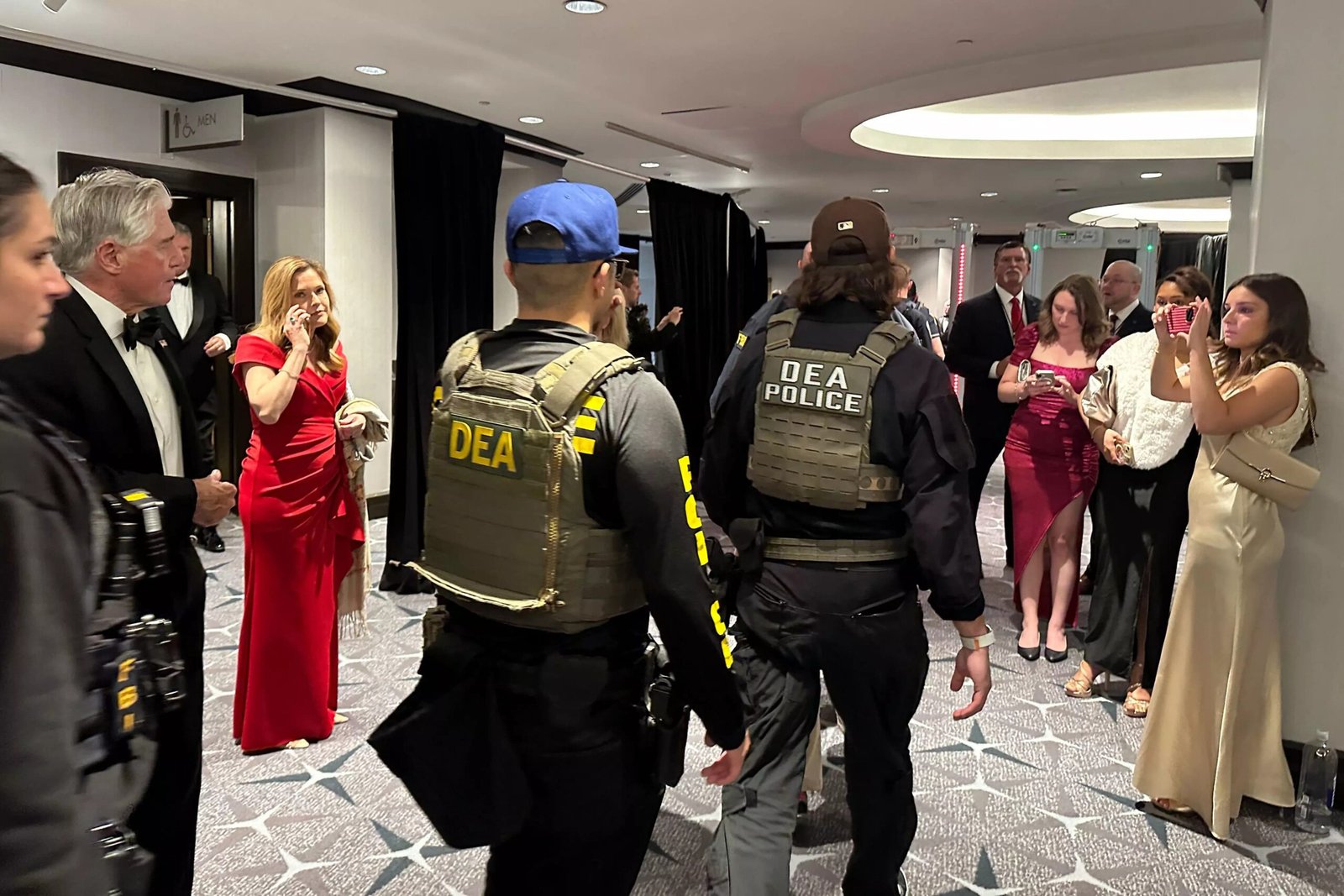
| 8:38 PM | Secret Service surrounds Trump and Vance, moves both off stage |
| 8:45 PM approx. | Cabinet members escorted from venue |
| 8:50 PM approx. | Venue lockdown begins, guests shelter in place |
| ~10:30 PM | Trump arrives at White House, holds press conference |
| ~11:55 PM | Federal criminal complaint filed against Allen |
| Sunday AM | FBI establishes perimeter at Allen’s Torrance, California home |
| Sunday AM | DOJ letter sent to National Trust for Historic Preservation |
| Sunday | White House confirms Allen’s note targeted administration officials |
The Security Questions That Remain Unanswered
Law enforcement has confirmed that Allen exchanged gunfire with officers at the checkpoint and was stopped before reaching the ballroom. That the outer perimeter held is being cited as evidence that post-2024 Secret Service protocol reforms functioned. Whether those reforms were sufficient is a separate question.
How Allen arrived at the Washington Hilton carrying a shotgun, a handgun, and multiple knives — in a city with strict firearms laws, at an event with extensive Secret Service advance work — has not been publicly explained. Metropolitan Police interim chief Jeff Carroll said the investigation into how Allen came to be at the checkpoint with those weapons is active and ongoing.
The Secret Service has faced sustained scrutiny since the July 2024 assassination attempt at Trump’s Pennsylvania rally. Saturday’s incident — the second major security failure in less than two years — will generate a formal review of the agency’s procedures for off-site presidential events, regardless of the outcome. That review is expected to begin this week.
Trump’s Response — and What Comes Next
Trump addressed the nation twice on Saturday — once at the hotel shortly after the shooting, and again at the White House at a full press conference. He described Allen as a “lone wolf” and a “very sick person,” urged Americans to resolve their differences peacefully, and said he “held it together for all of us.” On Sunday he posted on Truth Social that the incident proved the importance of building the White House ballroom — tying the attack directly to the pending litigation.
The Federal Bureau of Investigation is leading the investigation. Additional charges against Allen are expected to be filed in federal court this week. The investigation’s central question — beyond motive — is whether Allen received any assistance, encouragement, or radicalization through online communities, and whether any warning signs existed that law enforcement or any other institution could have acted on before Saturday night.
The preliminary answer, based on what authorities have said publicly, is that Allen was a highly educated man with no known prior criminal record who made a decision that no one around him anticipated. Whether that conclusion holds as investigators dig deeper into his communications and history will determine the fuller picture of what happened at the Washington Hilton on Saturday — and what, if anything, could have stopped it.