
WASHINGTON, MARCH 30, 2026 —
The war that has killed 13 Americans, wounded 300 more, pushed gas above $3.98 a gallon, and shaken the global economy for 30 days may have just turned its most significant corner yet. President Trump said Sunday that Iran has agreed to “most of” the 15 demands the United States sent through Pakistani intermediaries — and that Tehran has sent a shipment of oil to prove it is serious.
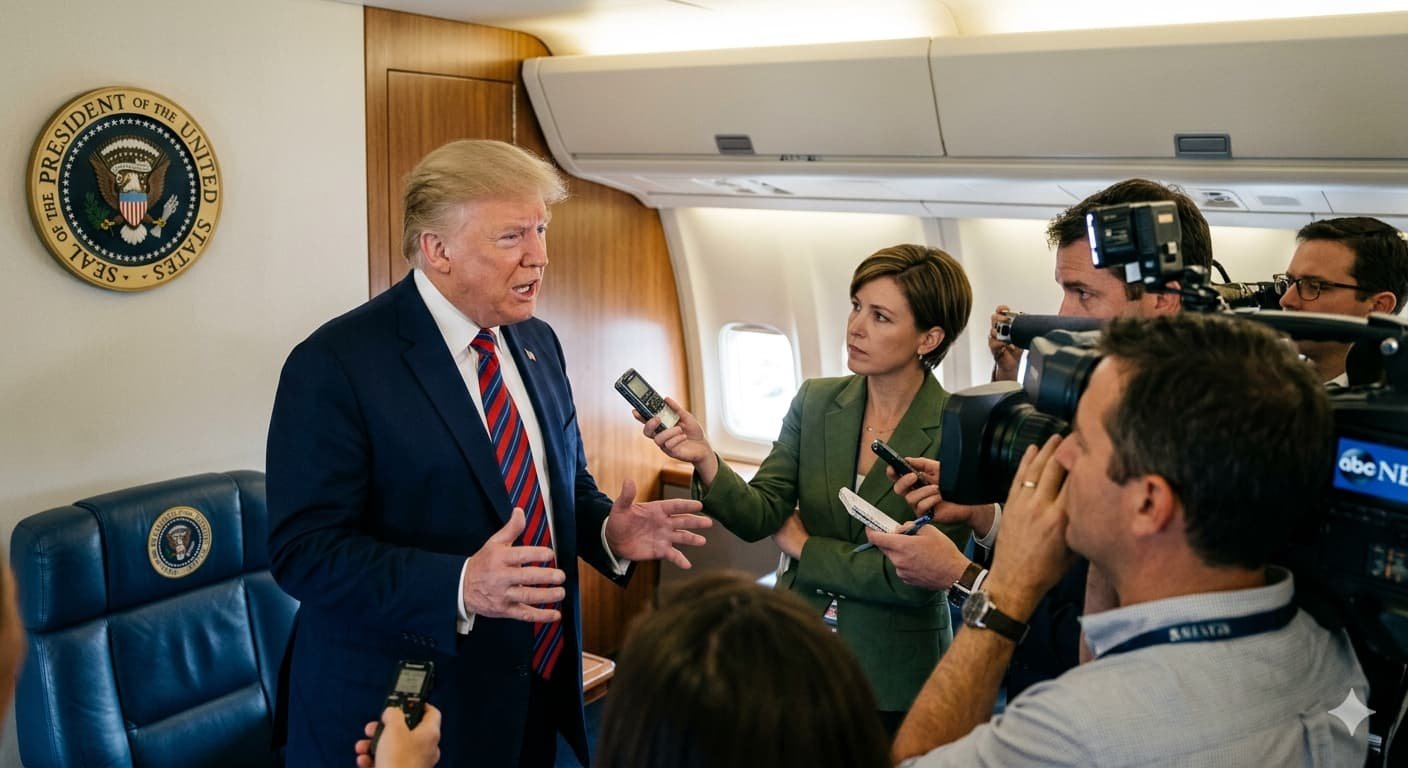
“They gave us most of the points. Why wouldn’t they?” Trump told reporters aboard Air Force One Sunday, returning from a weekend at Mar-a-Lago. “They’re agreeing with us on the plan. We asked for 15 things, and for the most part, we’re going to be asking for a couple of other things.”
He also revealed the true nature of the “present” Iran had sent the United States last week — the gift he had cryptically referenced without explanation. “They sent us oil,” Trump said. The shipment, which he said would arrive Monday, was framed by Trump as Tehran’s tangible signal that it is negotiating in good faith, even as Iranian officials continue to publicly deny any talks are taking place.
What Iran Has — and Has Not — Agreed To
The 15-point plan the United States transmitted to Iran through Pakistan addresses five core areas: Iran’s nuclear program, its ballistic missile arsenal, its support for regional proxy groups including Hezbollah and the Houthis, the reopening of the Strait of Hormuz, and sanctions relief. The reported terms include dismantling Iran’s three main nuclear facilities at Natanz, Isfahan, and Fordow, a permanent commitment never to develop nuclear weapons, and immediate transfer of all enriched uranium stockpiles to international monitoring.
Trump confirmed the nuclear commitment Sunday in the clearest language he has used since the war began. “They will never have a nuclear weapon,” he said. “That’s number one, two, and three.”
What remains unresolved — the “couple of other things” Trump referenced — are almost certainly the most contentious points. Iran has publicly insisted on war reparations from the United States, international recognition of its sovereignty over the Strait of Hormuz, and a complete halt to attacks on Hezbollah and Iraqi militias — all positions that the White House has previously described as non-starters.
The Gap That Still Exists
The distance between Trump’s “most of the points” and a signed ceasefire remains significant. Foreign Affairs magazine published an analysis Sunday morning framing the structural problem with unusual clarity: Washington is linking a ceasefire to a rollback of Iran’s capabilities. Iran is linking a ceasefire to security, sovereignty, and compensation. These positions do not overlap. That is why 30 days of war have not produced an agreement.
Iran’s Foreign Minister Abbas Araghchi acknowledged Sunday that messages are being exchanged through intermediaries — the furthest Tehran has gone toward confirming any diplomatic contact. But he was careful to draw a sharp distinction. “An exchange of messages does not mean negotiations with the U.S.,” he said in comments broadcast on state television.
A four-nation diplomatic summit — Pakistan, Turkey, Egypt, and Saudi Arabia — convened in Islamabad Sunday with the explicit goal of pressuring both Washington and Tehran toward a ceasefire framework. The summit reflects a growing international consensus that the war’s economic consequences — the biggest oil shock in history according to the International Energy Agency, with 20 million barrels per day lost from Middle East producers — have become intolerable for the global economy.
Trump Is Still Weighing Seizing Kharg Island
In a separate interview with the Financial Times published Sunday, Trump revealed that the United States is still actively considering a military seizure of Kharg Island — the Persian Gulf oil hub that handles 90% of Iran’s crude exports, already struck by U.S. forces on March 13. “Maybe we take Kharg Island, maybe we don’t. We have a lot of options,” Trump said. He acknowledged the seizure would require a prolonged American military presence. “It would also mean we had to be there for a while,” he added.
The Kharg Island option — simultaneous with peace talks — captures the essential contradiction of the Trump administration’s Iran strategy. Negotiations and military escalation are proceeding in parallel, with each track apparently unaware of how seriously the other is being pursued.
April 6 — The Date Everything Depends On
The diplomatic clock is running. Trump’s extended deadline to strike Iranian power plants expires Monday, April 6 at 8:00 PM Eastern Time. If a ceasefire framework — even a preliminary one — is in place before that deadline, the economic relief could be fast and significant. Oil could fall $20 to $25 per barrel. Gas prices could drop 50 cents or more within weeks. The Federal Reserve’s calculus on interest rates would shift immediately.
If the deadline passes with no agreement and Trump orders strikes on Iranian power plants, economists warn of a scenario where oil spikes back toward $130 and gas crosses $4.50. The next seven days are, in the most literal economic sense, the most consequential of the entire conflict.
📌 Read Next:
- Iran War Turns One Month: Houthis Enter, 300 Americans Wounded, and a World Running Out of Time
- Gas Is Closing In on $4 a Gallon — And the Trump Administration Is Running Out of Ways to Stop It