
By Harshit
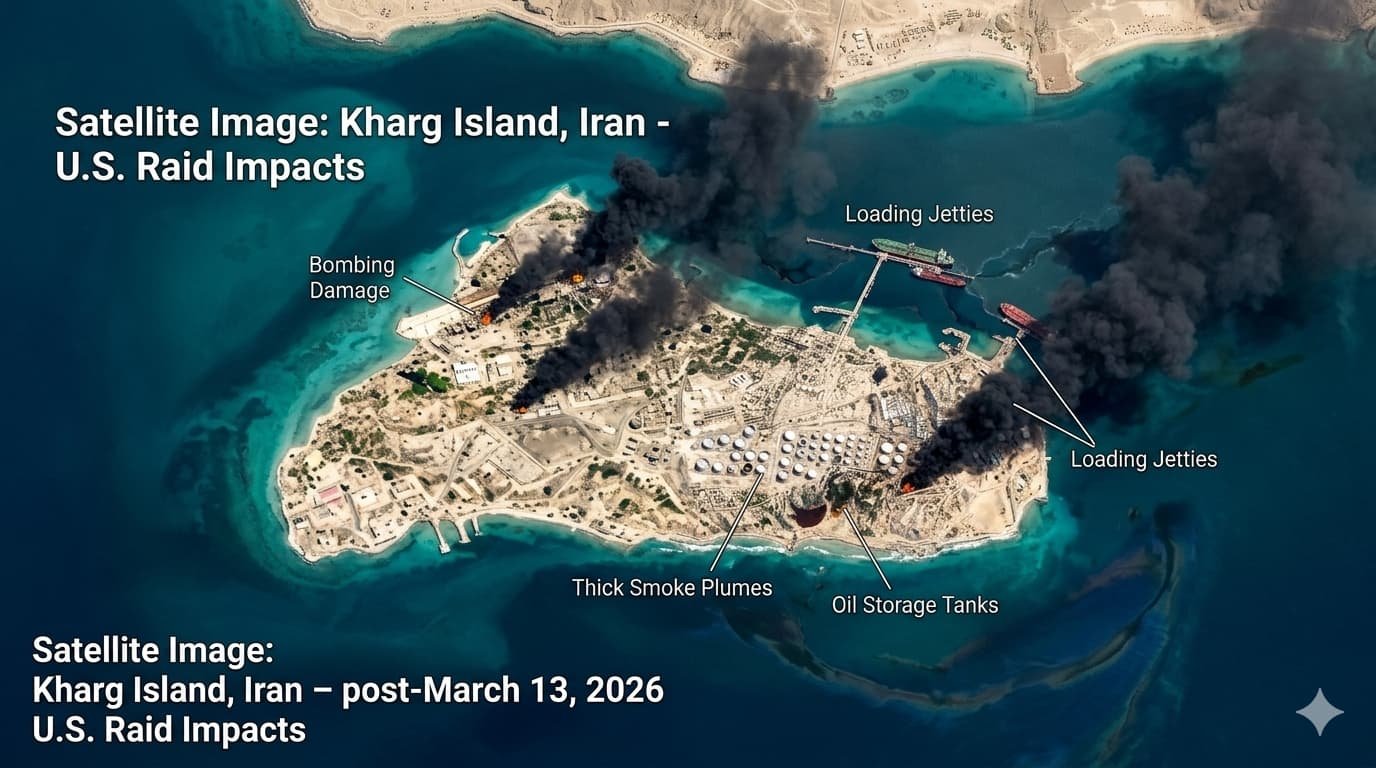
WASHINGTON, MARCH 14, 2026 — For two weeks, Kharg Island sat untouched. The five-mile stretch of coral and concrete sitting 15 miles off Iran’s southern coast — the island that handles 90% of Iran’s crude oil exports — had been conspicuously absent from America’s target list. On Friday night, that changed in a matter of minutes.
President Trump announced late Friday that U.S. Central Command had carried out what he called one of the most powerful bombing raids in the history of the Middle East, striking every military target on Kharg Island and leaving its oil infrastructure deliberately intact — for now. The announcement sent shockwaves through global energy markets, triggered an immediate Iranian threat to retaliate against oil facilities across the region, and pushed a war that was already reshaping the global economy into its most dangerous phase yet.
The Strike
Trump announced the operation himself, in characteristic fashion, posting directly on Truth Social rather than waiting for a Pentagon press briefing. The U.S., he wrote, had executed the raid at his direct order and totally obliterated every military target on what he called Iran’s crown jewel. He added that for reasons of decency, he had chosen not to destroy the island’s oil infrastructure — but warned he would immediately reconsider that decision if Iran continued blocking ships from passing through the Strait of Hormuz.
A U.S. official confirmed to reporters that the military had executed a large-scale strike on the island. Iranian state media reported at least 15 explosions, with thick black smoke rising over the island’s facilities. The confirmed targets included an air defense installation, the Joshen Sea Base, the airport control tower, and a helicopter hangar belonging to an offshore oil company. Iranian state media insisted no oil infrastructure was damaged.
Why Kharg Island Changes Everything
The decision to strike Kharg was the most consequential military move of the two-week war. The island is not just strategically important to Iran — it is Iran’s economic lifeline.
Kharg has a loading capacity of roughly 7 million barrels per day. Nearly all of Iran’s crude exports — the revenue stream that funds the government, the military, and the IRGC — flow through its terminals. The island is approximately the size of New York City’s Central Park but carries the economic weight of an entire nation. Most of those exports go to China and India, meaning Friday’s strike didn’t just threaten Iran’s finances — it sent a message to Beijing and New Delhi simultaneously.
For the first two weeks of the war, analysts had watched and waited for America to move on Kharg. The Trump administration had discussed the possibility as far back as March 7. Iranian Parliament Speaker Mohammad Baqer Qalibaf had already warned that any strike on Persian Gulf islands would cause Iran to abandon all restraint. Friday night, that restraint — on both sides — was formally abandoned.
Iran’s Immediate Response
Tehran moved quickly. Iran’s joint military command issued a direct threat within hours of Trump’s announcement — warning that any attack on Iranian oil and energy infrastructure would trigger retaliatory strikes against all oil and energy facilities in the region belonging to companies that cooperate with the United States. The threat was sweeping. It covered Saudi Aramco facilities, UAE energy infrastructure, Qatari LNG terminals, and any other regional energy asset with American ties.
Qatar began evacuating several key areas as Iranian missile and drone attacks continued across the Gulf. A missile struck the helipad inside the U.S. Embassy compound in Baghdad. A drone strike in northern Iraq killed a French soldier and wounded several others. Dubai reported explosions and smoke as Iranian projectiles were intercepted over the Gulf financial hub.
Iran’s new Supreme Leader Mojtaba Khamenei — wounded, according to Defense Secretary Pete Hegseth, and reportedly disfigured — remained out of public view. Vice President JD Vance confirmed to reporters that the new leader was hurt, saying only that the extent of his injuries remained unclear.
The Strait of Hormuz Equation
Everything in this war now runs through one narrow passage. The Strait of Hormuz — 21 miles wide at its narrowest point — carries roughly 20 million barrels of oil per day and about one-fifth of the world’s LNG supply. Iran has effectively shut it down since the war began. Treasury Secretary Scott Bessent confirmed Friday that the U.S. Navy was actively considering escorting oil tankers through the strait to break the blockade and bring oil prices down from their current perch above $100 per barrel.
Trump, in a separate Fox News interview Friday morning, told host Brian Kilmeade the war would end when he felt it was over — a statement that offered no timeline, no conditions, and no clarity to markets already shaken by two weeks of escalating strikes.
What Comes Next
The United States is sending 2,500 additional Marines and an amphibious assault ship to the Middle East as Operation Epic Fury enters its third week. Israel continued strikes in Lebanon, where more than 815,000 people have been displaced. The IDF issued an urgent warning to civilians near Tabriz, Iran, ahead of new airstrikes.
Eleven U.S. service members have now been killed in the conflict. Four of the six crew members aboard the KC-135 refueling aircraft that crashed in western Iraq on Thursday have been confirmed dead.
Kharg Island had been Iran’s last protected card — the one piece of infrastructure both sides understood, without saying so, was off limits because of what striking it could mean. Friday night, Trump played that card. The next move belongs to Tehran.