U.S. Tech Sector Snapshot: AI Concentration, Chip Boom, and Workforce Restructuring
By Harshit
NEW YORK, MARCH 9, 2026 — U.S. TECHNOLOGY & ECONOMY
The U.S. technology sector in early 2026 reflects a period of intense concentration, rapid semiconductor expansion, and a structural transformation of the workforce. While the largest technology firms continue generating record revenues and dominating market capitalization rankings, companies across the industry are simultaneously restructuring operations, cutting roles, and investing heavily in artificial intelligence infrastructure.
The result is a tech economy defined by both unprecedented corporate growth and a fundamental shift in how companies build products, deploy capital, and manage labor.
1. Market Overview: The Era of Concentration
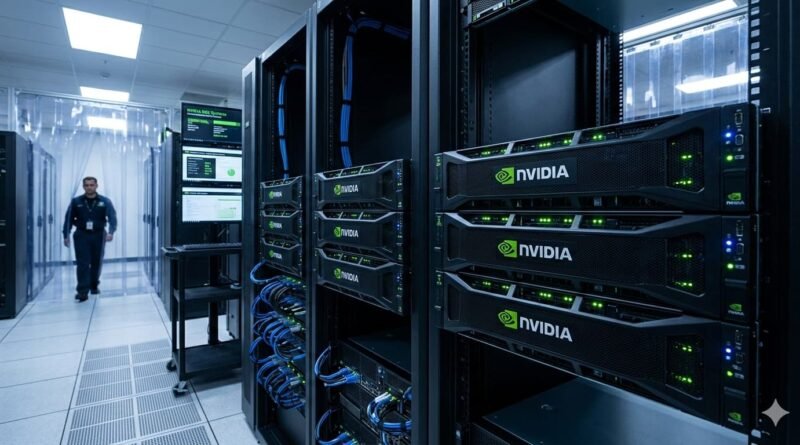
The group commonly known as the “Magnificent Seven” continues to anchor the S&P 500, but performance across the companies has increasingly diverged. At present, Nvidia holds an estimated 94% probability of ending March as the world’s most valuable company by market capitalization, supported by extraordinary demand for artificial intelligence hardware.
Global semiconductor sales are projected to approach $1 trillion in 2026, reinforcing Nvidia’s central role in the AI supply chain.
The “Big Three” Earnings (Q1 2026 Snapshots)
Apple reported record first-quarter revenue of $143.8 billion for its fiscal quarter ending in late December 2025. Despite a cooling consumer electronics market, the iPhone 17 cycle and growth in high-margin services have maintained Apple’s financial resilience. However, analysts continue to debate whether the company is moving too slowly into generative AI compared with competitors.
Alphabet has seen its cloud division emerge as the company’s primary growth engine. Google Cloud revenue has expanded rapidly, climbing 48% year-over-year and reaching an annual run rate exceeding $70 billion.
Microsoft remains a dominant force in enterprise AI deployment through its Azure platform. However, the stock—trading near $392—has experienced mild volatility as investors weigh the massive capital expenditures required to maintain AI infrastructure leadership against competitors such as Amazon Web Services and Google Cloud.
2. The Semiconductor Surge: “Inference Economics”
The semiconductor sector is currently experiencing one of the most concentrated growth cycles in its history. Global chip revenue is projected to reach approximately $975 billion by the end of 2026, representing a 26% year-over-year increase.
Structural Divergence
AI vs. the broader chip market:
Artificial-intelligence accelerators now generate more than $500 billion in revenue—over half of total semiconductor industry value—while representing less than 0.2% of total unit volume. This imbalance illustrates the extraordinary pricing power commanded by advanced silicon used for AI training and inference.
Memory shortages:
Demand for High-Bandwidth Memory (HBM), essential for AI accelerators, has dramatically disrupted the memory market. As hyperscale data centers compete for supply, prices for consumer DDR4 and DDR5 memory have increased by as much as 50% over the past two quarters.
Manufacturing expansion:
In response to accelerating demand for high-performance computing hardware, TSMC recently secured environmental clearance on March 7, 2026 for a new “Mega Fab” dedicated to advanced chip production.
3. The Great Workforce Rebuild
One of the most visible consequences of the AI transition is a major restructuring of the tech workforce.
Since the beginning of 2026, more than 165,000 roles have been eliminated across the global technology industry.
Why layoffs persist despite growth
Unlike earlier cycles, the current wave of layoffs is not primarily driven by recession fears. Instead, many companies are reallocating capital away from payroll toward AI infrastructure, data centers, and advanced silicon.
Intel is undergoing a large-scale restructuring that includes cutting roughly 24,000 jobs—around 15% of its workforce—as it shifts investment toward its foundry strategy and artificial-intelligence roadmap.
Amazon and Microsoft together have eliminated more than 30,000 roles in early 2026, focusing particularly on middle-management and administrative positions that companies believe can be streamlined through automation.
Meanwhile Block, founded by Jack Dorsey, reduced its workforce by roughly 40% in February, explicitly stating that the company intends to operate with smaller teams supported by AI tools.
According to Crunchbase tallies, at least 5,305 U.S. tech employees were laid off during the last week alone.
4. Regulatory Patchwork: The End of the “Wild West”
While the federal government continues to emphasize innovation and competitiveness in artificial intelligence, individual U.S. states have begun introducing their own regulatory frameworks.
This has created a complex compliance environment for technology companies operating nationwide.
The Spring 2026 Compliance Wave
Colorado AI Act:
Scheduled to take effect on June 30, 2026, the law requires companies deploying AI systems in sensitive decision-making contexts to demonstrate “reasonable care” to prevent algorithmic discrimination.
California AB 2013:
This legislation requires developers of generative AI systems to disclose summaries of their training datasets, including whether copyrighted material or personal data were used during model development.
Proposed federal legislation:
A proposal often referred to as the “Trump America AI Act,” introduced by Senator Marsha Blackburn, seeks to establish federal preemption that would override conflicting state-level AI laws.
The outcome of the debate could shape the long-term regulatory landscape for artificial intelligence in the United States.
5. Emerging Trends: Agentic AI and Robotics
The dominant technological shift of 2026 is the transition from conversational AI systems to autonomous “agents” capable of executing complex workflows.
According to Deloitte, about 38% of organizations are currently piloting AI agents, but only 11% have deployed them in full production environments.
The primary bottleneck is not the technology itself but the need to redesign operational processes rather than simply automate existing workflows.
At the same time, physical robotics is experiencing renewed momentum. Amazon recently deployed its millionth warehouse robot, while BMW has implemented its “DeepFleet” AI system to coordinate autonomous vehicles moving components within factory production lines.
2026 Tech Sector Outlook
| Category | Status | 2026 Projection |
|---|---|---|
| Global Chip Sales | Booming | $975 billion record |
| Tech Job Market | Contracting | High-skill engineers in demand |
| Cloud Computing | Expanding | Focus on inference infrastructure |
| Venture Capital | Stabilizing | Strategic acquisitions rising |
| Retail Technology | Transforming | AI-assisted commerce |
Conclusion
The U.S. technology sector in March 2026 presents a striking contrast. At the top of the AI stack—companies such as Nvidia, Microsoft, and Alphabet—extraordinary value creation continues as demand for advanced computing infrastructure accelerates.
At the same time, the broader workforce is undergoing a significant transition as companies restructure around automation and artificial intelligence.
The “Great Rebuild” of the tech industry is underway. Firms are becoming leaner, more automated, and more deeply integrated with advanced hardware supply chains as they prepare for a future in which artificial intelligence is not simply a tool but a foundational operating layer of the global economy.