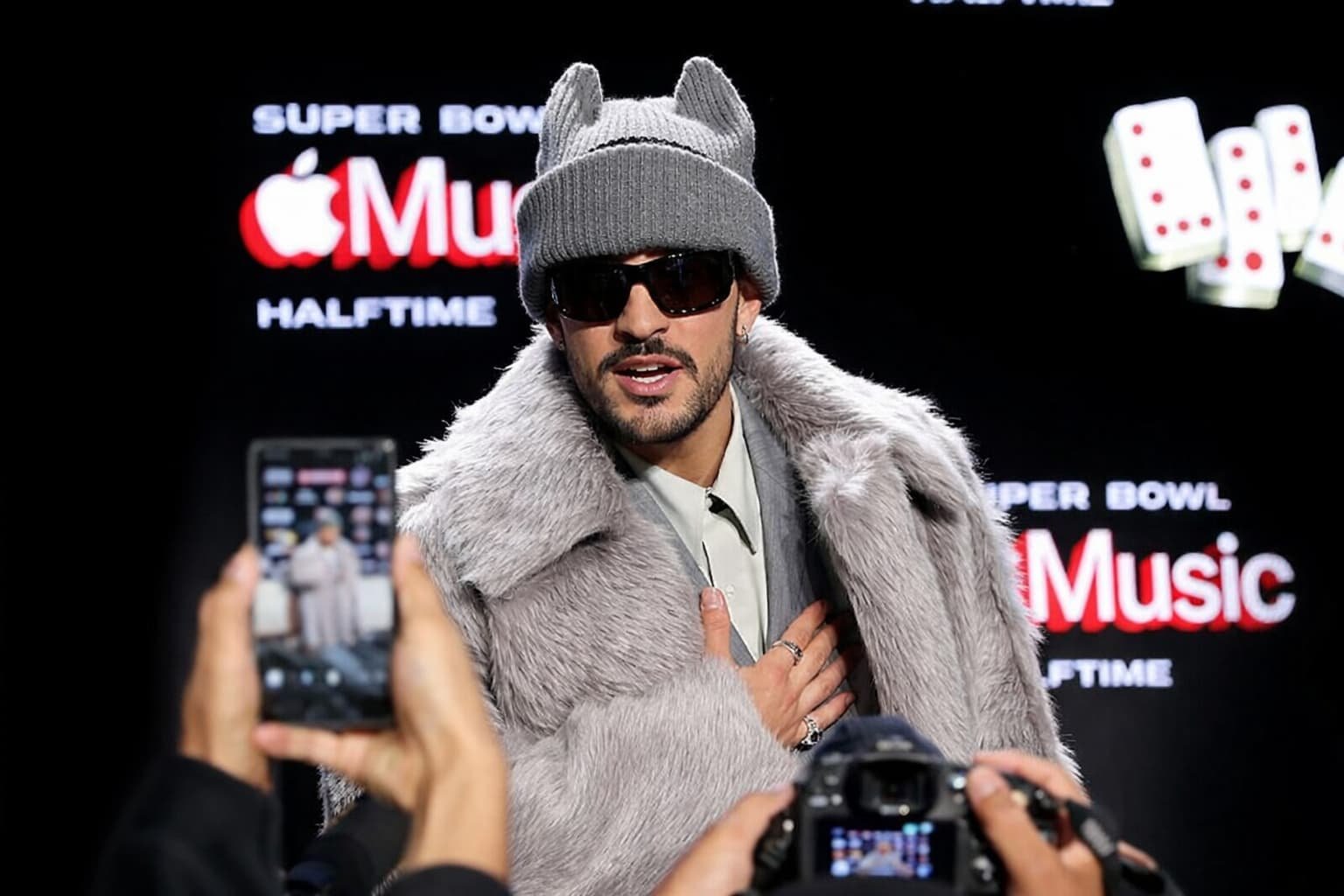
Bad Bunny’s Super Bowl Halftime Show Ignites Cultural and Political Firestorm
By: Entertainment Desk
SANTA CLARA, FEB. 10, 2026 —
Bad Bunny’s Super Bowl 2026 halftime performance was never going to be quiet. But few expected it to erupt into a full-blown cultural and political controversy that has now stretched from social media to the White House.
Fresh off a historic Grammy Awards sweep, Bad Bunny delivered a 13-minute halftime show at Super Bowl that functioned less as a pop spectacle and more as a declaration of identity. Sung almost entirely in Spanish, the performance centered Puerto Rican culture, Latin American geography, and an unapologetic message of belonging — drawing sharp criticism from conservative commentators, including Donald Trump.
A Halftime Show Rooted in Puerto Rico

Bad Bunny opened with a brief “God Bless America,” one of the only English phrases he spoke all night, before listing countries across North and South America — including the United States — reminding viewers that the Americas are a shared hemisphere, not a monolith.
Behind him, a message flashed across the massive screen: “The only thing more powerful than hate is love.” The phrase echoed his Grammy Awards acceptance speech earlier this year, when he won Album of the Year for Debí Tirar Más Fotos, the first Spanish-language album to claim the honor.
The setlist featured some of his biggest hits — Tití Me Preguntó, MONACO, and BAILE INoLVIDABLE — performed with traditional Caribbean rhythms, Puerto Rican symbolism, and dancers clad in island-inspired costumes. For supporters, it was a celebration of culture rarely centered on America’s biggest stage.
For critics, it became a political lightning rod.
Trump’s Reaction Fuels Backlash
Trump dismissed the halftime show as “absolutely terrible,” calling it “an affront to the greatness of America.” Posting on Truth Social, he mocked the Spanish-language performance by claiming, “Nobody understands a word this guy is saying,” despite census data showing more than 41 million Spanish speakers in the United States.
The criticism quickly expanded beyond Trump, with right-wing commentators framing the performance as “un-American” — a charge supporters noted ignores the fact that Puerto Ricans have been U.S. citizens since 1917.
Puerto Ricans living on the island, however, still lack full voting rights, have no voting representation in Congress, and are subject to federal policies — including military drafts and immigration enforcement — without full political power. That contradiction, many argued, was precisely the tension Bad Bunny was highlighting.
Instagram Wipe Raises Questions
Amid the online backlash, Bad Bunny’s Instagram account was suddenly wiped clean on Tuesday. His profile photo vanished, all posts were deleted or archived, and he appeared to unfollow all 51 million followers.
While no official explanation has been given, fans are split on the meaning. Some believe the move was a way to shut out online harassment. Others suspect it mirrors a common artist strategy — a digital reset ahead of a major announcement, possibly new music.
A Wedding, a Grammy, and a Message

Beyond politics, the performance included moments that stunned even longtime fans.
Midway through the show, a live wedding ceremony unfolded onstage. A smiling officiant declared a couple married as dancers and musicians surrounded them. After the broadcast, Bad Bunny’s representative confirmed the marriage was real. The couple had invited the artist to their wedding — instead, he invited them onto the Super Bowl stage, serving as a witness and signing the marriage certificate himself.
Other surprise moments included cameos by Ricky Martin and Lady Gaga, who performed Die With A Smile reimagined with Puerto Rican musical influences. In a symbolic gesture, Bad Bunny handed a Grammy statuette to a young boy watching television — a visual nod to his younger self and a message about representation and possibility.
More Than a Halftime Show
Bad Bunny’s Super Bowl appearance came at a moment of heightened political tension, particularly around immigration and cultural identity. His refusal to translate, soften, or apologize struck many as intentional — and necessary.
For supporters, the backlash only reinforced the point.
Puerto Ricans are Americans, regardless of language. Latino culture is American culture. And the Super Bowl stage, watched by more than 100 million people, became a platform for asserting that reality.
Whether praised as historic or criticized as controversial, Bad Bunny’s halftime show did exactly what few performances manage: it forced a national conversation — not about charts or choreography, but about identity, language, and who gets to be seen at the center of American culture.