
By Harshit
GLOBAL —23 JANUARY 2026 —
Deep beneath the fractured ice of Europa, one of Jupiter’s largest moons, lies a vast liquid ocean that scientists believe may contain the essential ingredients for life. The challenge has never been the ocean itself—it is how nutrients from the surface could possibly penetrate an ice shell tens of kilometers thick.
Now, a new study by geophysicists offers a compelling answer.
Researchers from Washington State University report that dense, nutrient-rich ice on Europa’s surface could slowly sink through the moon’s icy shell and deliver life-supporting materials directly into the subsurface ocean. Their findings, published in The Planetary Science Journal, describe a mechanism that could solve one of the biggest puzzles in planetary habitability.
Europa’s Ocean: Vast, Dark, and Cut Off From Sunlight
Europa is considered one of the most promising locations in the solar system to search for extraterrestrial life. Scientists estimate that its subsurface ocean contains more water than all of Earth’s oceans combined.
But there is a problem.
That ocean is sealed beneath a thick, frozen crust that blocks sunlight completely. Any potential life forms would need chemical energy and nutrients rather than photosynthesis to survive. While Europa’s surface is known to host salts and chemically altered compounds created by intense radiation from Jupiter, scientists have long struggled to explain how those materials could travel downward to the ocean below.
Most of Europa’s surface motion, driven by tidal forces from Jupiter, occurs sideways rather than vertically—making direct transport of nutrients extremely difficult.
Borrowing a Concept From Earth’s Deep Geology

To address this, the research team turned to an Earth-based geological process called crustal delamination. On Earth, delamination occurs when portions of the planet’s crust become dense enough to detach and sink into the mantle.
Using advanced computer simulations, the researchers explored whether a similar process could occur within Europa’s ice shell.
Their models suggest that surface ice enriched with salts becomes denser than the surrounding purer ice. Over time, this heavy ice weakens, breaks free, and begins to sink—slowly but steadily—through the ice shell.
“This is a novel idea in planetary science inspired by a well-understood process on Earth,” said lead author Austin Green. “Most importantly, it addresses one of the longest-standing questions about Europa’s habitability.”
How Sinking Ice Could Feed an Alien Ocean
According to the simulations, salt-rich ice does not need extreme conditions to sink. Even modest weakening of the ice structure allows dense blocks to descend through the shell.
Once these ice parcels reach the subsurface ocean, they would release chemical compounds produced at the surface—materials that could serve as nutrients or energy sources for microbial life.
Crucially, the process could repeat over geological timescales, providing a sustained delivery system rather than a one-time event.
That steady recycling of surface material into the ocean dramatically improves Europa’s prospects for supporting life.
Why Radiation Helps, Not Hurts

Europa is constantly bombarded by radiation trapped in Jupiter’s powerful magnetic field. While lethal to humans, this radiation drives chemical reactions on the moon’s surface, creating oxidants and other compounds known to support metabolism.
Until now, the missing link was transport.
The new study suggests that radiation-produced nutrients do not remain stranded on the surface. Instead, they may be systematically transported downward through sinking ice, completing a chemical cycle between the surface and the ocean.
Implications for NASA’s Europa Clipper Mission

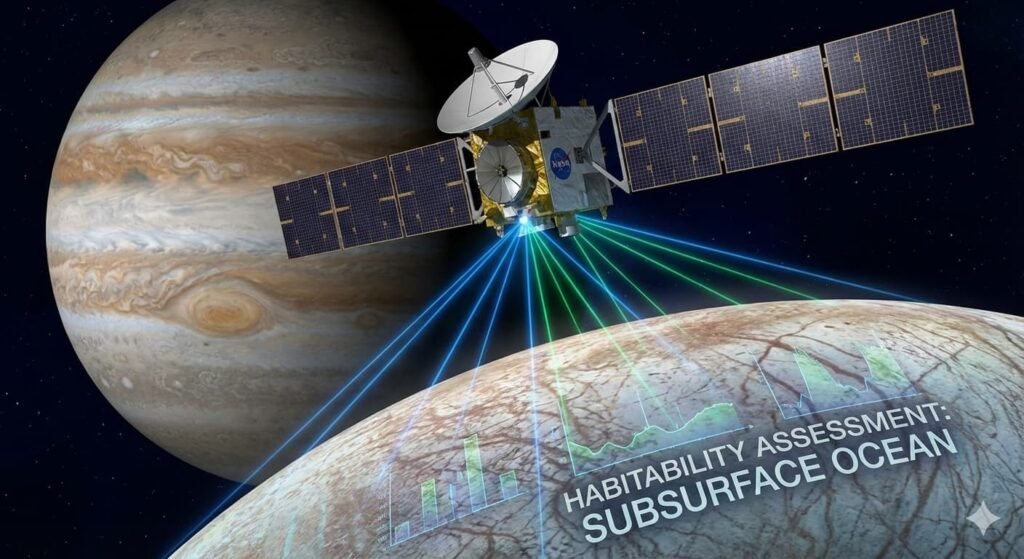
The findings arrive at a critical moment for planetary exploration. Europa Clipper, launched by NASA in 2024, is now en route to Jupiter and will begin detailed observations of Europa’s ice shell later this decade.
Europa Clipper’s instruments are designed to study ice thickness, surface composition, and subsurface structures—exactly the features predicted to influence this sinking-ice process.
If evidence of salt-rich regions and structural weakening is detected, it would strongly support the study’s conclusions.
A Stronger Case for Life Beyond Earth
For decades, Europa’s ocean has fascinated scientists, but uncertainty over nutrient delivery has limited assessments of its habitability. This new work provides a realistic, physics-based mechanism for overcoming that barrier.
Europa may not just have water—it may have circulation, chemistry, and long-term energy exchange.
And that combination places it firmly among the top candidates in the search for life beyond Earth.