
By Harshit
NEW YORK, JANUARY 18 — After years of crisis-driven decision-making, American companies are entering a new and less visible phase of transformation. Inflation has eased from its peak, supply chains are no longer in emergency mode, and interest rates—while still high—have stabilized. Yet beneath the surface, U.S. businesses are undergoing one of the most significant restructurings since the aftermath of the 2008 financial crisis.
This time, the changes are not being driven by collapse or panic. They are being driven by realism.
From Survival to Structural Efficiency
Between 2020 and 2023, U.S. corporations operated in survival mode. Executives focused on keeping shelves stocked, employees retained, and capital flowing. Speed mattered more than efficiency, and resilience often came at the cost of profitability.
That era is ending.
In 2025 and early 2026, corporate strategy has shifted decisively toward structural efficiency. Companies are re-evaluating which divisions genuinely create long-term value, which markets justify continued investment, and which roles exist primarily due to historical momentum rather than present necessity.
Unlike mass layoffs of past downturns, today’s restructuring is quieter. Job reductions are targeted. Departments are merged. Management layers are flattened. The goal is not contraction—it is sustainability.
Supply Chains Are Being Redesigned, Not Restored
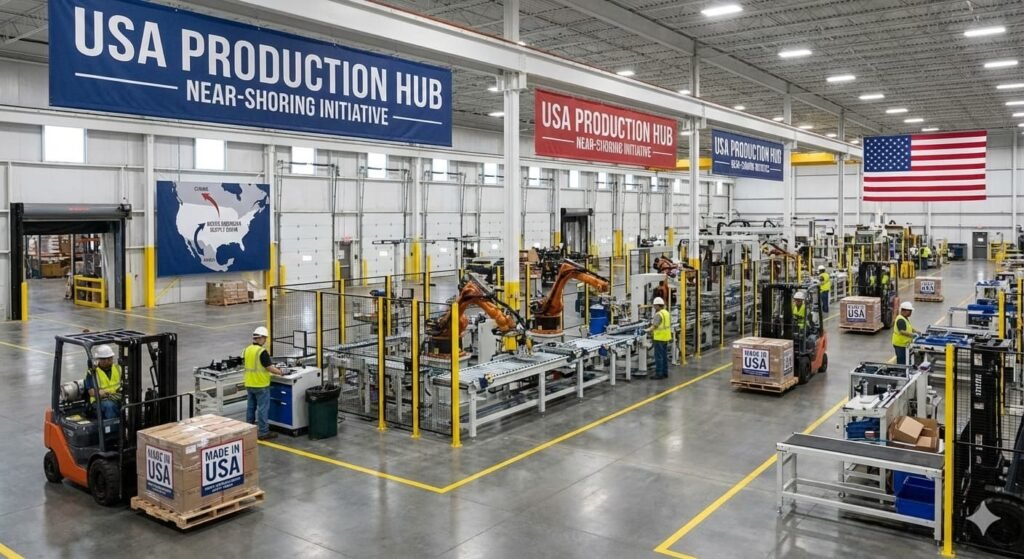
Perhaps the most profound change is happening in supply chains. U.S. firms are no longer trying to return to pre-pandemic sourcing models. Instead, they are redesigning them entirely.
Manufacturers across sectors—from automotive to medical equipment—are shifting production closer to home through near-shoring. Mexico, Canada, and parts of Central America are increasingly favored over distant Asian suppliers. While full reshoring to the United States remains costly, regional supply networks offer shorter delivery times, lower geopolitical risk, and greater predictability.
This trend is reinforced by U.S. government incentives tied to domestic manufacturing capacity, particularly in semiconductors, clean energy components, and pharmaceuticals. For businesses, supply chain decisions are now strategic assets, not back-office logistics concerns.
Labor Is Being Repriced, Not Eliminated
Despite headlines about layoffs in technology and finance, the broader U.S. labor market tells a more nuanced story. Companies are not abandoning workers en masse; they are repricing labor based on output and relevance.
Middle management roles are shrinking, while demand is rising for employees who directly contribute to revenue, innovation, or compliance. Technical specialists, cybersecurity professionals, data analysts, and skilled manufacturing workers continue to command strong wages.
Remote work, once seen as a temporary pandemic response, has stabilized into a hybrid norm. This allows firms to reduce real estate costs while accessing talent beyond expensive coastal cities. For workers, flexibility remains—but job security increasingly depends on measurable contribution.
Capital Discipline Returns to Corporate America
The era of cheap money reshaped corporate behavior for more than a decade. With interest rates now structurally higher, that behavior is being reversed.
U.S. companies are prioritizing:
- Paying down debt
- Preserving cash reserves
- Returning capital to shareholders through buybacks
- Limiting large, speculative acquisitions
Capital expenditure is still occurring, but it is more selective and focused on productivity gains rather than aggressive expansion. Investors, particularly institutional ones, are rewarding firms that demonstrate discipline over ambition.
Technology as a Cost-Control Tool
Technology investment has not slowed—it has changed purpose. Instead of funding experimental growth projects, companies are deploying technology to reduce operating costs and improve efficiency.
Automation is expanding in logistics, customer service, and accounting. Artificial intelligence tools are being used to optimize inventory management, detect fraud, and streamline compliance. These investments rarely make headlines, but they are reshaping corporate cost structures from the inside.
For small and mid-sized U.S. businesses, this shift is especially significant. Cloud-based tools and AI-driven platforms are allowing firms to operate with leaner teams while maintaining scale.
What This Means for the U.S. Economy
This quiet restructuring is contributing to a slower but more stable economic environment. Corporate bankruptcies remain low, profit margins are normalizing, and wage growth—while moderating—continues to outpace inflation in many sectors.
For workers, the message is clear: adaptability matters more than tenure. For investors, the environment favors companies with strong balance sheets and realistic growth expectations.
The post-inflation U.S. economy is not about rapid rebounds or dramatic collapses. It is about recalibration.
A More Disciplined Corporate Era
American companies are not retreating—they are maturing. The excesses of the ultra-low-interest-rate era are being replaced by caution, discipline, and long-term planning.
This transformation lacks the drama of past crises, but its impact may be just as lasting. The next decade of U.S. business will be shaped less by speed and more by structural strength.