
By Harshit
SAN FRANCISCO, JAN. 11, 2026 —
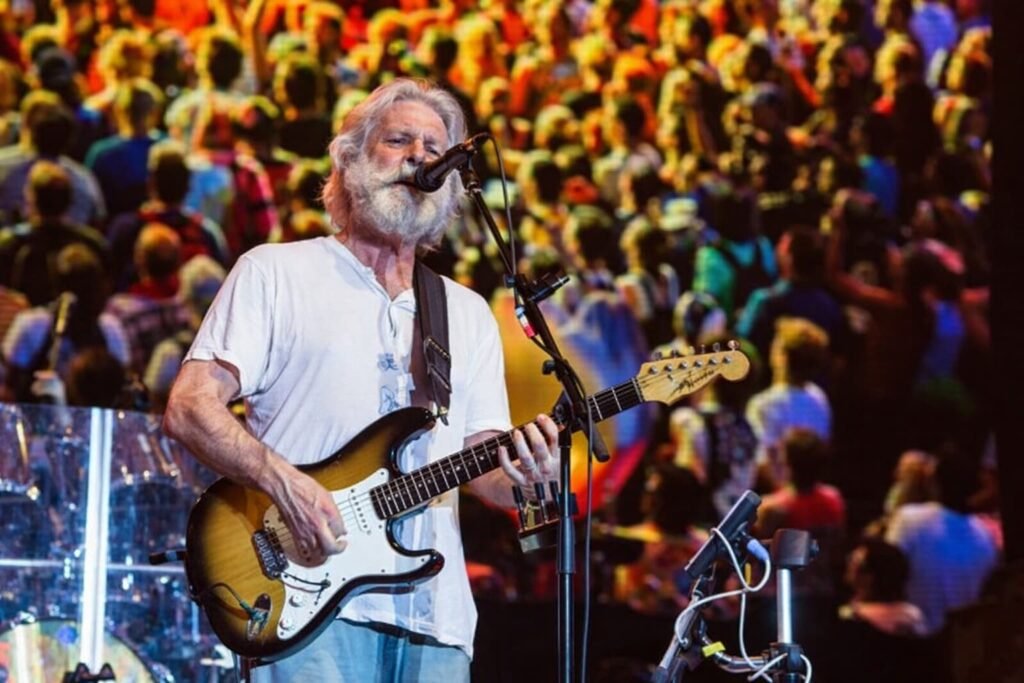
Bob Weir, the guitarist, singer, and founding member of the legendary rock band Grateful Dead, has died at the age of 78. His death was confirmed through a statement shared on his official Instagram account, which said Weir passed away peacefully after battling cancer and lung-related complications. He was surrounded by loved ones.
“There is no final curtain here, not really,” the statement read. “Only the sense of someone setting off again.” The message reflected Weir’s long-held belief that music, once created, does not end with the artist. “He often spoke of a three-hundred-year legacy,” the post continued, “determined to ensure the songbook would endure long after him.”
Weir’s passing marks the end of an era for American rock music and for generations of fans known as Dead Heads, whose devotion followed him across decades, continents, and countless live performances.
A Founding Force of a Cultural Movement
Born Robert Hall Weir on October 16, 1947, in San Francisco, Weir co-founded the Grateful Dead in 1965 alongside Jerry Garcia and others. What began as a local experiment in improvisational rock soon became the defining soundtrack of America’s counterculture movement.
The Grateful Dead were never a conventional band. They fused psychedelic rock with folk, blues, Americana, and jazz, creating extended live performances that were never played the same way twice. Weir’s rhythm guitar work—unusual, syncopated, and harmonically adventurous—became central to the band’s sound, often serving as the glue between Garcia’s lead improvisations and the group’s collective explorations.
By the late 1960s and 1970s, the Grateful Dead were no longer just musicians; they were a cultural institution. Their concerts became communal experiences, drawing fans who followed the band from city to city, forming one of the most enduring fan cultures in music history.
Beyond the Grateful Dead
After the Grateful Dead ceased touring following Garcia’s death in 1995, Weir did not retreat from music. Instead, he continued to reinvent himself through various projects, including RatDog and later Dead & Company, which brought the Grateful Dead’s catalog to new generations.
Dead & Company’s extended residencies at the Las Vegas Sphere in 2024 and 2025 were widely praised for blending classic material with cutting-edge visuals, underscoring Weir’s ability to remain relevant well into his seventies.
Despite declining health, Weir continued performing even after being diagnosed with cancer in July. According to his family, those late performances were not meant as farewells but as gifts—an artist choosing to continue on his own terms.
Honors and Recognition
The Grateful Dead were inducted into the Rock and Roll Hall of Fame in 1994 and received the Grammy Lifetime Achievement Award in 2007. Yet, Weir often seemed less concerned with accolades than with the act of playing itself.
For Weir, the road was not a burden but a calling. “Music was his life,” said longtime publicist Dennis McNally, who described Weir as possessing an offbeat, dry sense of humor and an unwavering commitment to serving the music above all else.
Tributes From Across the Music World
Tributes poured in almost immediately following news of Weir’s death. The Empire State Building honored him by lighting up in tie-dye colors, a nod to the psychedelic aesthetic he helped popularize.
Guns N’ Roses guitarist Slash shared a photo of Weir performing, simply writing “RIP.” Former Eagles guitarist Don Felder recalled seeing Weir perform at Woodstock and praised his musicianship and spirit.
These tributes reflected not just admiration for Weir’s talent, but respect for his authenticity—an artist who never chased trends, only truth.
A Legacy That Will Not Fade
Weir is survived by his wife, Natascha, and his daughters, Shala and Chloe. In a statement, the family asked for privacy while expressing gratitude for the outpouring of love and remembrance from fans worldwide.
Bob Weir’s influence cannot be measured solely in albums sold or awards won. His legacy lives in the jam band movement he helped pioneer, in the improvisational freedom now common in live music, and in the idea that a concert can be a shared journey rather than a scripted performance.
As Weir himself believed, the music does not end. It only keeps going—played differently each time, but always alive.