
Business Strategy & Markets — The Corporate Daily
UNITED STATES, DECEMBER 2026
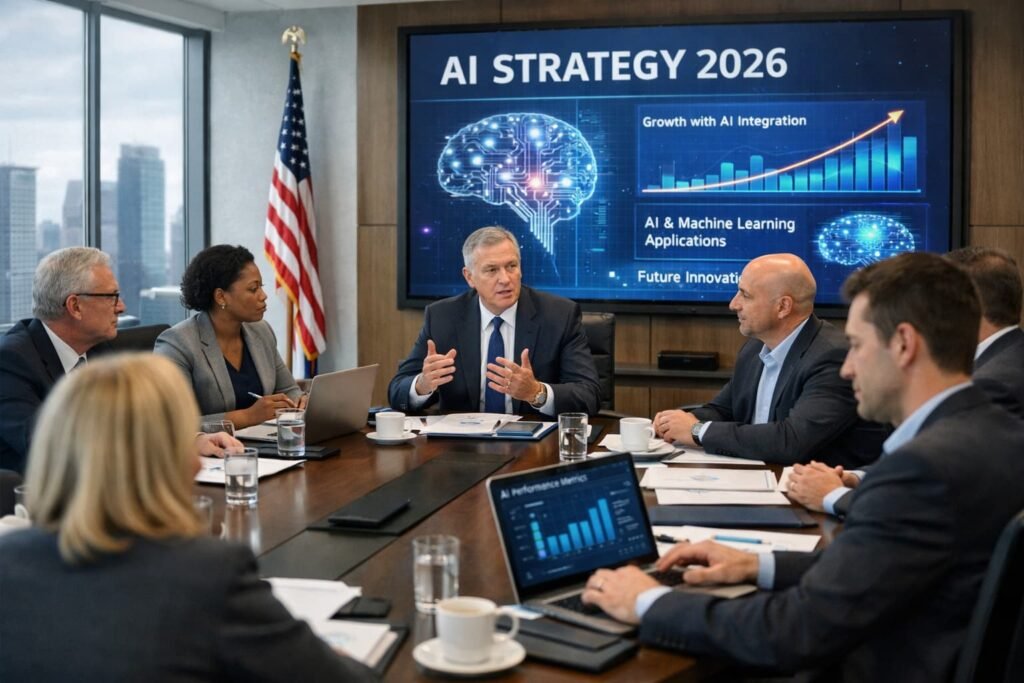
As U.S. companies move through the final quarter of 2026, a defining shift is underway across corporate America. The experimentation phase of artificial intelligence adoption has largely ended. In its place, firms are now engaged in a far more consequential process: embedding AI directly into the structural core of how organizations operate, allocate capital, and deploy labor.
This transition—often described by executives as the “agentic pivot”—marks a departure from AI as a productivity aid toward AI as an autonomous operational layer. The implications extend well beyond technology departments, reshaping financial markets, supply chains, retail economics, and workforce strategy.
Markets Signal a Preference for Infrastructure Over Novelty
Equity markets through 2026 have increasingly rewarded companies positioned to support AI at scale rather than those promoting experimental applications. Investors have shown a clear preference for firms tied to data storage, cloud infrastructure, energy reliability, and enterprise software with demonstrable enterprise demand.
This shift reflects a maturing view of artificial intelligence as capital-intensive infrastructure rather than a lightweight software trend. Companies such as Western Digital and Seagate have benefited from rising enterprise demand for high-throughput, low-latency storage as organizations deploy multi-agent systems that require constant data access and logging.
By contrast, speculative AI ventures without a clear path to integration or cost reduction have faced valuation pressure. Institutional investors now emphasize durability of cash flows, operational leverage, and alignment with long-term enterprise adoption.
From Chatbots to Enterprise Agent Systems
In earlier phases of AI adoption, companies focused on visible tools—chatbots, copilots, and text generation interfaces. By 2026, the strategic conversation has shifted decisively.
Large enterprises are increasingly building centralized internal AI platforms—often referred to as “agentic studios”—where reusable autonomous agents are developed to manage repeatable, high-value workflows. These systems are designed to operate across departments, handling functions such as demand forecasting, procurement optimization, compliance monitoring, and customer segmentation.
Consulting firms, including PwC, have documented a move away from decentralized experimentation toward tightly governed, enterprise-wide AI strategies. The rationale is straightforward: autonomous systems require oversight, security controls, and standardized data pipelines to deliver consistent value at scale.
Rather than replacing decision-makers, these agents increasingly function as execution layers, operating within predefined risk parameters while escalating exceptions to human supervisors.
Retail and Logistics Enter an Algorithmic Phase
The 2026 holiday season underscores how deeply AI has penetrated U.S. retail logistics. Inventory planning, routing, and fulfillment decisions are now routinely informed by predictive models that integrate sales velocity, regional demand signals, weather forecasts, and transportation constraints.
Logistics providers such as DHL and Ryder have expanded investments in predictive routing and automated fleet management. Retailers increasingly rely on these capabilities to reposition inventory dynamically while goods are already in transit.
However, efficiency gains have not translated into lower consumer costs. Last-mile delivery expenses remain elevated due to fuel costs, labor constraints, and capital investments in automation. While inflation has moderated compared with earlier years, delivery surcharges and service fees have become a structural feature of e-commerce economics.
Labor Markets Adjust to the Agentic Model
Perhaps the most significant long-term impact of the agentic pivot is unfolding in the labor market. Hiring patterns in 2026 reflect a growing bifurcation between roles that can be automated and those that require oversight, judgment, and system design.
Research institutions such as Stanford University have noted declining demand for entry-level roles centered on routine analysis, reporting, and administrative processing. At the same time, demand has increased for professionals who can supervise autonomous systems, interpret model outputs, and align AI behavior with organizational objectives.
Financial institutions including Goldman Sachs and JPMorgan Chase have publicly emphasized workforce restructuring as firms seek to improve productivity per employee rather than headcount growth.
The result is a widening skills premium. Workers who combine domain expertise with AI literacy command significantly higher compensation, while those without access to reskilling pathways face increased displacement risk.
Capital Allocation Reflects an Efficiency Mandate
High interest rates through much of the decade have reinforced a disciplined approach to capital allocation. Companies are prioritizing projects that deliver measurable efficiency gains, cost reductions, or resilience improvements.
This environment favors investments in automation, energy efficiency, and supply chain visibility over speculative expansion. Boards and investors increasingly evaluate AI spending through the lens of return on invested capital rather than innovation signaling.
The policy stance of the Federal Reserve continues to influence this discipline, reinforcing the expectation that capital will remain relatively expensive compared with the pre-2020 era.
Leadership Transitions Reflect Structural Change
Corporate leadership transitions in 2026 also reflect the end of a globalization-first management era. Executives who rose during decades of geographic expansion and low-cost labor arbitrage are increasingly giving way to leaders focused on operational resilience, automation, and regional risk management.
The retirement of long-tenured executives—such as Joe DePinto at 7-Eleven—symbolizes a broader generational shift. The next cohort of CEOs is expected to navigate tighter labor markets, geopolitical fragmentation, and AI-driven productivity expectations.
A Structural, Not Cyclical, Transition
The agentic pivot underway in 2026 is not a short-term technology cycle. It represents a structural redefinition of how value is created and scaled in the U.S. economy.
Companies that succeed in this environment will not be those that adopt the most tools, but those that integrate autonomous systems responsibly, align them with human judgment, and deploy capital with discipline. For American business, efficiency has become not just a goal, but the organizing principle of strategy itself.