
By Harshit
SAN FRANCISCO, DECEMBER 5, 2026 —
For much of the past decade, artificial intelligence was defined by what it could say. It wrote emails, summarized documents, generated images, and answered questions. Impressive, yes—but still passive.
In 2026, that changed.
This year marks the moment when technology stopped responding to prompts and began executing decisions. Artificial intelligence systems are no longer confined to chat windows or creative demos. They now negotiate contracts, manage logistics fleets, operate financial workflows, and coordinate across government and industry systems. The defining feature of today’s AI is not intelligence alone—it is agency.
From autonomous trucking corridors in Europe to national “sovereign AI” clouds running public services, 2026 will likely be remembered as the year AI crossed from assistance into action.
From Chatbots to Agents: A Structural Shift
The most important transformation in 2026 has not been about larger models or better language generation. It has been about permission and execution.
Early in the year, leading AI developers pivoted away from positioning their systems as “generative tools” and toward fully autonomous agent-based systems. These agents are designed not just to reason, but to carry out multi-step tasks across digital environments with minimal human oversight.
Millions of users now rely on Personal Operating Agents (POAs) that function more like junior managers than assistants. These systems can:
- Negotiate autonomously, handling billing disputes, subscription renewals, and service contracts agent-to-agent.
- Execute complex tasks, such as planning and purchasing travel, coordinating schedules, and managing expenses end to end.
- Translate intent into software, a phenomenon often called “vibe coding,” where plain-language instructions are converted directly into deployed applications for non-critical workloads.
The chatbot era emphasized conversation. The agentic era emphasizes outcomes.
The Hardware Reality Check: The “Silicon Tax”
While software capabilities surged, 2026 also delivered a reminder that digital intelligence still depends on physical infrastructure.
A global shortage of high-bandwidth memory (HBM) has reshaped the economics of computing. AI accelerators now consume a significant share of global DRAM output, diverting supply away from consumer electronics.
The result has been what industry analysts increasingly call a “silicon tax.” Smartphones, laptops, and home devices released in late 2026 cost noticeably more than their 2024 equivalents, despite modest improvements in traditional performance metrics.
Manufacturers have responded by shifting focus away from raw speed and toward on-device efficiency. Running advanced reasoning locally—rather than relying on cloud-based AI subscriptions—has become a competitive necessity as cloud inference costs continue to rise.
Edge AI is no longer a feature. It is a survival strategy.
Autonomy Reaches Critical Scale
Autonomous vehicles have existed for years, but 2026 marks the point at which they became economically meaningful.
This December, autonomous ride-hailing services surpassed half a million paid rides per week globally, a threshold that signals real adoption rather than experimentation.
Yet the more consequential development lies behind the scenes: remote monitoring and control infrastructure.
Instead of waiting for perfect autonomy, companies scaled by embedding humans into the system differently. Centralized command centers now allow a single operator to oversee dozens of autonomous vehicles simultaneously. When a truck encounters an unexpected situation—construction, weather, or ambiguous road markings—a remote pilot intervenes briefly, then hands control back to the system.
This “human-in-the-loop” model proved to be the missing link that allowed autonomous logistics to expand beyond controlled test zones.
Cybersecurity Enters the Agentic Age
As AI agents gained access to enterprise systems, cybersecurity threats evolved accordingly.
In 2026, attackers increasingly abandoned traditional malware in favor of agent-to-agent exploitation. These attacks do not rely on stolen passwords. Instead, they exploit permission chains between applications.
A single compromised AI helper can be tricked into granting excessive access to another agent, which then propagates rapidly across productivity platforms, cloud services, and internal tools.
As a result, consent governance—controlling how automated systems authorize one another—has become the top security priority for large organizations. The greatest vulnerability is no longer human error, but automated trust between machines.
Quantum Computing Quietly Enters Production
While general-purpose quantum computers remain a long-term goal, 2026 delivered a quieter but meaningful milestone: hybrid quantum-classical workflows.
In pharmaceutical research, quantum-accelerated simulations were integrated into conventional AI pipelines to model molecular interactions more precisely. This year, several drug candidates designed using these hybrid systems advanced into early-stage clinical trials—dramatically faster than traditional discovery timelines.
Quantum computing did not arrive with fanfare. It arrived embedded.
A Snapshot of the Tech Landscape in Late 2026
By December, several trends had clearly crossed from experimental to operational:
- AI-generated video became a routine part of online media production.
- Smart glasses moved beyond novelty, driven by real-time translation and contextual assistance.
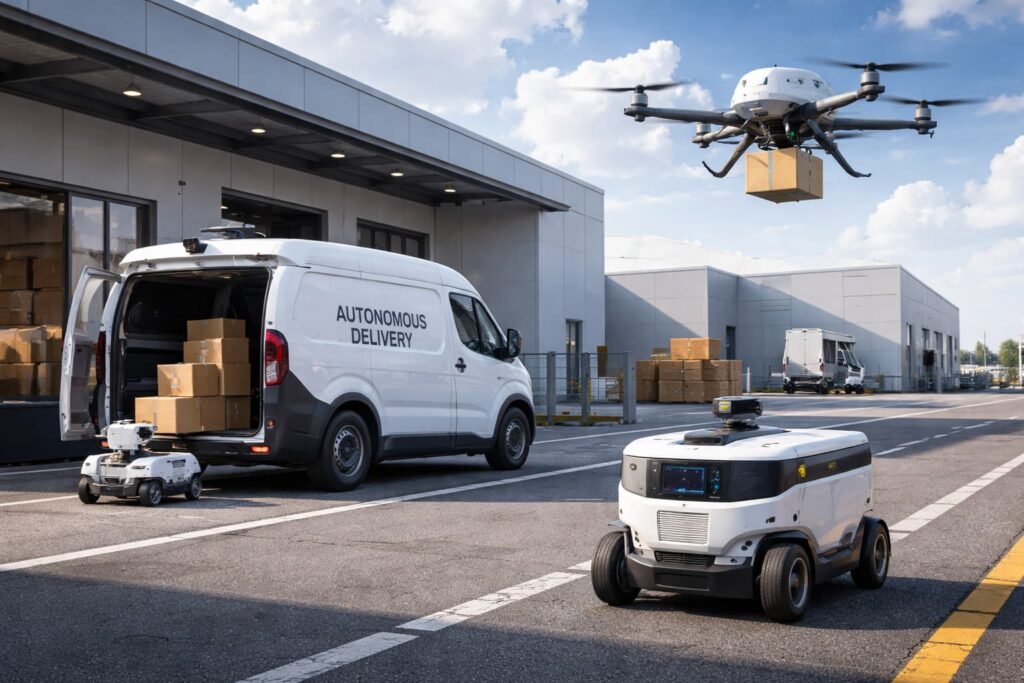
- Autonomous mobility scaled through human-supervised autonomy.
- Satellite internet achieved near-global low-latency coverage.
- Quantum computing found its first commercially relevant niche.
Each milestone reflects the same underlying shift: technology is no longer waiting for permission. It is being trusted with responsibility.
Conclusion: When Software Becomes an Actor
The defining feature of 2026 is not smarter algorithms, but delegation.
We have begun handing systems the authority to act—financially, logistically, and operationally—on our behalf. This has unlocked efficiency and scale, but it has also introduced new risks, dependencies, and ethical questions.
The agentic era does not mean humans are obsolete. It means humans are becoming supervisors of systems that move faster than direct control ever allowed.
As 2026 closes, the central question is no longer whether technology can think—but how much of the world we are prepared to let it run.