
By Harshit
NEW YORK, JANUARY 1, 2026
As the United States enters 2026, the economy has confounded both pessimists and optimists. The long-anticipated recession never fully materialized, yet the explosive rebound many hoped would follow aggressive inflation control has also failed to arrive. Instead, the country finds itself in a durable but constrained phase economists increasingly describe as “Sticky Stabilization.”
This new economic normal is defined less by momentum than by resistance. Inflation is resisting a full return to the Federal Reserve’s 2% target. Interest rates are resisting a drop back to the ultra-low levels of the 2010s. The labor market is resisting collapse—but also resisting renewed expansion. For businesses, investors, and households, 2026 is shaping up as a year that rewards discipline, efficiency, and realism rather than risk-taking or leverage.
1. The Macro Backdrop: ‘Stagflation Lite’ Takes Hold
The central feature of the 2026 outlook is what analysts have labeled “Stagflation Lite.” While the term evokes memories of the 1970s, the current environment is far less severe. Growth remains positive, but it is slower and more uneven, while inflation remains uncomfortably elevated.
Growth Slows to Trend
Consensus forecasts place U.S. GDP growth between 1.8% and 2.2% in 2026, marking a clear downshift from the roughly 2.8% pace recorded in 2024. This level of expansion is sufficient to avoid recession but insufficient to generate broad-based economic optimism.
The slowdown reflects tighter financial conditions, more cautious consumer behavior, and a normalization of demand following the post-pandemic surge.
The Inflation Floor
Despite the Federal Reserve’s aggressive tightening campaign over the past two years, core Personal Consumption Expenditures (PCE) inflation remains near 2.7%. Services inflation—driven primarily by wages, housing, insurance, and healthcare—has proven especially resistant.
Economists increasingly view this range as an inflation “floor” rather than a temporary plateau. Pushing inflation materially lower would likely require a sharper slowdown in employment or consumer spending—an outcome policymakers remain eager to avoid.
Interest Rates: Higher for Longer
The Federal Reserve entered 2026 with the federal funds rate in a 3.50%–3.75% range, following modest rate cuts late last year. Markets now expect only gradual, limited easing going forward.
Meanwhile, the 10-year Treasury yield remains near 4.2%, signaling that bond investors expect inflation and borrowing costs to remain structurally higher than in the previous decade. For businesses and households alike, this confirms that cheap money is no longer the default condition of the U.S. economy.
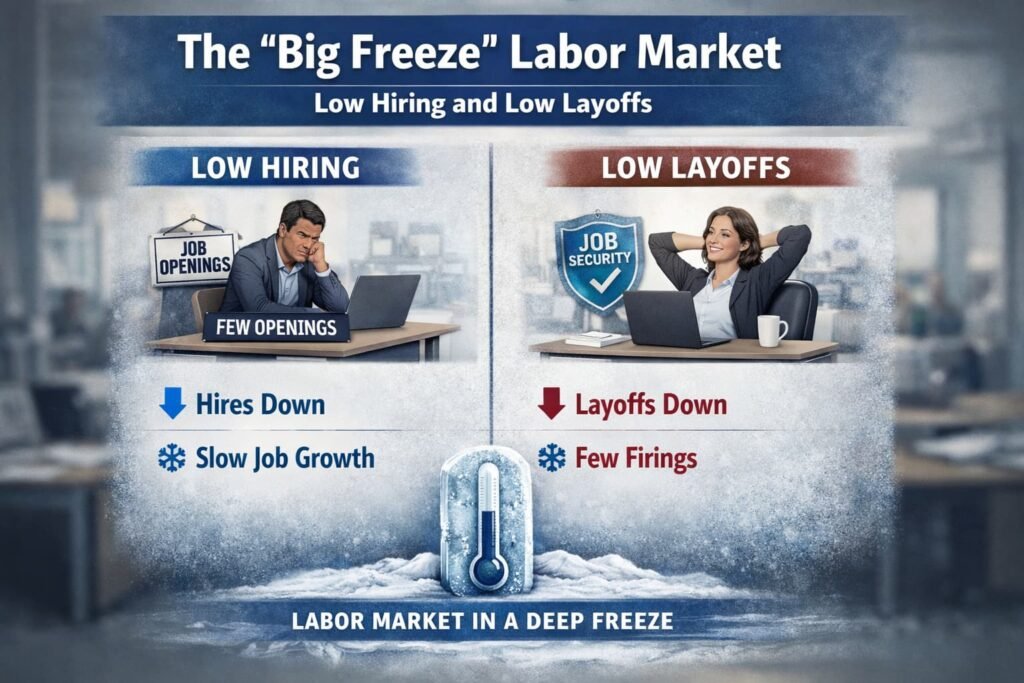
2. The Labor Market: From Resilience to ‘The Big Freeze’
Perhaps the most striking shift entering 2026 is in employment dynamics. After years of rapid hiring, labor shortages, and elevated worker mobility, the labor market has entered a phase many analysts are calling “The Big Freeze.”
Unemployment Rises—Quietly
The unemployment rate has drifted up to around 4.6%, the highest level since 2021. Yet this increase has not been accompanied by mass layoffs or widespread corporate distress.
Instead, companies are increasingly relying on “silent attrition.” Vacant positions are left unfilled, hiring plans are postponed, and expansion is delayed. Firms are choosing to stabilize payrolls rather than aggressively grow or cut.
The AI Shadow
A key contributor to this freeze is the rapid deployment of automation and agent-based artificial intelligence systems. Rather than replacing workers directly, many companies are using AI to absorb incremental workload—effectively eliminating the need to hire for roles that would have existed in previous cycles.
This has reduced labor demand at the margin, particularly in administrative, analytical, and customer-service functions.
Wages Lose Momentum
Wage growth has cooled to around 3.5%, barely outpacing inflation. As a result, the real income gains that supported strong consumer spending in 2024 have largely evaporated. Households are becoming more cautious, particularly in discretionary categories, contributing to softer spending expectations for the first half of 2026.
3. Housing: Relief Without a Reset
The housing market remains one of the most closely watched sectors in 2026—and one of the most constrained.
Mortgage Rates Ease, but Prices Stay High
Mortgage rates have settled in the high-5% range, down from the 7%–8% peaks seen in prior years. This has begun to loosen the so-called “lock-in effect,” encouraging more homeowners to list properties.
However, this is unlikely to result in a true buyer’s market. Years of underbuilding have created a structural housing shortage, keeping prices historically elevated despite reduced affordability.
A Slow Thaw, Not a Boom
Transaction volumes are expected to improve modestly, but affordability remains strained. For many households, renting remains the only viable option, reinforcing upward pressure on shelter costs—a key component of inflation.
4. Manufacturing Emerges as a Bright Spot
One of the most notable sources of strength in the 2026 economy is U.S. manufacturing investment.
Onshoring Drives Construction
Incentivized by industrial policy, tax reforms enacted in 2025, and geopolitical considerations, companies continue to invest heavily in domestic production. Semiconductor, battery, and advanced manufacturing facilities are under construction at record levels.
While this investment does not immediately translate into widespread job growth, it provides long-term support for industrial capacity, supply-chain resilience, and regional economic development.
Factories Busy, Offices Quiet
The contrast is stark: factory floors are active, while white-collar hiring remains subdued. This divergence reflects the economy’s structural shift toward capital-intensive, technology-enabled production.
5. What 2026 Means for Households and Businesses
The economic message of 2026 is neither alarmist nor celebratory—it is pragmatic.
For businesses, success depends on:
- Protecting margins rather than chasing volume
- Automating repetitive processes
- Managing debt carefully in a higher-rate environment
- Investing selectively in productivity-enhancing technology
For households, the emphasis is shifting toward:
- Saving over borrowing
- Managing variable-rate debt
- Adjusting expectations around housing affordability
- Preparing for slower real income growth
Conclusion: Stability Without Comfort
The U.S. economy in 2026 is stable, but not easy. The emergency conditions of the early 2020s have passed, yet the tailwinds that fueled rapid growth are gone. What remains is a slower, more disciplined economic environment shaped by sticky inflation, cautious hiring, and structurally higher interest rates.
This is not a year for excess. It is a year for efficiency, realism, and resilience. Those who adapt to the “Sticky Stabilization” will not only endure—but may quietly thrive as the economy grinds forward.