
By Harshit
GAZA / JERUSALEM, DECEMBER 31 —
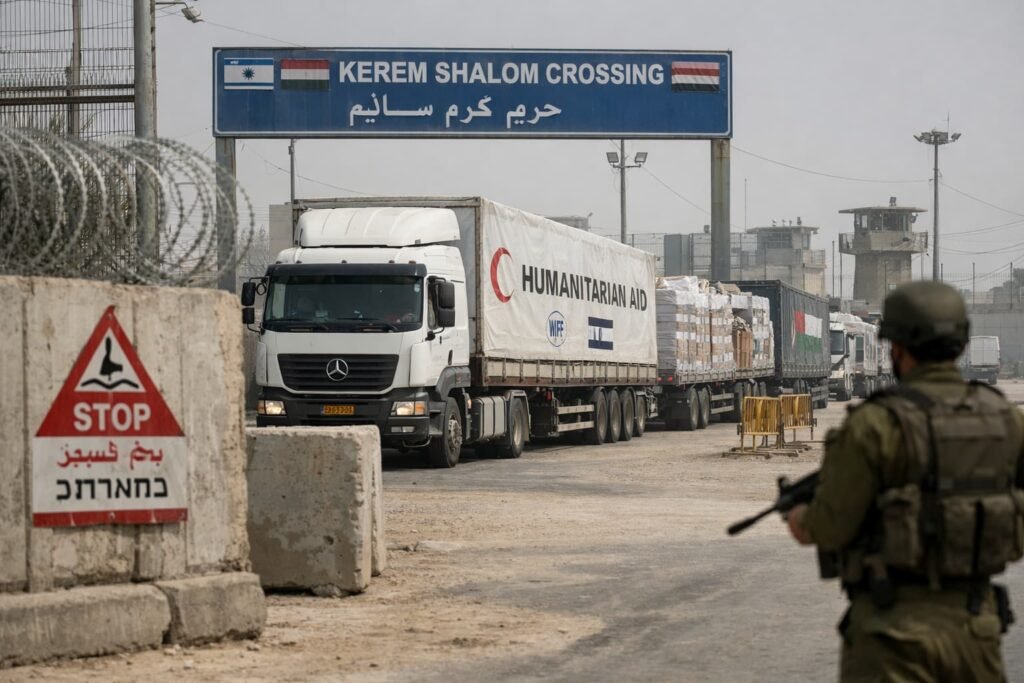
Israel has announced plans to suspend the operations of more than three dozen humanitarian organisations working in the Gaza Strip, including Doctors Without Borders (Médecins Sans Frontières – MSF), citing alleged failures to comply with new registration and operational requirements imposed on aid groups.
The move has triggered alarm among international humanitarian agencies, the European Union, and Palestinian officials, who warn the decision could sharply curtail life-saving assistance in an enclave already facing catastrophic shortages of food, medicine, shelter, and clean water.
Israel’s New Rules and the Aid Group Suspensions
Israeli authorities say 37 humanitarian organisations failed to meet newly introduced rules governing international aid operations in Gaza and will be suspended starting January 1. The regulations reportedly require extensive disclosure of staff details, registration procedures, and coordination mechanisms with Israeli authorities.
Israel argues the measures are necessary for security oversight. Aid groups, however, say the requirements are excessive, incompatible with international humanitarian principles, and in some cases violate European data protection laws.
A consortium of international and local NGOs issued a joint statement urging Israel to reverse the suspensions, warning that the affected organisations are “an essential part of the life-saving humanitarian operation” in Gaza.
MSF Warns of ‘Catastrophic’ Impact
MSF, one of the largest medical providers operating in Gaza, said Israel’s decision would have a catastrophic effect on the enclave’s collapsing healthcare system.
According to the organisation, MSF currently supports around 20% of Gaza’s hospital beds and approximately one-third of all births in the territory. The group strongly denied Israeli accusations regarding its staff and operations.
“The suspension would severely undermine emergency medical care at a time when Gaza’s health sector has been systematically damaged and overwhelmed,” MSF said, warning that thousands of patients could be left without treatment.
Gaza’s healthcare infrastructure has been largely devastated during more than two years of war, with hospitals repeatedly damaged, staff killed or displaced, and critical supplies blocked or delayed.
EU and International Reaction
The European Union warned that Israel’s move risks blocking life-saving aid. EU humanitarian chief Hadja Lahbib said the NGO registration law “cannot be implemented in its current form.”
“IHL leaves no room for doubt: aid must reach those in need,” Lahbib wrote on X, referring to international humanitarian law.
Human rights organisations argue that restricting independent aid groups also reduces outside witnesses to conditions on the ground, further isolating Gaza from international scrutiny.
Aid Groups Say Blockade Was Already Crippling Operations
Even before the suspensions, humanitarian groups say Israel’s blockade had already severely constrained their work.
Bushra Khalidi, policy lead for Oxfam in the occupied Palestinian territory, said Israel has continued blocking aid regardless of registration status.
“Israel continues to block us whether we’re registered or not,” Khalidi told Al Jazeera, noting that materials have largely been prevented from entering Gaza since early March. She described the new rules as part of a longstanding campaign to marginalise civil society organisations.
The Norwegian Refugee Council (NRC) also confirmed it had been suspended. NRC said it could continue limited local operations but would be unable to bring in international staff, removing a crucial layer of protection for Palestinian workers.
Mounting Humanitarian Crisis in Gaza
The suspensions come amid deepening humanitarian collapse. According to the Palestinian Central Bureau of Statistics, Gaza’s population has fallen by more than 10% over the past two years due to deaths and displacement.
Health officials say more than 71,000 Palestinians have been killed and over 170,000 wounded since October 2023. Nearly two million people remain displaced, many living in makeshift tents exposed to winter storms.
Medical officials warn that cancer patients and those with chronic illnesses face what one doctor described as a “slow death sentence” due to shortages of essential medicines.
Israel’s Broader Military and Security Context
The aid suspensions coincide with renewed scrutiny of Israel’s military tactics in Gaza. A Reuters investigation reported that Israeli forces used repurposed M113 armoured personnel carriers packed with up to three tonnes of explosives in Gaza City before the October ceasefire, flattening large residential areas.
Military experts cited by Reuters said such use was highly unusual and risked excessive civilian harm.
Meanwhile, Israeli forces have continued raids across the occupied West Bank, while hundreds of Israeli settlers recently entered the Al-Aqsa Mosque compound under heavy security, further inflaming regional tensions.
Uncertain Days Ahead
With the suspensions set to take effect, humanitarian agencies warn that Gaza is entering an even more dangerous phase, where lifesaving medical care and food assistance could be sharply reduced just as winter conditions worsen.
Aid organisations, diplomats, and rights groups continue pressing Israel to reverse or amend the policy, arguing that humanitarian assistance must remain neutral, independent, and uninterrupted — especially in one of the world’s worst humanitarian crises.