By Harshit
WASHINGTON, DECEMBER 26, 2025 —
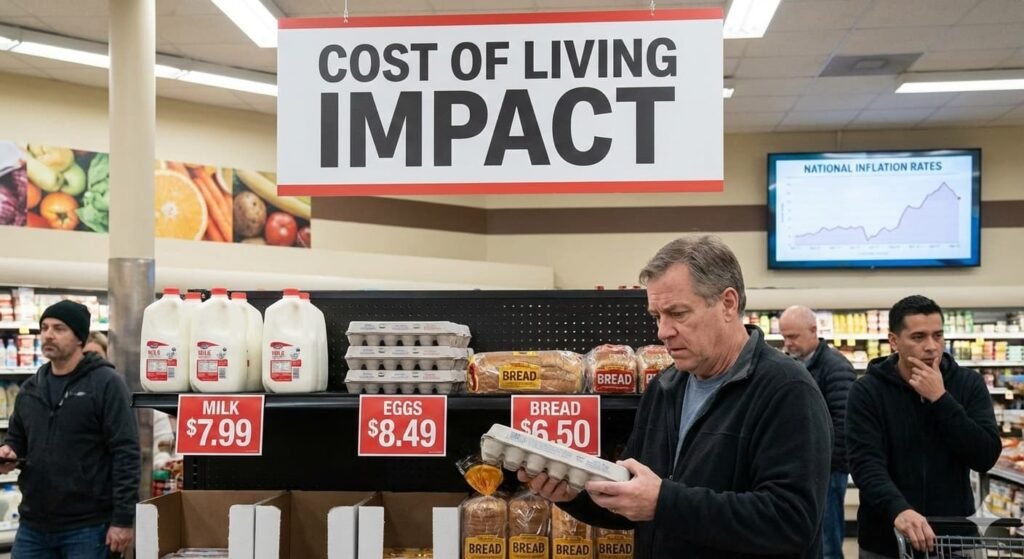
Although inflation cooled compared to the peaks seen earlier in the decade, price pressures continued to shape economic behavior across the United States throughout 2025. For households, businesses, and policymakers alike, the year underscored that inflation is not only about rising prices, but also about how elevated costs reshape expectations, spending habits, and long-term planning.
Economic data showed that inflation rates stabilized at lower levels than in previous years. However, the cumulative impact of earlier price increases meant that many goods and services remained significantly more expensive than they were before the pandemic era. This reality influenced consumer sentiment even as headline inflation numbers improved.
Inflation as a Psychological Factor
Economists increasingly emphasized that inflation in 2025 functioned as much as a psychological force as a statistical one. Even when prices stopped rising rapidly, households continued to behave cautiously because costs had not fallen back to earlier norms.
Housing, insurance, healthcare, and education expenses remained particularly burdensome. Rent growth slowed in some markets, but affordability challenges persisted due to limited supply and higher borrowing costs. Insurance premiums and medical expenses also consumed a larger share of household income than in past decades.
As a result, consumers adjusted behavior by prioritizing essential spending, delaying large purchases, and maintaining higher savings buffers.
Business Pricing and Wage Decisions
Businesses faced a delicate balance throughout the year. On one hand, easing inflation reduced pressure to raise prices aggressively. On the other, higher input costs and wage expectations limited the ability to cut prices meaningfully.
Many firms adopted cautious pricing strategies, focusing on maintaining margins rather than expanding volume. Wage growth continued, but at a slower pace, reflecting employer efforts to align compensation with productivity rather than inflation alone.
These dynamics contributed to a more stable but restrained economic environment, marked by steady activity rather than rapid expansion.
The Role of Monetary Policy
The Federal Reserve played a central role in shaping inflation expectations during 2025. Policymakers consistently emphasized that achieving sustained price stability required patience and discipline, even as inflation metrics improved.
Interest rates remained relatively high by historical standards, reinforcing cautious borrowing and spending behavior. While this stance helped anchor inflation expectations, it also limited the pace of economic acceleration.
Markets spent much of the year adjusting expectations around future rate cuts, contributing to volatility in financial conditions.
Uneven Impact Across Income Groups
Inflation pressures did not affect all Americans equally. Lower- and middle-income households experienced greater strain because essentials represent a larger share of their budgets. Higher-income households, while less exposed, also displayed caution due to uncertainty around long-term costs and asset valuations.
This uneven impact reinforced broader discussions about affordability, wage growth, and economic resilience.
Looking Ahead to 2026
As the U.S. enters 2026, economists expect inflation to remain a key influence on economic behavior, even if headline rates stay moderate. The experience of recent years has reshaped how households and businesses think about risk, savings, and spending.
Rather than signaling weakness, cautious behavior reflects adaptation to a higher-cost environment. In that sense, 2025 demonstrated how inflation’s legacy continues to shape the economy long after the most visible pressures subside.