
By Harshit
WASHINGTON, DECEMBER 22 —
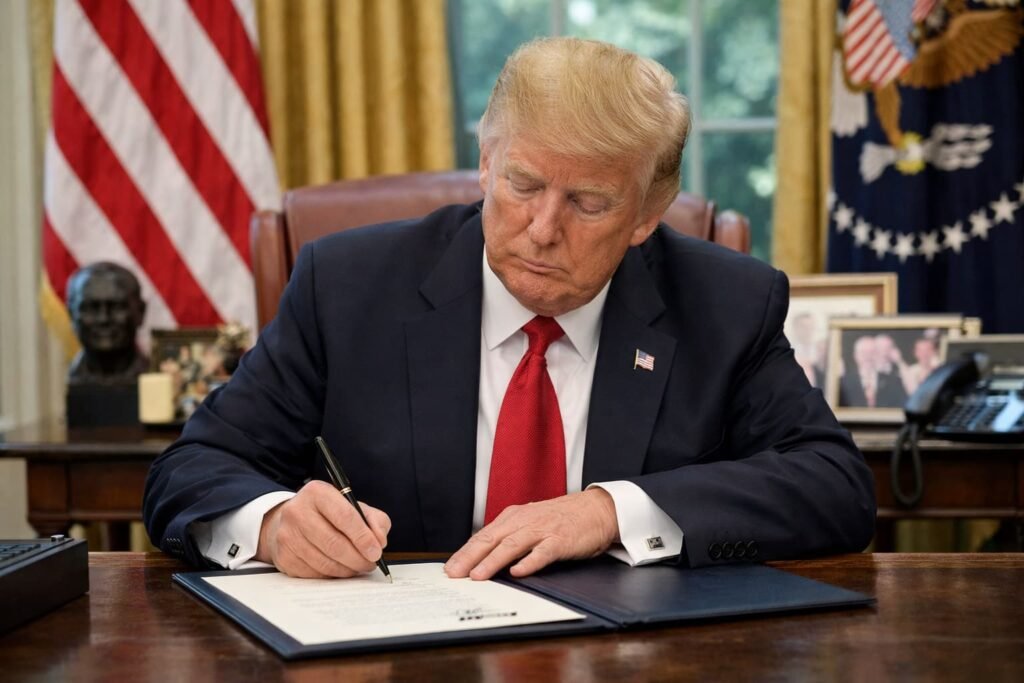
President Donald Trump on Thursday signed an executive order directing the federal government to expedite the reclassification of marijuana, a move that would ease restrictions on medical research but leave federal legalization unchanged.
Speaking in the Oval Office, Trump said the order would allow scientists to more easily study marijuana’s potential benefits and risks, calling the decision “common sense” and “long overdue.”
“This reclassification order will make it far easier to conduct marijuana-related medical research, allowing us to study benefits, potential dangers and future treatments,” Trump said. “It’s going to have a tremendously positive impact.”
What the Order Does — and Does Not Do
Under federal law, marijuana is currently classified as a Schedule I drug, a category reserved for substances considered to have no accepted medical use and a high potential for abuse, alongside heroin and LSD. Trump’s order directs the Justice Department to accelerate its review process to move marijuana to Schedule III, a category that includes drugs with recognized medical uses and a lower risk of dependency.
The order instructs Attorney General Pam Bondi to hasten the reclassification process but does not set a firm timeline.
Importantly, the move does not:
- Federally legalize marijuana
- Affect recreational marijuana laws
- Include criminal justice reforms related to marijuana convictions
Instead, it focuses narrowly on easing research barriers and reshaping federal drug policy around medical use.
Why Schedule III Matters
Schedule III status would dramatically reduce red tape for researchers seeking to study marijuana, which scientists say has long slowed progress on understanding its medical applications.
Trump argued that federal policy has failed to reflect scientific realities.
“The facts compel the federal government to recognize that marijuana can be legitimate in terms of medical applications when carefully administered,” he said, adding that cannabis could, in some cases, serve as an alternative to addictive opioid painkillers.
The Drug Enforcement Administration has historically rejected efforts to reschedule marijuana, arguing that its medical benefits were unproven. That position began to shift after former President Joe Biden ordered a review of marijuana’s classification in 2022. Federal health officials later recommended Schedule III status, but the process stalled in 2024.
Industry Applause, With Caveats
The cannabis industry welcomed Trump’s action but stressed that it does not solve all regulatory hurdles.
“We’ve been operating with both hands tied behind our back,” said Kim Rivers, CEO of Trulieve. “Now it’ll only be one hand tied behind our back.”
Industry leaders argue that reclassification could ease access to banking services and provide relief from federal tax rules that prevent cannabis businesses from deducting normal expenses — a restriction that has made many operations unprofitable.
Adam Hoffer, director of excise tax policy at the Tax Foundation, said reclassification could be transformative.
“It’s probably the biggest Christmas wish that any operator in the cannabis space could ask for,” he said.
CBD and Medicare: A Parallel Push
Alongside the marijuana order, Mehmet Oz, administrator of the Centers for Medicare & Medicaid Services, announced a new pilot model that could allow Medicare to cover CBD products for some seniors as early as next year, if prescribed by a physician.
The move follows recent concern from hemp and CBD advocates after Congress passed funding legislation that restricted products containing more than 0.4 milligrams of THC per milligram.
Critics Warn of Mixed Signals
Opponents of marijuana reform argue the reclassification sends a misleading message about safety, particularly to young people.
Kevin Sabet, president of Smart Approaches to Marijuana, called the move profit-driven.
“It’s going to allow massive tax breaks for the industry,” he said. “What it will do is send a powerful message that marijuana is less harmful than once thought — and that’s simply not true.”
Policy experts also caution that Schedule III status does not automatically clarify how marijuana would be prescribed, since doctors can only prescribe drugs approved by the Food and Drug Administration — something marijuana currently lacks.
A Symbolic Step With Unanswered Questions
While advocates view Trump’s order as a milestone, legal experts say uncertainty remains about how marijuana will ultimately be regulated under Schedule III.
“The assumption is that marijuana will be treated like every other Schedule III drug,” said Cat Packer of the Drug Policy Alliance. “But there are lots of reasons to suspect that it won’t be.”
Trump acknowledged that the move is only a first step, but framed it as a necessary correction to decades of federal policy.
“Marijuana should not be treated the same as heroin,” he said. “And it hasn’t made sense for a long time.”
For now, the order signals a shift in tone — offering researchers and the cannabis industry new momentum — while leaving the broader national debate over legalization firmly unresolved.