
By Harshit
JERUSALEM, DECEMBER 17, 2025
Long before numbers were written and equations were formalized, early human societies were already experimenting with mathematical ideas—using art as their medium. A new study published in the Journal of World Prehistory suggests that some of the world’s earliest plant-based images were not simply decorative but reflected deliberate numerical reasoning and geometric planning.
By analyzing prehistoric pottery from northern Mesopotamia, researchers argue that early farming communities used botanical motifs to organize space, express symmetry, and visually encode numerical patterns—centuries before the emergence of written mathematics.
A Turning Point in Human Visual Culture
The study, led by Professor Yosef Garfinkel and researcher Sarah Krulwich of the Hebrew University of Jerusalem, focuses on pottery produced by the Halafian culture between approximately 6200 and 5500 BCE. This culture flourished in what is now northern Iraq and surrounding regions.
Earlier prehistoric art largely emphasized animals and human figures, often linked to hunting or ritual life. Halafian pottery marks a clear shift. For the first time in human history, plants—flowers, branches, shrubs, and trees—became a consistent and carefully constructed artistic subject.
The team examined artifacts from 29 archaeological sites, documenting hundreds of plant motifs. While some designs appear naturalistic and others highly stylized, none were random. Instead, they followed repeated visual rules.
“These vessels represent the first moment when humans chose the botanical world as an artistic focus,” the authors note, linking this shift to settled village life and growing aesthetic awareness.
Flowers as Numerical Blueprints
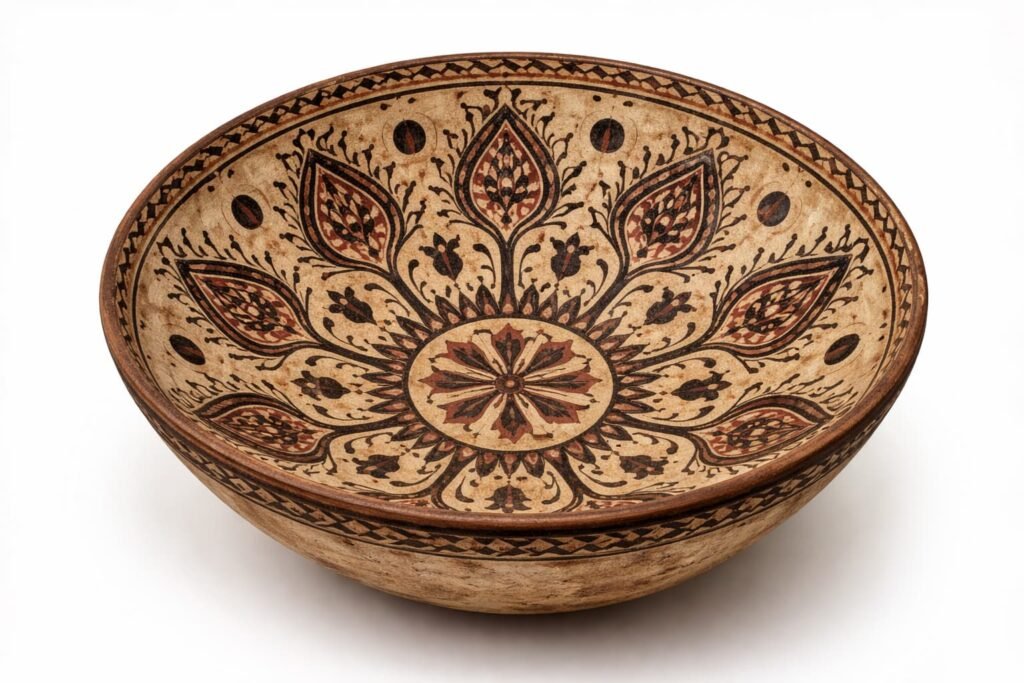
One of the study’s most striking findings lies in how floral patterns were arranged on bowls and vessels. Many examples show flowers painted with petal counts that follow clear numerical progressions: 4, 8, 16, 32, and in some cases even 64 repeated elements.
According to the researchers, these sequences required intentional planning and a clear understanding of how to divide circular space evenly. Such precision strongly suggests early numerical cognition rather than casual ornamentation.
Professor Garfinkel explains that this spatial reasoning likely emerged from everyday activities, such as dividing food, managing shared land, or organizing communal resources. Art, in this sense, became a visual extension of practical problem-solving.
Mathematics Before Numbers
The findings challenge the traditional assumption that mathematics began with written symbols in early Sumerian civilization. Instead, Halafian pottery reveals an intuitive, visual mathematics rooted in symmetry, repetition, and proportional balance.
Krulwich emphasizes that these designs show people thinking mathematically without formal notation. Rather than recording numbers, they expressed numerical order through visual rhythm and pattern.
This approach aligns with the field of ethnomathematics, which studies how mathematical ideas develop within cultural practices rather than formal academic systems.
What the Artists Chose Not to Depict
An intriguing aspect of the pottery is what it excludes. Despite being farming communities, the Halafian artists did not portray edible plants or crops. Wheat, barley, and other staples are absent.
Instead, flowers dominate the imagery. The researchers suggest this choice may reflect emotional or aesthetic preferences rather than agricultural documentation. Flowers likely held symbolic value, offering visual pleasure and perhaps representing ideas of balance, renewal, or beauty rather than subsistence.
A Broader View of Early Cognition
Beyond mathematics, the study sheds light on how early societies perceived and organized their world. The structured plant motifs suggest a shared visual language, one that communicated order and harmony within growing communities.
By combining archaeology, art analysis, and cognitive theory, the research presents prehistoric pottery not as simple decoration but as evidence of complex mental frameworks.
“These patterns show that abstract thinking emerged far earlier than we once believed,” the authors conclude, highlighting how early humans used art to explore concepts that would later become central to mathematics and science.