
By Harshit
WASHINGTON, D.C., DECEMBER 13, 2025
The Federal Reserve on Thursday unanimously reappointed 11 of its 12 regional bank presidents, ending weeks of quiet speculation about whether the Trump administration would attempt to reshape central bank leadership ahead of the 2026 term. The decision, which came earlier than the Fed’s typical renewal schedule, solidifies continuity within the Federal Open Market Committee (FOMC) as policymakers prepare for their rate decision next week.
The reappointments cover all regional Federal Reserve Bank leaders except Raphael Bostic, the Atlanta Fed president, who previously announced he will retire in February. Under federal law, regional bank presidents serve five-year terms that begin on March 1 of years ending in one or six. Their reappointment requires approval from the Fed’s Board of Governors in Washington, D.C., even though regional banks operate with their own boards and hiring processes.
In Thursday’s vote, all seven governors—including Stephen Miran, a recent Trump appointee whose board term expires in January—approved the slate of reappointments. The outcome dampened rumors that the administration might seek to exert influence over monetary policy by reshaping regional leadership, a move many economists warned would risk undermining the Fed’s political independence.
Early Renewals Signal Institutional Stability
Historically, the Federal Reserve waits until late February to finalize reappointments. This year’s early action signals the Board’s preference for stability as the U.S. economy transitions into a possible rate-cut cycle in 2026. Markets have increasingly priced in the likelihood of interest-rate reductions next year as inflation continues to moderate and growth indicators stabilize.
The timing also provides clarity ahead of next week’s FOMC meeting, where officials are expected to maintain the federal funds rate but could adjust forward guidance in response to cooling inflation data. The core PCE index, the Fed’s preferred gauge, recently slowed to 2.8% year-over-year in delayed September data, reinforcing expectations of softer policy in the months ahead.
Political Pressure Surrounding Regional Presidents
President Donald Trump has been an outspoken critic of the Federal Reserve and its leadership, repeatedly suggesting that central bank decisions have hindered economic performance. This backdrop fueled concerns that some regional presidents—particularly those perceived as hawkish—might face greater political scrutiny during the reappointment process.
Treasury Secretary Scott Bessent added to the discussion last month when he criticized what he described as disproportionate influence from New York–connected officials within the system. His comments referenced Dallas Fed President Lorie Logan, who previously ran the New York Fed’s trading desk, and Cleveland Fed President Beth Hammack, a former Goldman Sachs executive. Both were among the 11 presidents reappointed on Thursday.
Bessent has floated the idea of requiring future regional Fed presidents to reside in their districts for at least three years before assuming office, although no such requirement currently exists in law or policy.
Why the Reappointments Matter
Regional Fed presidents hold significant sway over U.S. monetary policy. While only five presidents vote at each FOMC meeting—New York as a permanent member and four rotating seats—non-voting presidents still shape debate, forecasts, and public messaging.
The early confirmation of 11 presidents provides:
- Policy predictability at a time when markets are highly sensitive to rate-cut signals
- Continuity in regional economic analysis, which feeds into national decision-making
- Institutional insulation from political pressures during a high-stakes election cycle
With Bostic set to retire, the Atlanta Fed must begin its search for a successor. That appointment, which also requires Board of Governors approval, will be closely watched given the district’s growing economic influence.
Renovation at the Eccles Building Highlights a Transitional Moment
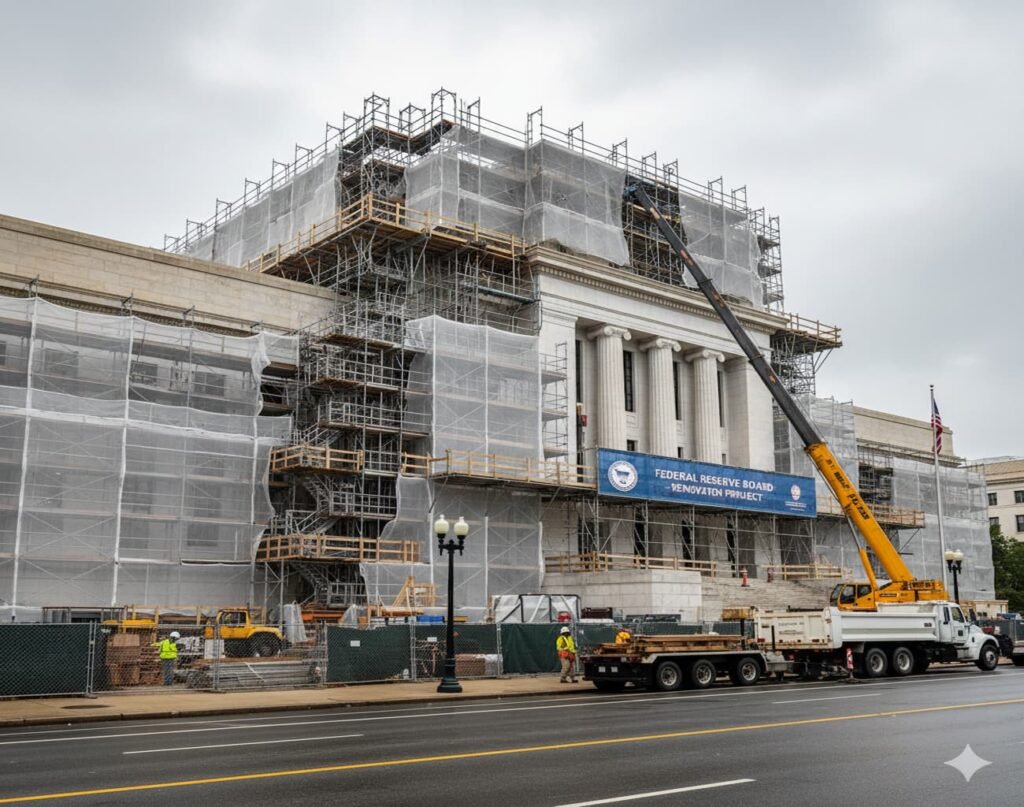
As the Fed prepares for next week’s meeting, renovations continue at the historic Marriner S. Eccles Building—the nerve center of the Board of Governors. The symbolism is not lost on policymakers: structural changes both literal and institutional are underway as the central bank navigates a post-inflation era and reassesses long-term policy tools.