
By Harshit
WASHINGTON, DECEMBER 11 —
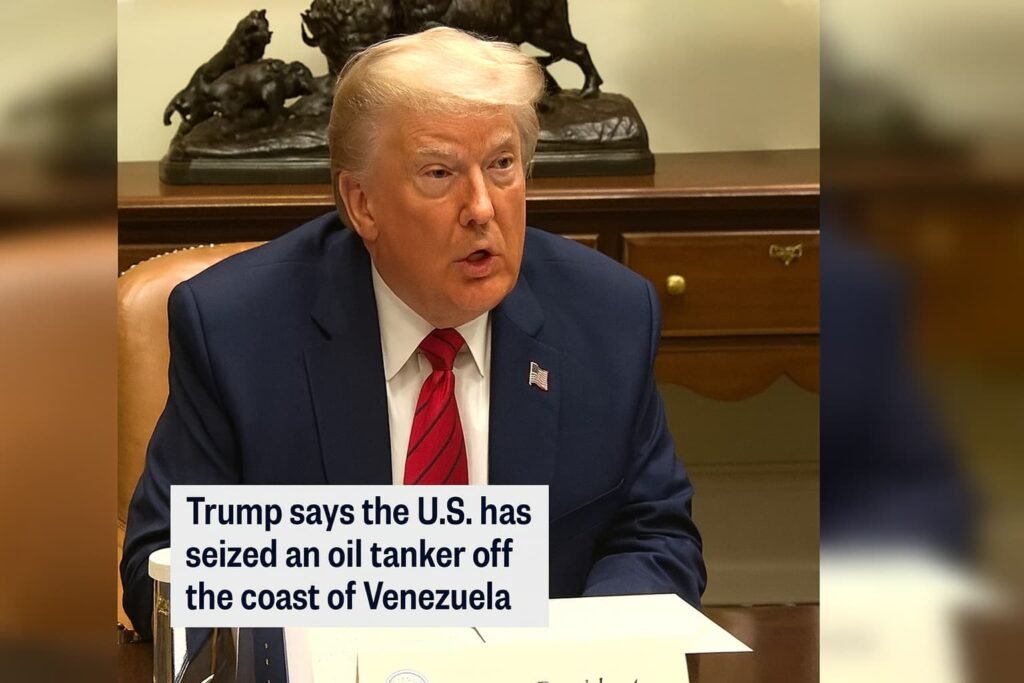
The United States has seized a large oil tanker off the coast of Venezuela, President Donald Trump confirmed Wednesday, marking a major escalation in Washington’s expanding military posture in the Caribbean and further straining relations between the two countries.
Calling it “the largest tanker ever seized,” Trump told reporters the operation was executed hours earlier and involved multiple U.S. federal agencies as part of a years-long effort to dismantle what his administration describes as an illicit oil smuggling network tied to sanctioned entities in Venezuela and Iran.
When asked what would happen to the seized oil, Trump gave an unfiltered response: “We keep it, I guess. I don’t know.”
His comments came shortly before Attorney General Pam Bondi posted on X that federal authorities had executed a seizure warrant on the vessel for its role “in supporting foreign terrorist organizations” through covert oil shipments.
Video released by Bondi showed U.S. Coast Guard commandos rappelling from hovering helicopters onto the tanker’s deck with long guns and tactical gear — the clearest imagery yet of the Biden-era expansion of maritime interdiction tactics now embraced by the Trump administration.
Elite Coast Guard Teams Led the Seizure
According to two U.S. government officials, the boarding team consisted of members of the Coast Guard’s Maritime Security Response Team (MSRT), an elite unit trained for high-risk maritime counterterror and counternarcotics missions.
The seizure was carried out in coordination with the FBI, Homeland Security Investigations, and the Defense Department. A senior White House official said no additional seizure warrants for other tankers have been approved, though officials did not rule out future actions.
This operation represents the latest flashpoint in a broader U.S. military campaign that has intensified sharply since September, when Trump declared that drug cartels operating in the Caribbean constituted “foreign terrorist organizations” and that the U.S. was engaged in “armed conflict” with them.
Venezuela Condemns ‘International Piracy’
Venezuelan Foreign Minister Yván Gil Pinto condemned the tanker seizure as “blatant theft” and “an act of international piracy.”
“The true reasons for the prolonged aggression against Venezuela have been laid bare. It has always been about our natural wealth — our oil, our energy, our resources,” he said on X.
He also accused Washington of orchestrating the operation to distract from the “political spectacle” unfolding in Oslo, where Venezuelan opposition leader María Corina Machado made her first public appearance in nearly a year as her daughter accepted the Nobel Peace Prize on her behalf.
Oil Markets React Immediately
Oil prices jumped more than 1.3% as news of the tanker seizure spread, adding roughly 75 cents per barrel by late afternoon. Analysts say further escalations could disrupt crude flows and push global prices higher, particularly if tensions extend into tanker routes near Venezuela and the Caribbean basin.
The U.S. has long targeted Venezuela’s state-owned oil sector, but the latest action comes amid Trump’s assertion in an interview this week that President Nicolás Maduro’s “days are numbered.” Trump declined to discuss possible troop deployments.
Mounting Scrutiny Over U.S. Strikes at Sea
The seizure also comes as Defense Secretary Pete Hegseth faces bipartisan scrutiny over a controversial September 2 strike on a suspected drug vessel that included a secondary hit — known as a “double tap” — killing two survivors of the initial explosion. Critics have raised questions about whether the strike may constitute a war crime under international law.
Hegseth defended the decision by citing “the fog of war” and stating he did not personally see evidence of survivors before the second strike was approved.
Members of both the House and Senate have opened inquiries into the administration’s tactics.
Maduro Accuses the U.S. of Fabricating War
Maduro, addressing agricultural workers Wednesday, avoided direct mention of the seized tanker but alluded to worsening tensions.
“The country is ready for a fight,” he said.
Maduro has repeatedly accused the U.S. of manufacturing a pretext for military confrontation. He faces longstanding U.S. indictments for narcoterrorism and conspiracy to import cocaine. Last week, Trump increased the reward for Maduro’s arrest to $50 million.
Meanwhile, the U.S. continues to bolster its presence in the region, including the deployment of the USS Gerald R. Ford aircraft carrier — one of the most powerful warships in the world — alongside fighter squadrons and guided-missile destroyers.
With no indication of de-escalation from either side, the tanker seizure has now become one of the clearest signals that the U.S.–Venezuela confrontation is entering a more volatile and unpredictable phase.