
By Harshit
WASHINGTON, DEC. 11 —
Nvidia has confirmed that it has built a new location verification technology designed to help data-center operators determine where their AI chips are physically operating. The move comes at a time when U.S. lawmakers and regulators are intensifying pressure on chipmakers to prevent advanced processors from being smuggled into countries where their export is restricted, particularly China.
The company disclosed the feature after Reuters first reported the existence of the software on Tuesday. Nvidia later published additional technical details in a blog post, emphasizing that the tool is designed for transparency and fleet management — not remote control or disabling of hardware.
A Security-Focused Software Layer for AI Data Centers
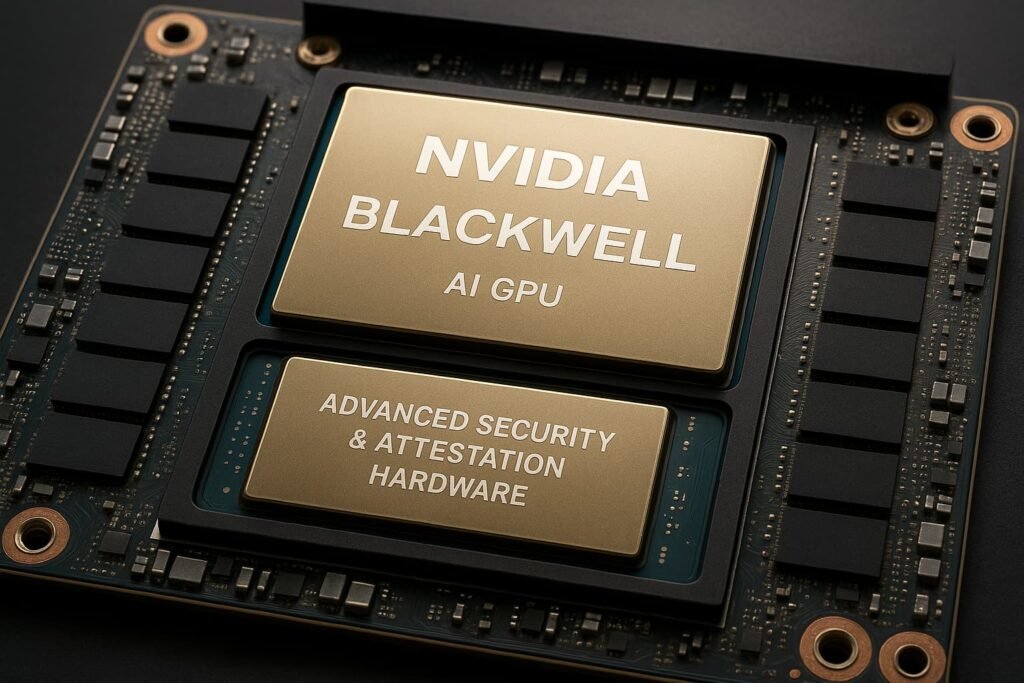
Nvidia’s new verification capability is built as a customer-installed software agent, not a firmware or hardware-level feature. According to the company, it leverages the confidential computing architecture present in its latest GPU family, known as Blackwell.
The mechanism works by analyzing GPU telemetry and measuring the latency between the chip and Nvidia-operated servers, which provides an approximate, internet-based inference of a device’s location. This type of latency triangulation is similar to what cloud applications already use to estimate user geography.
Nvidia said the system will help data-center operators track GPU health, performance, and physical distribution — an increasingly important requirement as hyperscale AI clusters continue to scale into the tens of thousands of chips.
The company stressed two key points:
- Nvidia cannot remotely control the GPUs.
- Telemetry data sent to Nvidia’s servers is read-only.
“There is no kill switch,” the company stated unequivocally, addressing speculation that the system could be used to disable hardware remotely at the direction of governments.
First Deployment on Blackwell GPUs, Expansion Under Study
The location verification feature is planned to debut on Nvidia’s Blackwell architecture, the successor to its high-performance Hopper and Ampere generations. The new Blackwell GPUs include enhanced attestation frameworks, enabling stronger guarantees about a device’s identity and integrity.
Nvidia officials told reporters that the company is exploring whether similar capabilities can be adapted to older GPU families, though technical limitations may prevent a complete back-port.
If formally released, the technology could become a compliance tool for U.S. export-controlled hardware, validating whether chips meant for domestic or allied markets are being operated in unauthorized jurisdictions.
A Response to U.S. Government Pressure and Growing Smuggling Schemes
The U.S. government has been calling for more robust mechanisms to prevent high-end AI chips from being diverted to China through third-party intermediaries or black-market supply chains.
Recent U.S. Department of Justice indictments have accused China-linked networks of attempting to smuggle more than $160 million worth of Nvidia GPUs into the country. Lawmakers from both political parties have urged the Commerce Department to work with the semiconductor industry on stronger safeguards.
Industry analysts say Nvidia’s software-only approach may satisfy those concerns while avoiding the creation of backdoors in hardware that foreign regulators fear.
China Raises Questions About Potential Backdoors
China’s top cybersecurity regulator recently summoned Nvidia officials seeking clarification about whether any form of remote access capability exists in its AI chips. Those concerns have grown amid geopolitical tensions, the widening U.S. export blacklist, and Washington’s attempts to restrict China’s access to high-end AI computing.
The issue resurfaced this week after U.S. President Donald Trump said he would authorize exports of Nvidia’s H200 chips — predecessors to the Blackwell models — to China. Some foreign policy experts have questioned whether Beijing would trust or allow importation of those chips given recent scrutiny.
Nvidia maintains its hardware includes no hidden access controls, and security experts confirmed that it is technically feasible to build a location-verification system without creating exploitable vulnerabilities.
Industry Implications: A New Phase of Compliance Technology
If rolled out broadly, Nvidia’s location verification capability could become the semiconductor industry’s first standardized mechanism for geographic compliance tracing, addressing a long-standing gap between export policy and enforcement.
For companies deploying massive AI clusters, it may also become a core tool for asset management and operational oversight — especially as GPU fleets grow into billions of dollars in capital expenditure.
For regulators, it represents the first tangible step toward ensuring that the most powerful AI chips in the world do not end up in unauthorized hands.