
By Harshit, 9 Dec, 8 PM JST
TOKYO —
Japanese authorities have issued a rare warning that a so-called “megaquake” could strike along the country’s northern Pacific coast within the coming week, following a powerful 7.5-magnitude earthquake that jolted the region late Monday night.
Officials from the Japan Meteorological Agency (JMA) said the earthquake, which struck at 11:15 p.m. off the Pacific coast of Aomori Prefecture at a depth of about 54 kilometres, has increased the short-term probability of another major quake of similar or greater magnitude occurring in the same area. While stressing that such an event is far from certain, experts warned the risk is higher than normal and urged residents to take precautions.
According to Japanese media, this is the first time the agency has issued a megaquake warning covering the coastal regions of Hokkaido and Sanriku since the alert system was introduced in December 2022.
What happened on Monday
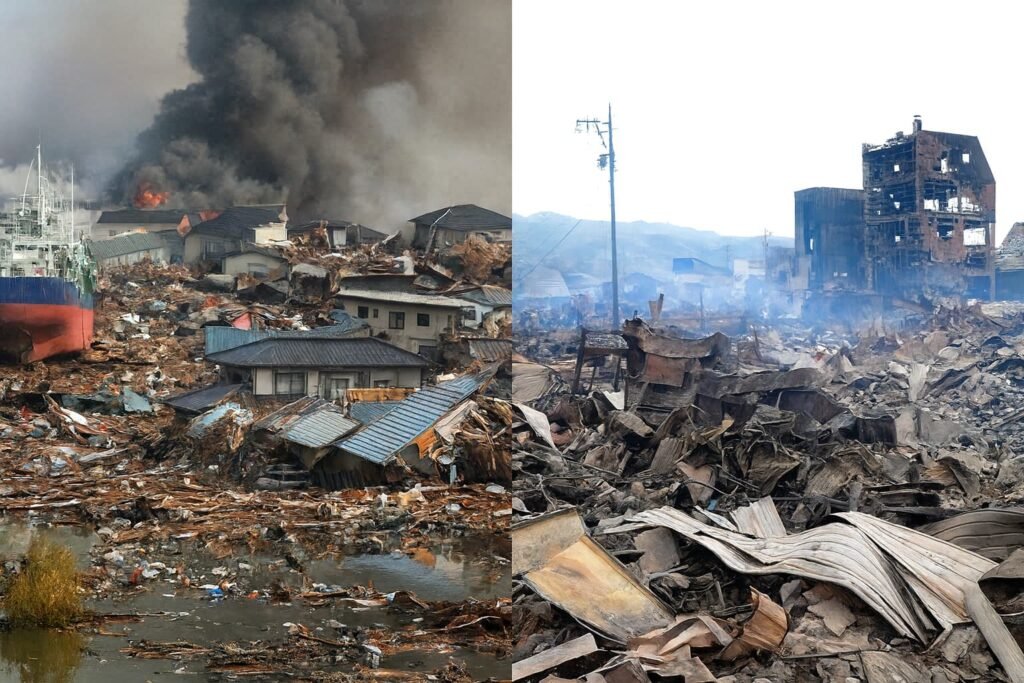
The quake was strong enough to trigger tsunami waves of up to 60 centimetres (about two feet) along parts of the northern coast, injure at least 30 people, and prompt evacuation advisories for roughly 90,000 residents. Social media footage showed violent shaking that made it difficult for people to stand, while photographs from Aomori revealed cracked roads and damage to buildings.
Despite being more than 350 miles away, residents in Tokyo also reported feeling the tremor, underlining the quake’s broad impact.
“The shaking was extremely strong in coastal areas,” the JMA said in a briefing, adding that aftershocks are expected to continue.
Why authorities are concerned
Tsukasa Morikubo, a cabinet official in charge of disaster management, told reporters Tuesday that the earthquake could be linked to activity along the Japan Trench and the Kuril Trench — major undersea fault zones off Hokkaido known for producing large earthquakes.
“It is unclear whether a large-scale earthquake will occur,” Morikubo said. “But everyone should heed the call to take precautions to protect their own lives.”
The JMA explained that, based on global statistical data, the chance of a magnitude-8.0 or higher earthquake occurring within a week of a magnitude-7.0 or greater tremor is roughly 1 in 100 — a probability officials describe as “higher than usual.”
Prime Minister Sanae Takaichi echoed the warning, urging residents to closely monitor updates from authorities and to review emergency preparedness plans.
“In addition to securing furniture and other everyday precautions, please ensure that you are ready to evacuate immediately if you feel strong shaking,” she said.
What is a “megaquake”?
Japan defines a megaquake as an earthquake of magnitude 8.0 or higher. These massive events typically occur at subduction zones, where one tectonic plate is forced beneath another. Japan is surrounded by such zones due to its location on the circum-Pacific “Ring of Fire,” making it one of the world’s most earthquake-prone countries.
Megaquakes can cause intense shaking across wide areas, often with epicentres extending hundreds of kilometres. They frequently trigger destructive tsunamis.
Japan’s history includes several devastating earthquakes, including the 1946 Nankai quake (magnitude 8.0) and the 2003 Tokachi-oki quake (magnitude 8.0). The most catastrophic in modern times was the 2011 Great East Japan Earthquake, a magnitude-9.0 event that unleashed towering tsunamis, killed more than 20,000 people, and led to the Fukushima nuclear disaster.
Lessons from the past
The country has issued megaquake alerts before. In August 2024, a 7.1-magnitude earthquake in southern Japan prompted the first-ever warning for a potential megaquake along the Nankai Trough. No major quake followed, and daily life resumed after a week.
However, experts caution that smaller quakes can sometimes act as foreshocks. Two days before the 2011 disaster, a magnitude-7.3 earthquake struck offshore.
Yoshihiro Hiramatsu, an earthquake expert at Kanazawa University, said the latest tremor may have altered stress levels in the Earth’s crust.
“The balance underground may have shifted,” he told Kyodo News. “That does not guarantee a major earthquake, but it could create conditions that make one more likely.”
Government estimates suggest the northern Sanriku coast has a 4% to 20% chance of experiencing a magnitude-8.0 or larger quake within the next 30 years. The last such event there was the 1968 Tokachi earthquake, which measured 8.3.
What residents are being asked to do
Despite heightened concern, authorities emphasized that a megaquake warning does not mean evacuation is required. The JMA acknowledged that forecasting earthquakes involves “a very high degree of uncertainty.”
Instead, residents are being urged to prepare thoroughly: confirm evacuation routes, assemble emergency kits, secure food and water supplies, and prepare portable toilets and other essentials. Coastal communities are also being reminded to be ready to move quickly to higher ground if a tsunami warning is issued.
Earthquakes are a constant reality in Japan — small tremors occur every few minutes — but the possibility of a megaquake brings renewed anxiety due to the scale of potential devastation.
For now, officials stress vigilance rather than panic, as the nation watches closely during what experts say is a critical period following Monday’s quake.