
By Harshit
BANGKOK, DECEMBER 8, 2025 — 8 AM EDT
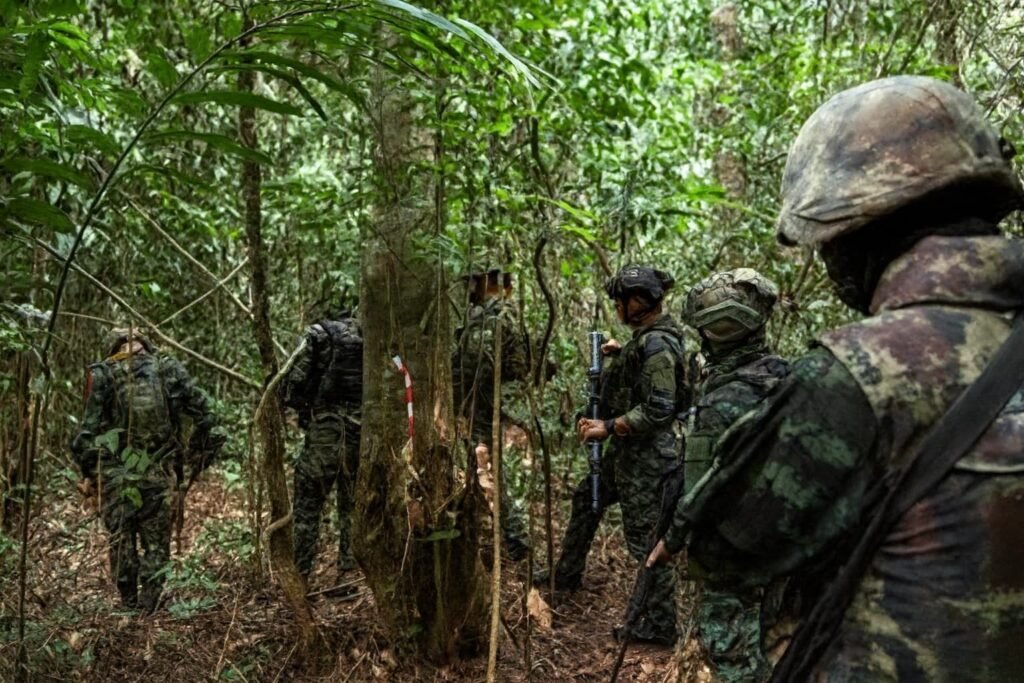
Fresh fighting along the contentious Thailand–Cambodia border has killed at least one Thai soldier and four Cambodian civilians and forced thousands of people to flee their homes, underscoring how fragile the latest ceasefire remains despite high-profile international mediation.
Monday’s clashes mark the most serious escalation since July, when five days of cross-border shelling and gun battles left dozens dead on both sides and pushed the region to the brink of a wider confrontation. The renewed violence threatens a peace agreement brokered in July by Malaysian Prime Minister Anwar Ibrahim and formally signed in October in the presence of US President Donald Trump.
Airstrikes, accusations and rising mistrust
Thailand’s military says it launched airstrikes early Monday in response to what it called a Cambodian attack on Thai soldiers guarding an engineering project near the frontier. Officials in Bangkok insist Thai forces were acting in self-defence and deny initiating the latest round of hostilities.
Cambodia has issued a sharply different account. Its Ministry of National Defence accused Thailand of striking first, alleging that Thai forces used tanks, artillery and even “toxic gas” against both Cambodian troops and border communities — claims that Thai authorities have not commented on in detail and which have not been independently verified.
Information Minister Neth Pheaktra said four Cambodian civilians were killed and nine injured in northern provinces near the frontier, adding that tens of thousands had been displaced from their homes. On the Thai side, the army confirmed that one soldier was killed in the fighting, while local officials reported waves of evacuations from frontline villages into makeshift shelters and schools.
Despite the ceasefire framework agreed earlier this year, both sides accuse the other of violating its terms, deepening a long-standing mistrust that has festered for more than a decade along this disputed stretch of border.
Villages emptied, hospitals closed, lives on hold
For border communities, the renewed clashes are another painful reminder that the line between daily life and sudden violence can vanish in an instant.
Residents in Thailand’s Si Sa Ket, Surin and Ubon Ratchathani provinces described waking to the sound of artillery and small-arms fire, then racing to gather elderly relatives and children before boarding evacuation trucks. Some hospitals in Surin and Ubon Ratchathani closed temporarily, with health authorities redirecting patients to emergency field facilities and urging those in need of urgent care to call national hotlines.
Locals interviewed by Thai media spoke of “constant evacuations” and a sense of exhaustion with a cycle that repeatedly disrupts farming, schooling and small businesses. One agricultural worker said he chose to stay behind in his village to guard neighbours’ homes and livestock from possible looting, while his family joined thousands sheltering in temporary camps away from the firing line.
On the Cambodian side, authorities in border provinces such as Preah Vihear and Oddar Meanchey reported similar scenes: families crowding into schools and community centres, farmers abandoning fields during harvest season, and children asking anxious questions about whether the shooting would start again.
UN agencies and humanitarian groups have urged both governments to guarantee safe corridors for civilians and to prioritise protection of children, noting that repeated displacements compound trauma and disrupt education, health care and livelihoods.
Peace deal under strain — and Trump remains silent
The clashes are a major test of the July peace framework brokered by Malaysia’s Anwar Ibrahim and later endorsed at a formal signing ceremony witnessed by President Trump in October. That deal sought to freeze military positions, establish joint monitoring mechanisms and reduce the risk of miscalculation along one of Southeast Asia’s most volatile borders.
So far, Trump has issued no public statement on the latest escalation, even as Thai Prime Minister Anutin Charnvirakul vowed to “take all necessary measures” to defend national sovereignty and Cambodia’s government called on the international community to condemn what it labelled Thai “aggression.”
Malaysia has appealed for restraint from both sides, while regional diplomats privately worry that each new clash makes it harder to restore confidence in the Trump-backed accord. Analysts say neither Bangkok nor Phnom Penh appears eager for a full-scale war, but domestic political pressures and nationalist sentiment can make compromise difficult.
A century-old dispute that keeps flaring
The current tensions sit atop a deeper, unresolved territorial dispute dating back more than a century, when colonial-era borders between Thailand and what was then French-ruled Cambodia were first drawn.
Much of the friction has focused on territory around the 11th-century Preah Vihear temple, a dramatic clifftop complex awarded to Cambodia by the International Court of Justice (ICJ) in 1962. Sporadic clashes around the temple and nearby areas between 2008 and 2011 killed at least dozens of soldiers and civilians and displaced tens of thousands of residents on both sides of the border. Wikipedia+1
Although an ICJ clarification in 2013 reaffirmed Cambodian sovereignty over the promontory around the temple, demarcation of the broader border region remains incomplete, leaving room for competing claims and periodic military standoffs. Wikipedia
The latest fighting also carries political overtones. In Thailand, previous border flare-ups have fed domestic controversy — including the fall of former prime minister Paetongtarn Shinawatra earlier this year after a leaked phone call with ex-Cambodian leader Hun Sen, in which she appeared deferential during a period of high tension. In Cambodia, Prime Minister Hun Manet’s government faces pressure to show it can defend national territory while avoiding a confrontation that could damage a fragile economy.
Border residents bear the cost
As diplomats weigh next steps and regional leaders debate how to salvage the peace framework, people living closest to the frontier are once again paying the highest price.
With hospitals shut, schools turned into shelters and gunfire audible across farming communities, many residents say they no longer trust assurances that each new ceasefire will hold. Some are packing evacuation bags permanently; others are trying to keep businesses running while staying ready to flee at short notice.
Whether the renewed violence becomes another short-lived flare-up or the start of a longer crisis may depend on how quickly Thailand and Cambodia can re-establish communications, allow independent verification of events and recommit — under regional and US pressure — to the peace deal they signed barely two months ago.
For now, the border remains tense, the ceasefire fragile and thousands of ordinary people caught in the middle.