
By Harshit
NEW DELHI, Dec. 6, 2025, 8 AM EDT
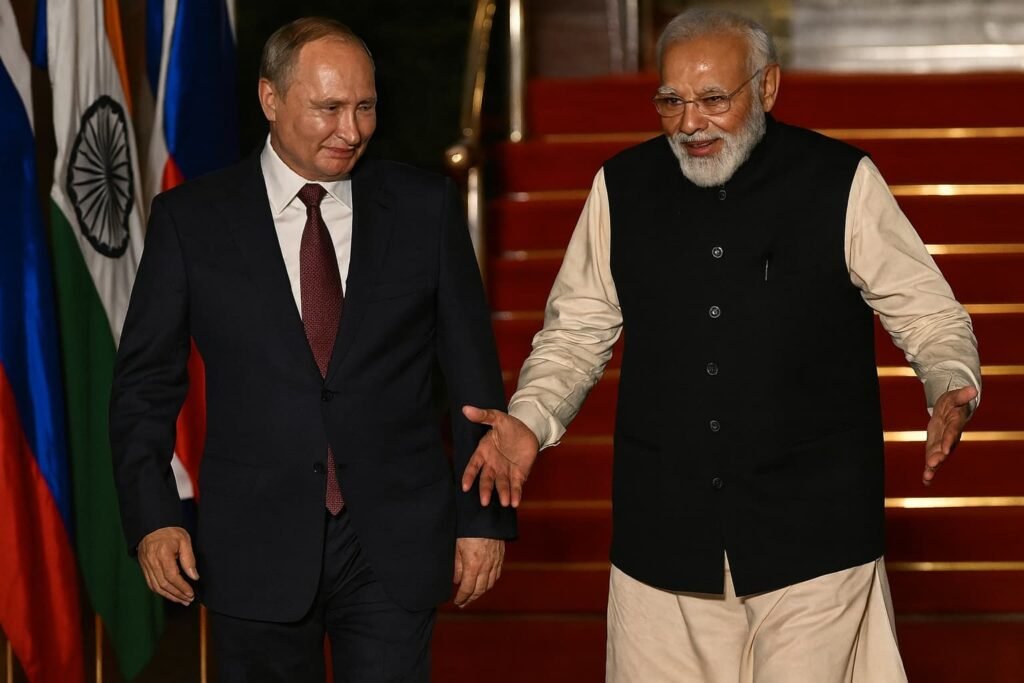
When Russian President Vladimir Putin stepped onto the tarmac in New Delhi on Thursday, he was greeted not with protocol-heavy restraint, but with a warm embrace from India’s Prime Minister Narendra Modi. The optics were unmistakable. At a moment when Moscow remains isolated by much of the West over its war in Ukraine, the display signaled that Russia is far from diplomatically alone — and that India intends to preserve its long-standing strategic autonomy.
After briefly observing a traditional dance performance, Modi and Putin departed together in the same vehicle for a private dinner at the prime minister’s residence. Streets across the Indian capital were lined with Indian and Russian flags, enormous billboards welcomed the Russian leader, and at one point Putin’s aircraft became the most-tracked flight on FlightRadar.
But behind the pageantry lies a far more complex geopolitical calculation. Modi is simultaneously deepening ties with Moscow while seeking to protect — and potentially expand — India’s critical partnership with the United States, Russia’s chief global rival.
This dual engagement defines India’s current foreign policy posture: hedging, balancing, and maximizing leverage amid intensifying global polarization.
A Split-Screen Strategy
India’s diplomatic challenge is stark. On one side is Russia — a historic partner offering discounted oil, advanced military hardware, and political continuity dating back to the Cold War. On the other is the United States — a vital source of technology transfer, investment, intelligence cooperation, and a potential escape route from punishing tariffs imposed by President Donald Trump’s administration.
Since Russia’s full-scale invasion of Ukraine in 2022, New Delhi has increasingly leveraged its status as both a massive consumer market and a key Indo-Pacific power. That leverage has allowed India to maintain ties with Moscow while avoiding direct confrontation with Washington.
Yet the timing of Putin’s visit could hardly be more sensitive.
India is currently negotiating a crucial trade agreement with the US after Washington imposed 50% tariffs, partly as retaliation for New Delhi’s continued purchases of Russian oil. In response, India has made visible gestures to placate the White House — reducing Russian crude imports and agreeing to purchase 2.2 million metric tons of liquefied petroleum gas from the US.
Despite those efforts, defense cooperation with Russia sits prominently on this week’s agenda.
Security Needs Drive Russia Ties
India views Russian military equipment as essential to its national defense, particularly amid unresolved border tensions with China and Pakistan. Moscow remains New Delhi’s top military supplier, even as procurement volumes have declined in recent years, according to the Stockholm International Peace Research Institute.
Russia’s Su-30 fighter jets constitute the backbone of India’s air force, accounting for the majority of its 29 combat squadrons. Kremlin officials confirmed this week that talks may include a potential deal for Russia’s most advanced stealth aircraft, the Su-57.
This creates a delicate paradox: Russia is now a close partner of China — India’s principal strategic rival — while Beijing is also Pakistan’s leading arms supplier. Still, maintaining Moscow as a defense partner provides India with an important strategic buffer.
Rolling out the red carpet for Putin sends a message to both Washington and Beijing, analysts say.
“It’s diplomatic hedging,” said Kanti Bajpai, visiting professor of international relations at Ashoka University. “It shows Delhi has options and that it’s prepared to stick with Russia despite international pressure.”
Oil, Sanctions, and Economic Pressure
India’s economic relationship with Russia has grown even as Western sanctions tightened. When Russian oil prices collapsed in 2022, India dramatically increased imports, becoming one of Moscow’s largest buyers.
New Delhi has consistently argued that its foremost responsibility is to its own economy and population of more than 1.4 billion people.
That stance strained relations with Washington. In August, Trump imposed steep tariffs on Indian goods, followed by new sanctions in October on two major Russian oil companies — moves that immediately disrupted India’s refining sector. Trade sources told Reuters that December oil imports could sink to their lowest levels in at least three years.
Ahead of his arrival, Putin questioned the logic behind penalizing India.
“The United States itself still buys nuclear fuel from us,” Putin said in an interview aired Thursday. “If the US has the right to buy from Russia, why shouldn’t India?”
India’s Global Balancing Act
The pressure from Washington has also nudged New Delhi toward cautious re-engagement with Beijing. Shortly after tariffs took effect, Modi attended a summit hosted by Chinese President Xi Jinping — his first visit to China in seven years — designed to present Beijing as a counterweight to Western dominance.
That summit was also the last time Modi and Putin met, underscoring how India’s diplomacy is increasingly defined by strategic multi-alignment rather than fixed alliances.
Still, ties with the US are far from breaking.
India and the United States recently approved a new 10-year framework for technology, intelligence, and industrial cooperation. A US trade delegation is expected in New Delhi next week, and Indian officials maintain that a comprehensive trade deal could be finalized before year’s end.
“There is no contradiction,” said Nandan Unnikrishnan of the Observer Research Foundation, “in having an ambitious trade deal with the US and a working relationship with Russia.”
A Calculated Embrace
For Modi, the embrace of Putin was not merely symbolic — it was strategic. It conveyed resilience, autonomy, and bargaining power. But it also places India under close scrutiny from Washington, particularly as defense contracts move forward.
“India will have to be careful,” Unnikrishnan warned. “You don’t want to add new irritants during an already difficult phase.”
For now, New Delhi appears confident it can walk the tightrope — maintaining friendships across rival power blocs without falling into open confrontation.