
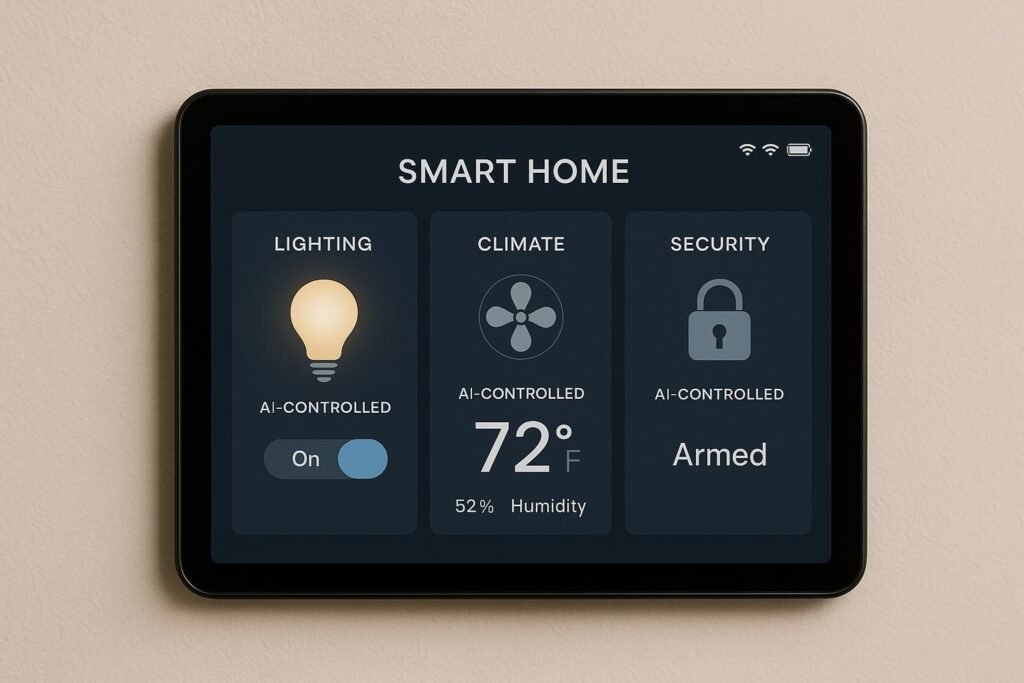
By Harshit, December 6, 2025 —
The U.S. is entering a new era of technology-driven living.
The “Connected Life” — powered by smart home ecosystems, digital health devices, artificial intelligence (AI), and next-generation networks — is no longer an emerging trend. It has become the foundation of modern American life, reshaping comfort, health, safety, and national connectivity.
Below is a detailed, factual breakdown of how this transformation is unfolding across three main pillars: smart homes, digital health, and the connectivity infrastructure that ties it all together.
I. Smart Home Security and Energy Efficiency: The New Standard for American Living
The U.S. smart home market reached $27.8 billion in 2024 and continues to climb at 11.5% CAGR through 2032. What was once a scattered landscape of incompatible devices is now becoming a unified, intelligent ecosystem focused on security and energy savings.
A. Matter Protocol: The End of Device Fragmentation
By late 2025, the Matter protocol — backed by Apple, Google, Amazon, and Samsung — has successfully delivered universal device compatibility.
Key Outcomes
- A Google Nest thermostat, Apple HomeKit bulb, and Amazon Ring camera can now communicate seamlessly.
- Consumers no longer fear “buying the wrong device.”
- Professional home integrators now prefer Matter-certified systems, dramatically accelerating adoption.
Matter has eliminated the walled-garden era, finally giving the smart home a stable, reliable backbone.
B. AI-Powered Predictive Automation: Homes That Think for You
The smart home has evolved past simple scheduling. AI systems now learn behavior patterns and adjust automatically.
How AI Changes Daily Life
- Knows when you typically arrive home → adjusts temperature in advance.
- Learns preferred lighting and energy habits.
- Integrates with weather data to optimize HVAC and reduce bills.
Energy ROI
AI-driven load balancing — especially in states with time-of-use electricity pricing — can reduce annual energy costs enough to offset the cost of smart home devices.
Security Improvements
AI-based cameras now:
- Recognize familiar vs. unknown faces.
- Detect unusual behavior or vehicles.
- Reduce false alarms through pattern-based alerts.
Security remains the largest segment, making up 30% of the smart home market.
C. Energy Management & Grid Integration: Beyond the Smart Thermostat
American homes are evolving into mini energy ecosystems.
Key Technologies
- Smart electrical panels
- Solar + home battery systems
- Automated EV charging hubs
- Motorized shades for thermal efficiency
Motorized, AI-driven window shades alone can reduce home energy consumption by up to 30% by regulating solar heat gain.
Builders are now targeting certifications like HERS as energy efficiency becomes a top priority for new U.S. homes.
II. Digital Health & Wearables: From Wellness Tracking to Clinical-Grade Monitoring
Digital health has shifted from “fitness tracking” to preventative medical monitoring, supported by AI and Remote Patient Monitoring (RPM).
A. Next-Generation Wearables and Digital Biomarkers
Today’s wearables produce continuous medical-grade data.
Breakthrough Capabilities
- AI-enhanced cardiac monitoring
- Non-invasive or minimally invasive continuous glucose monitoring
- Smart fabrics and insoles that track balance, gait, and recovery
- Fall and cardiac event detection with automatic emergency response
These devices generate digital biomarkers, objective physiological measurements increasingly accepted in clinical settings.
B. Remote Patient Monitoring (RPM): Continuous Care at Home
Healthcare providers are rapidly adopting RPM to prevent costly hospital readmissions and manage chronic diseases like diabetes and hypertension.
Clinical Benefits
- Real-time monitoring supports early intervention.
- Continuous data encourages individualized care plans.
- Providers can track patient outcomes remotely, reducing strain on hospitals.
Regulatory Maturity
As of mid-2025, the FDA has cleared over 1,250 AI/ML medical algorithms — a major milestone validating the clinical readiness of AI.
Digital Therapeutics (DTx)
Software-based treatments delivered via connected devices are gaining insurer support, expanding their clinical legitimacy.
III. Connectivity & Infrastructure: The Backbone of the Connected Life
None of these advancements work without strong, ubiquitous connectivity. The U.S. is now undergoing a dual transformation: expanding 5G and preparing for 6G, while satellite networks close rural gaps.
A. 5G Expansion & Early Foundations of 6G
5G Today
5G Advanced is now the backbone for:
- Massive IoT deployments
- Real-time industrial automation
- High-speed telemedicine
- Connected vehicles
Edge Computing Synergy
By processing data near the device instead of the cloud, edge AI reduces latency to milliseconds, essential for safety-critical IoT.
6G on the Horizon
Commercial service is expected around 2030, with early research focusing on:
- Integrated sensing + communications
- True global seamless coverage
- Mid-band spectrum improvements for reliability
B. Satellite Internet: Closing the U.S. Digital Divide
The Rural Solution
Low-Earth Orbit (LEO) satellite constellations, especially Starlink, have become crucial for:
- Remote homes
- Agriculture
- Tribal communities
- Mobile operations (fleet trucks, aviation, maritime)
NTN (Non-Terrestrial Network): The Next Step
Future networks will allow devices to switch automatically between cell towers and satellites, achieving nationwide coverage regardless of geography.
Conclusion: Intelligence, Interoperability & Access — The New American Baseline
As of late 2025, the Connected Life has evolved into a unified ecosystem defined by:
1️⃣ Intelligent automation — homes and devices that learn.
2️⃣ Universal compatibility — thanks to Matter and open standards.
3️⃣ Nationwide accessibility — powered by 5G, edge AI, and LEO satellites.
4️⃣ Proactive health monitoring — shifting care from hospitals to homes.
These technologies now shape essential American expectations for safety, savings, health, and reliable connectivity.
The Connected Life isn’t just a trend — it’s the new infrastructure of everyday living.