
By Harshit, LOS ANGELES
As the United States—and the world—moves deeper into advanced digital transformation, cybersecurity has shifted from a reactive IT function to a foundational pillar of national resilience, business continuity, and public trust. The rise of Artificial Intelligence (AI), edge computing, cloud-native infrastructures, quantum threat models, and massive cross-border data flows has created a landscape in which data integrity, authenticity, and privacy are now as strategically important as economic stability or physical infrastructure.
In 2025, cybersecurity is no longer a “technology problem.”
It is a systems problem, a governance problem, and increasingly, a trust problem.
Three interconnected forces define this long-term, evergreen tech trend:
- AI-driven cyber defense, built to match the scale and speed of AI-enabled attacks.
- Zero Trust Architecture, now a federal mandate and an enterprise standard.
- Privacy-Enhancing Technologies (PETs), enabling data sharing and analytics without compromising confidentiality.
These forces, taken together, represent the permanent future of cybersecurity: an environment where organizations assume compromise, defend continuously, and operate in a landscape of persistent global threats.
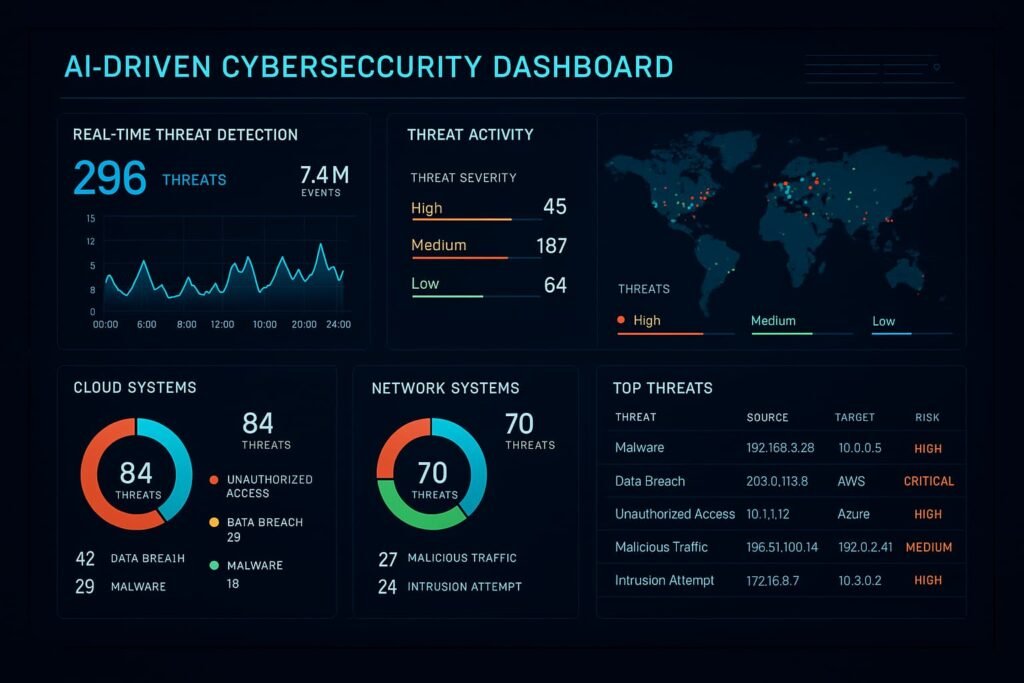
I. AI-Driven Cyber Defense: Autonomous Security in an Era of AI-Powered Attacks
By 2025, cyberattacks have become fully automated, adaptive, and AI-assisted. Threat actors—from state-sponsored espionage units to organized cybercrime groups—are using generative AI to:
- write malware,
- generate polymorphic code that mutates on every execution,
- impersonate executives with real-time deepfake voice and video,
- and exploit vulnerabilities at machine speed.
In response, cybersecurity strategy has undergone its most dramatic shift in decades:
humans are no longer the first line of defense—AI is.
✔ Machine Learning for Threat Detection
Modern security operations centers (SOCs) rely on machine learning models trained on billions of telemetry signals from endpoints, cloud systems, network logs, and identity activity. These systems autonomously identify irregular patterns such as:
- unusual lateral movement,
- abnormal data exfiltration,
- anomalous login behavior,
- or privilege escalation inconsistent with a user’s history.
What used to require hours of manual investigation can now be surfaced in seconds.
✔ Autonomous Incident Response
Next-generation AI systems—sometimes called SOAR 2.0 (Security Orchestration, Automation, and Response)—execute mitigation actions without waiting for human approval:
- isolating compromised endpoints
- rolling back system states
- detecting and killing malicious processes
- deploying patches
- rebuilding affected containers or cloud workloads
These automated responses are modeled after the NIST SP 800-61 Incident Response Lifecycle but operate orders of magnitude faster.
✔ AI Against AI: Battling Synthetic Threats
A major challenge in 2025 is the proliferation of AI-generated attacks, including:
- synthetic phishing emails indistinguishable from human writing
- deepfake-based social engineering
- LLM-driven reconnaissance
- autonomous vulnerability hunting tools
To counter this, cybersecurity vendors have built adversarial AI models that detect the subtle statistical fingerprints left behind by AI-generated content.
✔ Continuous Backup & Cyber Resilience
With ransomware attacks occurring every 11 seconds in the U.S. (2025 estimates), continuous data protection has become mandatory. AI systems now:
- create near-real-time encrypted backups
- monitor backup integrity to ensure data hasn’t been tampered with
- support ultra-fast restoration in minutes rather than hours
This transforms cybersecurity from mere “defense” into resilience engineering.
II. Zero Trust Architecture: The New Security Operating System of the U.S.
Zero Trust is not a product.
It is not a firewall.
It is not a platform.
Zero Trust is a security philosophy—and as of 2024–2025, a federal mandate.
The U.S. government’s Zero Trust strategy, driven by OMB Memorandum M-22-09 and reinforced in 2024–2025 updates, requires all federal agencies to abandon perimeter security and adopt a model where no user, device, application, or network segment is trusted by default.
Enterprises have now followed suit.
✔ The Five Core Pillars of Zero Trust (CISA ZT Model)
- Identity – Every request is authenticated and verified continuously.
- Device – Devices must meet strict health and compliance checks.
- Network/Environment – Micro-segmented networks restrict movement.
- Application Workloads – Applications authenticate to each other via secure tokens.
- Data – Data is encrypted and tagged for access control and monitoring.
✔ Continuous Verification Through Multi-Factor Authentication
In Zero Trust systems, verification never stops.
A device authenticated at 9 AM must be revalidated at 9:01 AM if risk conditions change.
Modern systems use:
- biometric MFA,
- adaptive risk scoring,
- behavioral analytics (typing cadence, user habits),
- geolocation intelligence.
✔ Micro-Segmentation: Stopping Lateral Movement
Attackers cannot move laterally if every server, database, and workload is isolated behind its own micro-perimeter.
This is largely achieved using:
- software-defined perimeters (SDP),
- identity-aware proxies,
- east-west firewalls inside cloud networks.
✔ Federal Leadership Drives Private Adoption
Executive Orders, CISA frameworks, and NIST 800-207 guidelines have forced rapid industry adoption.
By 2025:
- 92% of U.S. enterprises are actively implementing Zero Trust controls
- 70% have micro-segmentation in production
- 100% of federal agencies are required to support phishing-resistant MFA
The Zero Trust model is no longer emerging—it is the default for national cyber resilience.
III. Privacy-Enhancing Technologies (PETs): Securing Data While Keeping It Usable
In 2025, one of the most challenging cybersecurity debates concerns the balance between data privacy, data utility, and regulatory compliance.
Privacy-Enhancing Technologies (PETs) solve this by enabling organizations to compute on data without accessing the raw data itself.
These technologies are foundational for healthcare, finance, government, and cross-border data flows.
✔ 1. Homomorphic Encryption
Homomorphic Encryption (HE) allows computation on encrypted data.
A bank or hospital can run machine learning algorithms without ever decrypting sensitive information.
This prevents:
- insider threats,
- cloud exposure risks,
- data exfiltration attacks.
By late 2025, HE has become more efficient thanks to hardware acceleration from Intel, AMD, and specialized encryption chips.
✔ 2. Federated Learning
Federated Learning (FL) trains machine learning models without centralizing the data.
Data remains stored at:
- hospitals,
- mobile devices,
- financial institutions,
- regional cloud zones.
Only the model updates are shared, not the actual data.
This is crucial for:
- HIPAA-regulated medical research
- multi-state insurance risk modeling
- cross-border finance where data sovereignty laws apply
✔ 3. Differential Privacy
Differential Privacy mathematically injects “noise” into datasets to protect individual identities while preserving statistical accuracy.
It is widely used in:
- U.S. Census Bureau operations
- large tech platforms
- healthcare research
- government analytics
By 2025, DP has become the standard for publishing aggregate insights without exposing individuals.
✔ Why PETs Are Essential
PETs solve compliance challenges associated with:
- GDPR
- HIPAA
- California Consumer Privacy Act (CCPA)
- new 2024–2025 state-level data protection laws (Texas, Washington, Florida, Virginia)
They enable organizations to extract value from data while preserving civil rights and regulatory trust.
IV. The Permanent Future of Cybersecurity: A System of Continuous Trust
Cybersecurity in 2025 is fundamentally shaped by three realities:
Reality 1: Attacks Will Always Outpace Defenses
AI-enabled attackers operate 24/7, at machine speed, and at scale.
Defensive systems must be continuous, autonomous, and adaptive.
Reality 2: Trust Is the New Security Perimeter
Identity, context, and device health—not network location—determine what access is allowed.
Reality 3: Privacy Is Now a Competitive Advantage
Consumers and regulators demand systems that protect sensitive data even during use.
PETs aren’t simply technical innovations—they are business necessities.
Conclusion: Cybersecurity + Data Trust = National Resilience
Cybersecurity has evolved from firewalls and antivirus software to a complex, AI-driven ecosystem that underpins every facet of modern society.
In a world defined by real-time data flows, autonomous systems, and global connectivity, trust becomes just as important as protection.
AI-driven threat detection, Zero Trust architecture, and privacy-enhancing technologies form the triad of modern digital defense. They ensure that organizations can both harness the full potential of data and protect the civil, economic, and national-security interests of the United States.
Cybersecurity is not merely an IT function anymore.
It is the lifeblood of digital society, the foundation of public trust, and the core infrastructure of the 21st century.