
By Harshit
WASHINGTON, NOVEMBER 30 —
The United States escalated its confrontation with Venezuela on Saturday as President Donald Trump issued an extraordinary public warning to airlines, pilots, and criminal networks, urging them to avoid Venezuelan airspace entirely. The directive, posted on Truth Social, comes as the administration intensifies efforts that officials say are aimed at curbing drug trafficking and illegal migration — but which critics and analysts see as a de-facto push for regime change in Caracas.
“Please consider the airspace above and surrounding Venezuela to be closed in its entirety,” Trump wrote, a message without legal force but one that signals a dramatic widening of the administration’s posture toward President Nicolás Maduro.
Venezuela swiftly condemned the statement. Foreign Minister Yván Gil denounced it as a “colonialist threat,” calling Trump’s order “an extravagant, illegal, and unjustified aggression against the people of Venezuela.”
The United States has no authority to close another country’s airspace, and commercial flights between the two nations have been suspended since 2019. But the FAA last week issued its own advisory, warning of a “potentially hazardous situation” over Venezuelan territory. Some US airlines still overfly Venezuela en route to deeper parts of South America, meaning Trump’s message is likely intended to serve as a political warning rather than a regulatory one.
CIA Operations, Terrorist Designation, and Talk of Land Strikes
The airspace warning is only the most recent step in a fast-moving sequence of actions. In recent weeks, Trump publicly acknowledged authorizing the CIA to conduct operations inside Venezuela, a revelation that stunned some lawmakers and fueled accusations of covert destabilization.
Earlier this week, the administration formally designated Maduro and senior Venezuelan officials as part of a foreign terrorist organization. While legal experts emphasize that this designation does not grant authority for military action, several Trump aides — notably Secretary of State Marco Rubio — have privately discussed whether the label could help justify strikes inside Venezuela.
The president himself appeared to hint at imminent action.
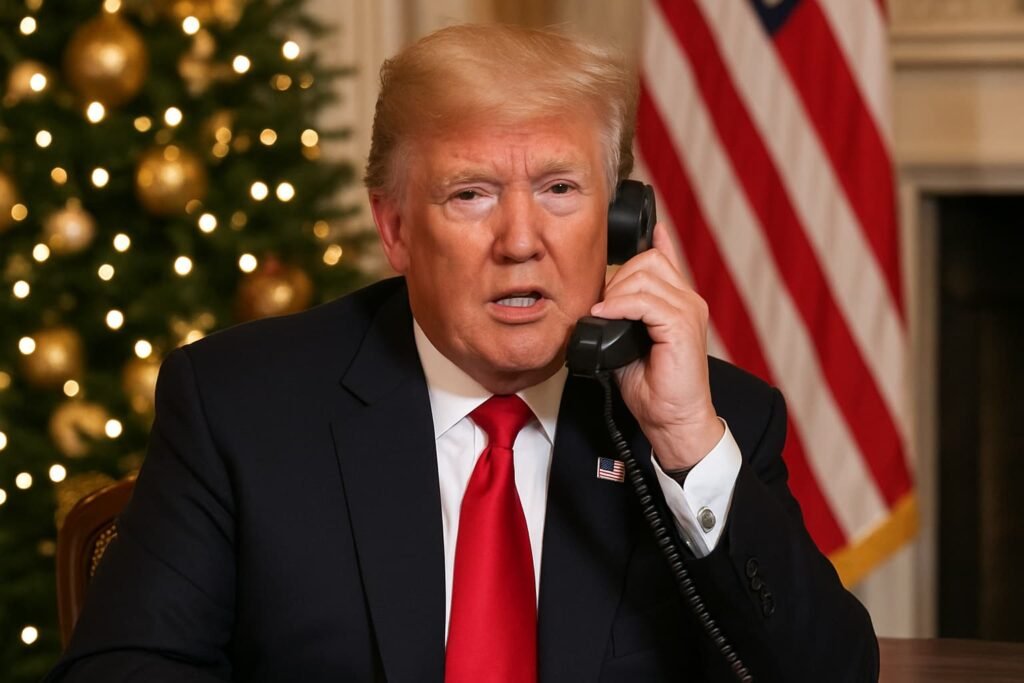
“You probably noticed that people aren’t wanting to be delivering by sea anymore,” Trump told service members during a Thanksgiving call. “We’ll be starting to stop them by land also. The land is easier, but that’s going to start very soon.”
Republican Sen. Lindsey Graham praised the remarks, calling Venezuela “a drug caliphate country” and urging swift action.
A Massive US Military Presence Offshore
The Pentagon continues its large-scale deployment under Operation Southern Spear, one of the most expansive military mobilizations in the region in decades. More than 15,000 troops and over a dozen US Navy warships, including advanced destroyers and surveillance aircraft, have been stationed across the Caribbean and near Venezuelan maritime routes.
Dozens have been killed in maritime strikes targeting vessels the US claims were part of narcotics trafficking networks. No narcotics have been publicly presented as evidence from the downed boats.
Maduro, meanwhile, has sought to project control.
“We are a republic in arms!” he declared Thursday in a televised address, urging troops to remain “unshakeable” and ready to defend the nation’s sovereignty.
Diplomacy in Flux: From Silence to Secret Calls
Despite rising military tensions, communication channels between Washington and Caracas have quietly reopened.
Trump cut off all diplomatic dialogue with Venezuela in October. Yet multiple administration officials tell CNN that Maduro and his associates have recently reached out to the White House through various intermediaries. Trump and Maduro even spoke by phone last week, according to the New York Times and Wall Street Journal, marking the first confirmed direct contact in months.
During earlier informal discussions, Maduro reportedly floated the possibility of stepping down — but not for at least 18 months, a timeline US officials rejected. The White House has stated it supports only an immediate transfer of power.
Still, Trump framed his willingness to speak with Maduro as a humanitarian calculation.
“If he’s the leader, if we can save lives doing things the easy way, that’s fine,” Trump told reporters. “If we have to do it the hard way, that’s fine, too.”
Fear and Uncertainty Inside Venezuela
As geopolitical pressure mounts, everyday Venezuelans remain caught between anxiety and exhaustion. In Caracas, residents told CNN they are unsure how close the country is to direct conflict.
“Will they bomb? Will they not bomb? Who knows,” said Marilyn, a waitress who did not want to give her last name out of fear of government reprisal. “Nobody knows anything.”
Government repression remains constant. In October alone, at least 54 people were detained for sharing anti-Maduro messages, according to local rights group PROVEA.
Publicly, however, life carries on. Christmas music plays in shopping streets, Black Friday sales continue, and Maduro appears on television almost daily insisting the country is “invincible.”
But behind closed doors, Venezuelans acknowledge rising apprehension.
“You don’t talk about the possibility of US strikes in public,” one resident said. “You whisper it.”