
By Harshit
HONG KONG, NOVEMBER 28, 2025

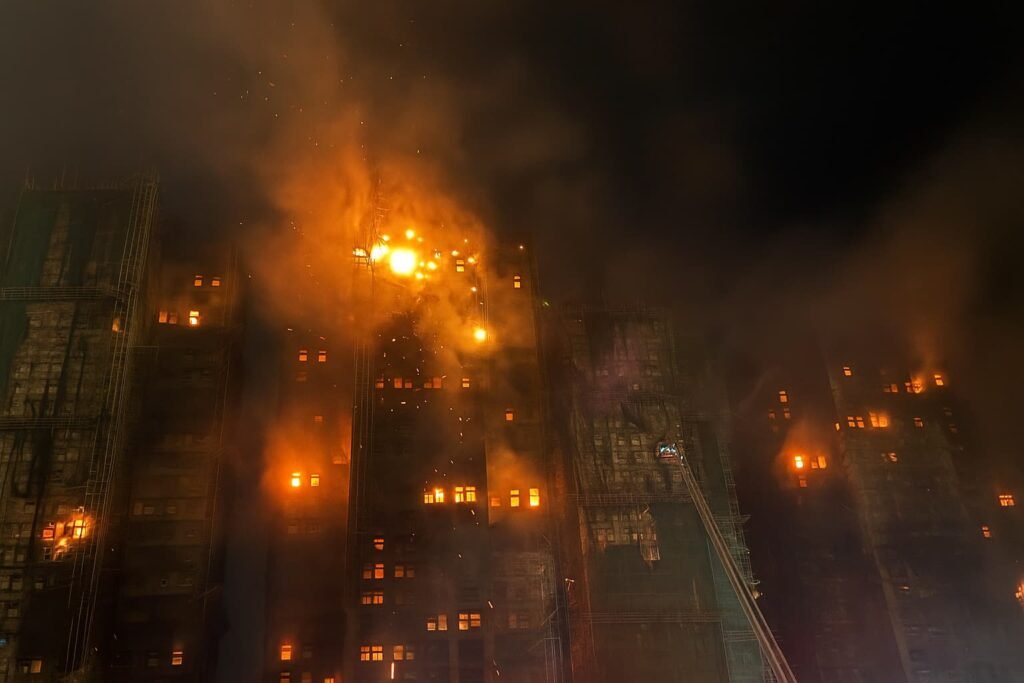
Hong Kong is reeling from its deadliest fire in modern history after officials confirmed Friday that at least 128 people have been killed and as many as 200 remain missing following a catastrophic blaze that tore through multiple high-rise towers at the Wang Fuk Court public housing estate. Firefighters finally declared the inferno “under control” 42 hours after it ignited, but rescue teams warn the toll could still rise sharply as they comb through burnt-out floors and collapsed scaffolding.
The level of destruction has shocked a city known for rigorous building codes and one of the highest fire-safety standards in Asia. The sprawling residential complex, home to more than 4,000 people—many of them elderly—was undergoing large-scale renovations when the blaze erupted, wrapping all eight towers in bamboo scaffolding and green protective mesh that became a deadly conduit for flames.
Speaking at a packed press conference Friday, Hong Kong Secretary for Security Chris Tang said 79 people were injured, several critically, and stressed that conditions inside the buildings were “extreme,” with temperatures exceeding 500°C (930°F) during the height of the blaze. “This is a profound tragedy,” he said. “There are still about 200 residents whose situation remains unknown.”
A Fire That Leapt From One Tower to Several in Minutes
Authorities believe the initial fire began on the lower levels of Wang Cheong House (Block 6) before racing upward and into surrounding towers in a chain reaction almost unprecedented in Hong Kong’s urban landscape. Investigators say bamboo scaffolding, netting, and flammable polystyrene boards used to block windows during renovation created a lethal pathway.
“The mesh nets ignited and quickly spread the fire to polystyrene boards around the windows,” Tang said. “The high temperature caused windows to shatter, allowing the fire to spread indoors. As the scaffolding collapsed, it carried burning debris to other floors.”
The rapid upward progression mirrored the infamous Grenfell Tower fire in London, with exterior materials serving as the primary vector. At Wang Fuk Court, firefighters reported entire exterior walls engulfed before alarms had sounded—alarms that, officials now say, were “not functional” in all eight buildings.
Residents previously told CNN that the fire alarm in their building “never went off.”
Inside the Inferno: Conditions Too Severe for Rescue Teams
The fire’s intensity made interior rescue efforts extremely dangerous. With temperatures surpassing 500°C, firefighters were repeatedly forced to retreat, allowing flames to re-establish themselves even after appearing to be extinguished.
“We encountered multiple reignitions of units that had already been put out,” Director of Fire Services Andy Yeung said.


Many hallways collapsed or were blocked by fallen bamboo poles. Smoke visibility was near zero on several floors. Some units were sealed tightly due to renovation works, slowing ventilation and creating deadly heat pockets.
Rescuers described melted door frames, collapsed ceilings, and stairwells so hot they burned through protective gear.
A Community of Elderly Residents Hit the Hardest
Wang Fuk Court has an unusually high concentration of elderly tenants. Government data shows:
- 36% of residents were aged 65 or older
- Median age of residents: 56
- More than 4,600 residents living across eight towers
- Many lived alone and had mobility issues
Elderly residents were especially vulnerable to smoke inhalation and delayed evacuation.
“This building has always been full of old people,” said 68-year-old Mrs. Dang, who watched her home burn. “There were neighbors who could not walk fast, neighbors who lived alone. I don’t know how many escaped.”
200 Still Missing: Families Waiting in Agony
At emergency shelters set up in schools and community centers, desperate families waited for updates on loved ones. Three nights after the blaze started, hundreds remain displaced, clutching donated blankets and clothing as temperatures dipped.
One man searching for his mother described the atmosphere as “a nightmare without answers.”
Some residents said they had run from their buildings in seconds, leaving behind IDs, phones, pets, and medications. Others returned to find nothing but blackened ruin. “All I have are the clothes on me,” said one displaced resident.
Fire Alarms “Not Functional” Across All Eight Buildings
One of the most troubling findings emerged Friday: fire alarms in all eight towers were discovered to be non-functional during post-fire inspections.
Director of Fire Services Andy Yeung said it was unclear whether the alarms had been operational at the moment the fire broke out.
Residents told CNN the building alarm “did not ring,” leaving many unaware of the danger until smoke poured into their units or neighbors began banging on doors.
This revelation has sparked outrage across Hong Kong, with lawmakers demanding accountability from the Housing Authority and renovation contractors.
Renovation Under Scrutiny: Scaffolding, Polystyrene, and Corruption Probe
All eight towers were tightly wrapped in bamboo scaffolding and green mesh—a common practice in Hong Kong’s construction industry. But police and inspectors discovered flammable polystyrene boards bearing the construction company’s name blocking window structures at the time of the fire.
Authorities have already arrested three men connected to the company on suspicion of manslaughter, accusing them of gross negligence.
Parallel investigations include:
- A police criminal probe into fire spread
- An ICAC corruption investigation into the renovation project
- A government review of bamboo scaffolding across the entire city
- Building materials compliance checks
Police say the cause of the initial spark remains unknown, and a full investigation is expected to take three to four weeks.
Firefighter Efforts and Reignition Dangers
Even after bringing the fire “under control,” firefighters continued battling regenerating flames where combustible materials had embedded behind walls and in sealed units.
“At times, the fire burned inside walls we couldn’t access,” one firefighter said.
The entire operation lasted 42 hours, one of the longest continuous firefighting efforts in recent Hong Kong history.
Citywide Mourning and Government Response
Hong Kong’s government has announced:
- HK$10,000 (US$1,200) to each affected household
- A HK$300 million (US$38.5 million) relief fund
- Cancellation of all official celebratory events
- Nine emergency shelters housing 500 displaced residents
- Deployment of 250 doctors and 250 medical personnel to care for survivors
Chief Executive John Lee said the tragedy brought “collective pain” to Hong Kong and vowed a full investigation.
Residents and activists, however, are calling for deeper systemic changes, including stricter regulation of external cladding and scaffolding.
Hong Kong’s Worst Fire in Decades
With 128 confirmed dead and possibly hundreds more missing, the Wang Fuk Court blaze is now one of the worst high-rise fires in the city’s history and among the deadliest peacetime disasters in modern Hong Kong.
The tragedy has raised profound questions:
- Why were alarms not working?
- Why were flammable boards used during renovation?
- Why was bamboo scaffolding approved on aging residential towers?
- Could residents have been evacuated earlier?
As search teams continue to work floor by floor, Hong Kong faces a long road ahead — both in recovering from the loss and in rebuilding the trust of thousands whose homes, families, and futures now lie in ashes.