
By Harshit
PERTH, AUSTRALIA | November 28, 2025
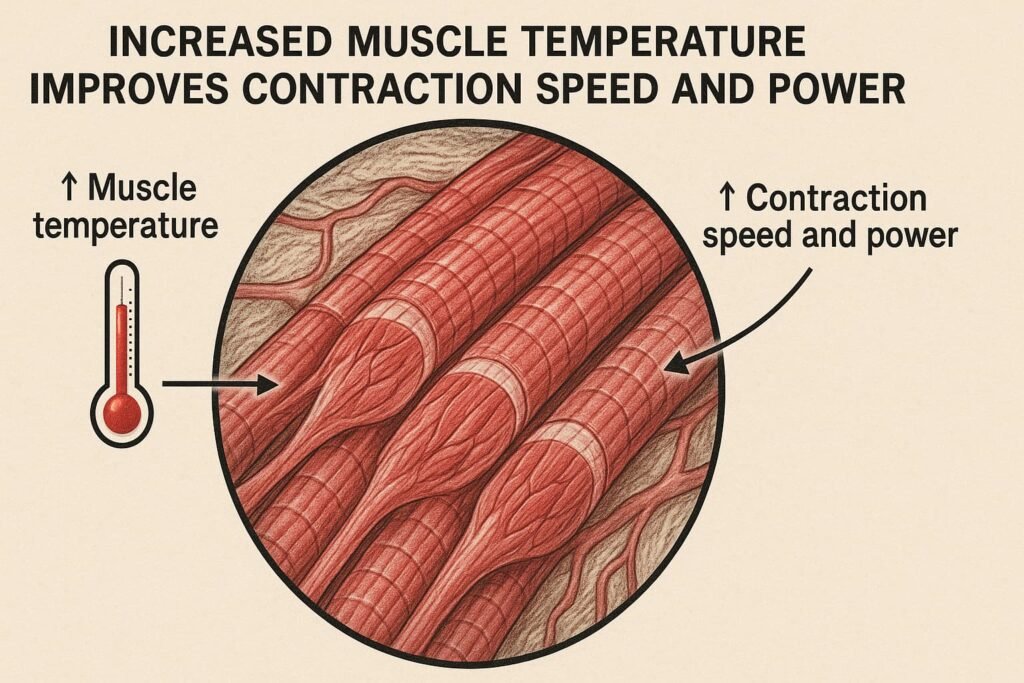
Warming up before exercise has long been considered best practice, but new research from Edith Cowan University (ECU) offers one of the clearest explanations yet for why it works. The study found that increasing muscle temperature — whether through movement or external heat — can significantly improve the speed and power of muscular contractions. The findings suggest that the right warm-up may meaningfully enhance performance in activities ranging from sprinting and jumping to weightlifting and competitive sports.
The research, led by Dr. Cody Wilson and published this week, shows that for every 1°C rise in muscle temperature, performance improves by approximately 3.5%. The effect was most pronounced in explosive, rate-dependent movements requiring rapid force, rather than in slow, maximal strength tasks.
Temperature, Speed, and Power: What the Researchers Found
According to the team at ECU’s School of Medical and Health Sciences, warmer muscles contract faster and more forcefully due to improved nerve conduction speed, enhanced enzyme activity, and increased elasticity within muscle fibers.
“The greatest benefits were seen in actions that require quick, powerful contractions — things like jumping, sprinting, or fast lifts,” Dr. Wilson explained. “These performance traits respond strongly to temperature increases, whereas maximum strength does not improve to the same degree.”
The research reviewed existing experimental studies and confirmed a consistent pattern: athletes perform better when their muscles are warm.
Active vs. Passive Warm-Ups: Surprisingly Similar Effects
The study also compared two categories of warm-ups:
Active Warm-Ups
These involve physical movement — cycling lightly, jogging, or performing easier sets of the exercise to come.
Passive Warm-Ups
These rely on external heat sources such as hot showers, heating pads, or warm clothing to raise temperature without movement.
Researchers expected active warm-ups to far outperform passive ones. Instead, the difference was minimal.
However, the team emphasized that many active warm-up routines used in previous studies were not specific enough to the exercises that followed, which may have narrowed the performance gap.
Why Exercise-Specific Warm-Ups Work Best
Lead author Dr. Wilson and co-author JP Nunes both stressed that warm-ups closely resembling the primary workout provide the greatest advantage.
“If you’re about to lift weights, warming up by lifting lighter weights is more effective than simply doing light cardio,” Nunes said. “Practicing the movement improves muscle activation and coordination — your nervous system learns the pattern in real time.”
This aligns with long-standing coaching principles: technique rehearsal sharpens neuromuscular efficiency and primes athletes for peak performance.
How to Know When You’re Warm Enough
Professor Tony Blazevich, a biomechanics expert at ECU, noted that the point at which a warm-up becomes effective is different for everyone.
“As you warm up, movements feel easier, coordination improves, and you may start to sweat,” he said. “That light sweat is often a good sign that your muscle temperature has risen enough.”
He stressed that what matters most is simply getting started — whether by walking, climbing stairs, or participating in light activity that gradually increases intensity.
Implications for Training and Athletic Performance
The study reinforces a practical takeaway for athletes, coaches, and even casual exercisers:
warming up is not optional if peak performance is the goal.
Key implications include:
- Explosive movements benefit most from elevated muscle temperature.
- Warm-ups should resemble the main exercise whenever possible.
- Passive heating can be useful when active movement is limited (e.g., injury recovery, halftime breaks).
- Warm-up duration matters less than quality — the goal is elevated muscle temperature, not prolonged exertion.
The researchers suggest future studies explore individualized warming strategies and the role of temperature in endurance-based performance.