
By Harshit
JENIN / TULKAREM, West Bank — 21 November 2025
Human Rights Watch (HRW) has alleged that the forced removal of tens of thousands of Palestinians from refugee camps in the occupied West Bank in early 2025 amounts to war crimes and crimes against humanity. The organisation’s 105-page report claims that approximately 32,000 Palestinians were expelled from three major refugee camps — Jenin refugee camp, Tulkarem refugee camp and Nur Shams refugee camp — during January and February, and have not been permitted to return.
Human Rights Watch’s findings
HRW said it interviewed 31 displaced Palestinians from the three camps; analysed satellite imagery and Israeli military demolition orders; and verified video and photo evidence of the operations. The group found that more than 850 homes and other buildings were either destroyed or heavily damaged across the camps.
One senior researcher at HRW, Nadia Hardman, said: “Israeli authorities in early 2025 forcibly removed 32,000 Palestinians from their homes in West Bank refugee camps without regard to international legal protections and have not permitted them to return.”
The report asserts that the removals constitute forced displacement, a violation of the Fourth Geneva Convention, when carried out without imperative military reasons, and may amount to crimes against humanity of persecution, forcible transfer, or ethnic cleansing.
The Israeli military’s response
Israel Defense Forces (IDF) confirmed it launched an operation named Operation Iron Wall in the three camps ten months ago, citing “security threats posed by these camps and the growing presence of terrorist elements within them.”
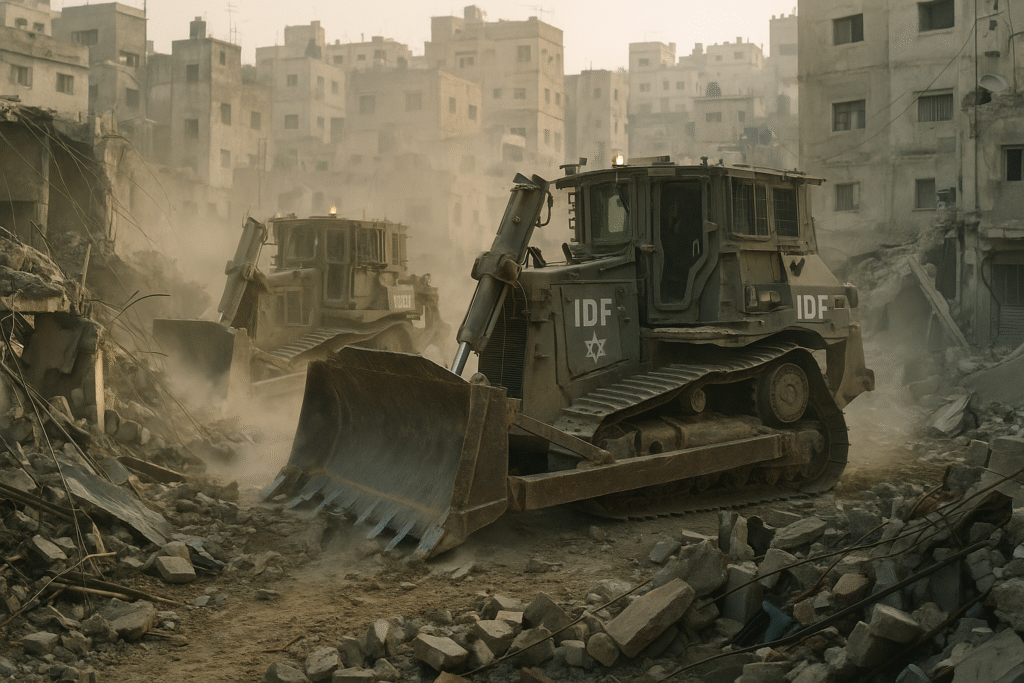
In its statement, the IDF said it destroyed “rows of buildings” to create “new access routes inside the camps.” The military maintained that the demolition decisions were taken “based on operational necessity, with careful consideration and only after alternative options were examined.” It further stated the demolitions were conducted lawfully, proportionately, and justified by the reduction of terrorist activity in the region. The IDF claims a 70 % drop in “terrorism in Judea and Samaria” since the operation began.
What the survivors say
Residents described scenes of armed forces using helicopters, drones, bulldozers and tanks to clear out the camps. One woman, aged 54, told HRW: “Israeli soldiers were yelling and throwing things everywhere… It was like a movie scene — some had masks and they were carrying all kinds of weapons.”
The displaced families say they were given no shelter or humanitarian assistance by Israeli forces. Many have taken refuge in mosques, with relatives or aid-charities. According to HRW, entire family homes were left behind; some residents were fired upon when attempting to return. Their belongings remain inaccessible.
Legal context and accountability demands
Under the Geneva Conventions, the forced transfer or displacement of an occupied population is prohibited unless the security of the civilians or imperative military reasons demand it, and only temporarily. HRW argues the circumstances here do not meet those standards.
HRW calls for investigations into senior Israeli officials, including Benjamin Netanyahu (Prime Minister), Bezalel Smotrich (Finance Minister) and Avi Bluth (Central Command commander) for their roles in planning or overseeing the removals. The organisation argues they should face criminal prosecution where responsible.
Humanitarian impact and displacement scale
According to the report, the three refugee camps date back to the 1950s, originally established by UNRWA (the United Nations Relief and Works Agency for Palestine Refugees in the Near East) to house Palestinians expelled in 1948. Many of the residents are descendants of those original refugees.
Satellite imagery six months after the removal showed the camps were effectively uninhabitable, with destroyed water, electricity and road infrastructure. One analysis counted hundreds of destroyed buildings in the camps, and camp-based services were severely impacted.
Aid agencies now warn of a prolonged humanitarian crisis: displaced families waiting for assistance, living in overcrowded shelters, schools converted to temporary housing, and minimal sanitation in many locations. The scale is one of the largest displacements in the West Bank since 1967.
Wider context: West Bank escalation
Since the October 7 2023 attacks by Hamas in southern Israel, the Israeli military has stepped up operations in the West Bank. The camps targeted in early 2025 were among the most visible. The area has also seen a surge in settler violence, home demolitions, arrival of military forces, and restrictions on movement — raising concerns from multiple human rights groups about a broader trend of militarisation and forced displacement.
Why this matters
Forced evacuation of civilian populations in occupied territory without clear, lawful justification, and without means of return, is considered a grave violation under international law. The impact on generations of Palestinian families, the destruction of homes and communities, and denial of return elevate the issue from a temporary security operation to a long-term human-rights crisis.
For Israel, the challenge will be to defend the operation as strictly necessary, proportionate and temporary — criteria demanded under the laws of armed conflict. For Palestinians and humanitarian actors, the lack of return, the destruction of civilian homes and infrastructure, and the apparent absence of alternative livelihood options raise the question of whether this amounts to forced transfer or even persecution.
What’s next
HRW is calling on international bodies to investigate and hold accountable those responsible. Tools such as targeted sanctions, arms-sale suspensions, and referral to the International Criminal Court have been cited.
For the displaced Palestinians, the immediate priorities are: safe return to their homes, restoration of shelter and utilities, access to humanitarian aid, and compensation for lost property. Without progress in these areas, the camps risk becoming permanently altered, with generations uprooted.