
By Harshit
Paris, France | November 21, 2025 — 04:10 PM CET
A team of scientists at the Institut Pasteur and Inserm has demonstrated that a carefully designed triple-therapy drug combination can force leukemia cells to self-destruct in a way that alerts and activates the immune system, leading to complete elimination of disease in preclinical models.
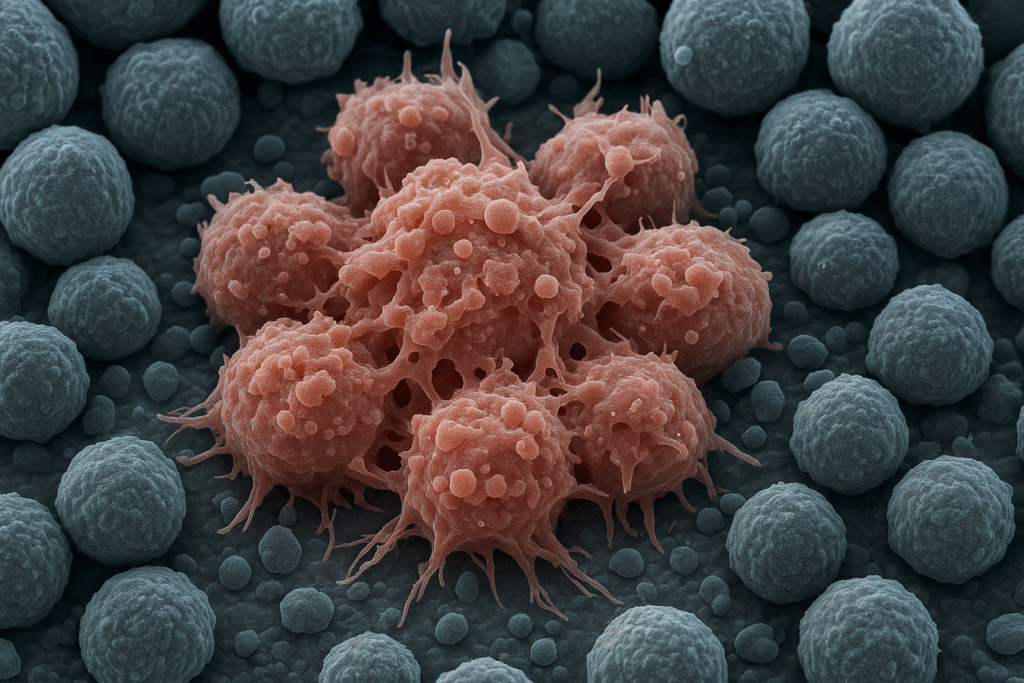
The approach harnesses a dramatic form of programmed cell death known as necroptosis, which turns dying cancer cells into distress beacons that draw immune cells to the tumor. The findings, published in Science Advances, may open new therapeutic possibilities for B-cell leukemias and lymphomas—especially those that resist standard immunotherapies.
Turning Cancer Cell Death into an Immune Alarm System
Modern immunotherapy works by training or enabling the immune system to hunt down and destroy cancer cells. Yet many blood cancers, especially those involving malignant B cells, are able to evade immune detection.
The Institut Pasteur and Inserm research team studied whether changing how cancer cells die could overcome this problem.
Unlike apoptosis—the “silent,” tidy form of cell death—necroptosis is noisy. When necroptosis occurs, dying cells release molecules that act as danger signals, rallying immune cells to the site.
“By changing the way cancer cells die, we can harness the support of our immune system to fight the tumor,” said
Philippe Bousso, Inserm Research Director and Head of the Dynamics of Immune Responses Unit at the Institut Pasteur.
However, malignant B cells are known to be poor candidates for necroptosis because they lack a protein called MLKL, which acts as the executioner of the necroptotic pathway. Without MLKL, cancer cells cannot undergo this potent, immune-activating death process.
Triple-Drug Combo Overcomes B Cells’ Resistance to Necroptosis
To solve this biological bottleneck, researchers designed a combination of three already-approved drugs that together:
- Restore the necroptosis machinery inside malignant B cells
- Trigger necroptotic cell death
- Amplify immune activation in the surrounding tissue
When deployed together, the drugs forced leukemia cells to undergo necroptosis and release strong inflammatory signals that attracted immune cells.
The result was dramatic:
complete elimination of leukemia in the preclinical model, without additional immunotherapy.
“The triple therapy forces cancer cells to die in a way that activates the immune system,” Bousso noted.
“It turns tumor cells into triggers for the immune system.”
Watching Immune Cells Attack Cancer in Real Time
A key part of the study involved a sophisticated imaging method known as intravital microscopy, which allowed scientists to visualize living immune cells interacting with dying cancer cells in real time—within live tissue.
This provided direct evidence that:
- Necroptosis produced strong immune-activating signals
- Immune cells rapidly accumulated near the dying cancer cells
- The combination therapy created a self-reinforcing immune response that persisted long enough to clear residual tumor cells
The technique showed marked differences between apoptosis (silent removal) and necroptosis (immune-alerting destruction). Under triple therapy, immune cells behaved as if a “flare” had been set off inside the tumor microenvironment.
Toward New Immunotherapies for Difficult Blood Cancers
The implications could be significant for blood cancers such as:
- B-cell leukemias
- B-cell lymphomas
- Cancers resistant to checkpoint inhibitors
- Tumors that evade CAR-T cell therapies
Because the triple-drug approach uses existing medications, it could potentially move toward clinical testing more quickly than brand-new compounds.
Still, the researchers caution that human trials will require careful evaluation of safety, toxicity, and dosage.
The work was supported by the European Research Council (ERC), the ARC Foundation for Cancer Research, Inserm, and the Institut Pasteur.
“This novel strategy shows how manipulating cancer cell death can reshape immune responses,” Bousso said.
“It offers a potential therapeutic avenue for leukemias or lymphomas involving B cells.”