
By Harshit
LOS ANGELES, November 16, 2025 — 3 AM EDT
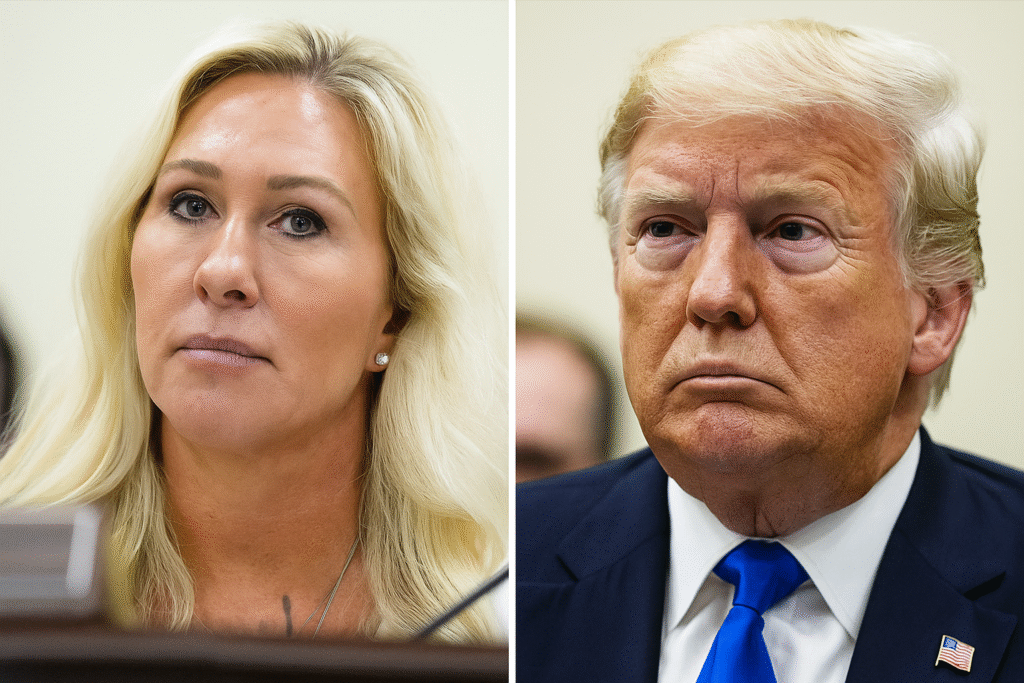
The long-simmering tensions between President Donald Trump and Republican Congresswoman Marjorie Taylor Greene have exploded into a full-scale public feud, marking one of the most dramatic ruptures between a sitting US president and a member of his own party in recent years. What began as a series of policy disagreements has now spiraled into name-calling, threats of political retaliation, and a bitter clash over the impending congressional vote to force the release of the highly sensitive Jeffrey Epstein files.
The dispute comes at a critical moment in Washington, as the House prepares to consider the Epstein Files Transparency Act, a bipartisan push to compel the Justice Department to release all non-classified records linked to the disgraced financier. The vote—expected as early as Tuesday—has put intense pressure on Republican lawmakers, many of whom are caught between public demands for transparency and the White House’s quietly mounting resistance.
Against this backdrop, Greene has emerged as one of the few Republican voices breaking ranks to support releasing the files. Her stance has triggered an increasingly hostile exchange with Trump, who spent the weekend attacking her in unusually personal terms.
Trump Escalates: Calls Greene “Wacky,” “Lunatic,” and “Traitor”
On Friday night, Trump launched his first volley, posting that Greene “does nothing but COMPLAIN” and accusing her of turning against him because he discouraged her from pursuing a Senate or gubernatorial run in Georgia.
“She has told many people that she is upset that I don’t return her phone calls anymore,” Trump wrote. “I can’t take a ranting Lunatic’s call every day.”
By Saturday, the rhetoric had intensified.
“Marjorie ‘Traitor’ Green [sic] is a disgrace to our GREAT REPUBLICAN PARTY!” he posted from Mar-a-Lago.
Trump also pledged to support any primary challenger who attempts to unseat her in the 2026 midterms—an extraordinary move by a sitting president against an incumbent of his own party.
The attacks mark a stunning reversal of their once-close alliance. Greene had been one of Trump’s most outspoken defenders during the fallout from the Capitol riot and remained loyal throughout multiple controversies. For years, she echoed Trump’s rhetoric, championed his policies, and enjoyed the political benefits of being in his inner circle.
But now, that relationship appears irreparably broken.
Greene Fires Back: “I Don’t Worship Donald Trump”
Greene responded publicly and defiantly.
On Friday, she accused Trump of trying to intimidate Republicans ahead of the Epstein vote.
“He’s coming after me hard to make an example to scare all the other Republicans before next week’s vote to release the Epstein files,” she wrote on X.
“It’s astonishing really how hard he’s fighting to stop the Epstein files from coming out.”
On Saturday, she said Trump had unleashed a wave of threats and vitriol from his supporters.
“As a Republican, who overwhelmingly votes for President Trump’s agenda, his aggression against me… is completely shocking,” she wrote.
Then came the line that signaled a profound shift:
“I don’t worship or serve Donald Trump. I worship God… I serve my district GA-14 and the American people.”
For a figure long viewed as a Trump loyalist, the statement underscored just how deep the rift had become.
The Epstein Files: A Flashpoint That Republicans Can’t Ignore
At the heart of the dispute is the Epstein Files Transparency Act, a bipartisan bill demanding the release of all unclassified records connected to Epstein, who died in federal custody in 2019.
Greene is one of just four Republicans who signed the discharge petition alongside Democrats. Polling shows overwhelming public interest in the case—and frustration with years of secrecy surrounding influential figures who interacted with Epstein.
Politico reports that the vote could happen as early as Tuesday, turning the issue into a high-stakes showdown between Trump and transparency advocates in both parties.
Republican strategist Robert Moran told reporters the president’s resistance is “obvious” and “significant.”
“It’s clear Trump does not want these files released,” Moran said. “He is trying to pressure Greene and others. But the reality is that the files will come out eventually.”
Moran believes the dispute may not damage Trump’s political base—“his voters are locked in”—but said it puts him at odds with Americans who believe powerful figures must be held accountable.
“Many of his voters want those files out,” Moran noted. “They distrust institutions. They distrust elites. They believe transparency should apply to everyone.”
Greene Says Trump Is Blocking Republicans From Supporting the Disclosure Bill
Greene has repeatedly accused the White House of actively discouraging Republican lawmakers from backing the release effort.
In a post on Friday, she wrote:
“He’s trying to stop other Republicans from voting for the release of the Epstein files.”
Her characterization paints Trump as someone working behind the scenes to maintain secrecy, even as public calls for disclosure grow louder.
The White House has denied pressuring lawmakers, but Trump’s own comments—calling the bill a “distraction,” according to aides—suggest he is deeply uneasy about the implications of unsealing Epstein-related records.
Long History, Lingering Suspicion
Epstein and Trump were social acquaintances for years in the 1990s and early 2000s. Trump has said publicly that he “was not a fan” and cut ties around 2004—two years before Epstein’s first arrest.
Yet Trump’s name has appeared in the periphery of various documents and testimonies over the years, though he has never been accused of misconduct.
Both Democrats and Republicans have criticized his handling of the DOJ files tied to Epstein, which have remained largely shielded from public view.
Greene argues Trump’s efforts to block transparency raise deeper questions.
“This isn’t America First,” she posted. “This is protecting the powerful.”
Political Fallout: Will It Hurt Trump? Will It Hurt Greene?
Analysts are divided.
Some believe Trump’s base will remain unmoved—his supporters tend to interpret criticism of him, even from fellow Republicans, as proof of establishment sabotage.
But others argue Greene’s challenge carries unusual weight.
She represents the populist right, not moderates or institutional Republicans. If Trump alienates that faction, the political cost could be real.
One senior GOP aide put it bluntly:
“If Trump loses Greene’s wing, he loses part of the grassroots energy that keeps the party alive.”
Still, Greene’s own political future becomes more uncertain if Trump follows through on his threat to back a primary challenger.
“She could survive,” the aide said, “but it would be an all-out war.”
What Happens Next?
The timing is crucial.
The House vote on the Epstein files is imminent.
If the bill passes with Republican support—despite Trump’s pressure—it will signal a major shift in the party’s power dynamics.
If it fails, the White House may claim victory, but at the expense of inflaming public suspicion.
Either way, the feud between Trump and Greene has already reshaped the political landscape. What once seemed unthinkable—a public break between the president and one of his most vocal allies—is now unfolding in real time.
As Greene wrote on Saturday:
“I am not backing down.”
And from Mar-a-Lago, Trump appears equally determined.
The confrontation, once simmering quietly behind closed doors, has now burst into the open—and its consequences may reverberate long after the Epstein vote is decided.