
By Harshit
BOSTON, November 15, 2025 — 10:45 PM EDT
When Carol Saffran, 71, from the greater Boston area, began taking Ozempic last year to control her blood sugar, she didn’t expect her hair to thin. Prescribed the drug to prevent diabetes after a prediabetic diagnosis, she reached her ideal weight — but soon noticed an unsettling change.
“I would brush my hair and look at my hairbrush, and there was just a little bit more [hair] than normal,” Saffran said. “It’s not coming out in clumps, but it’s definitely thinner than before.”
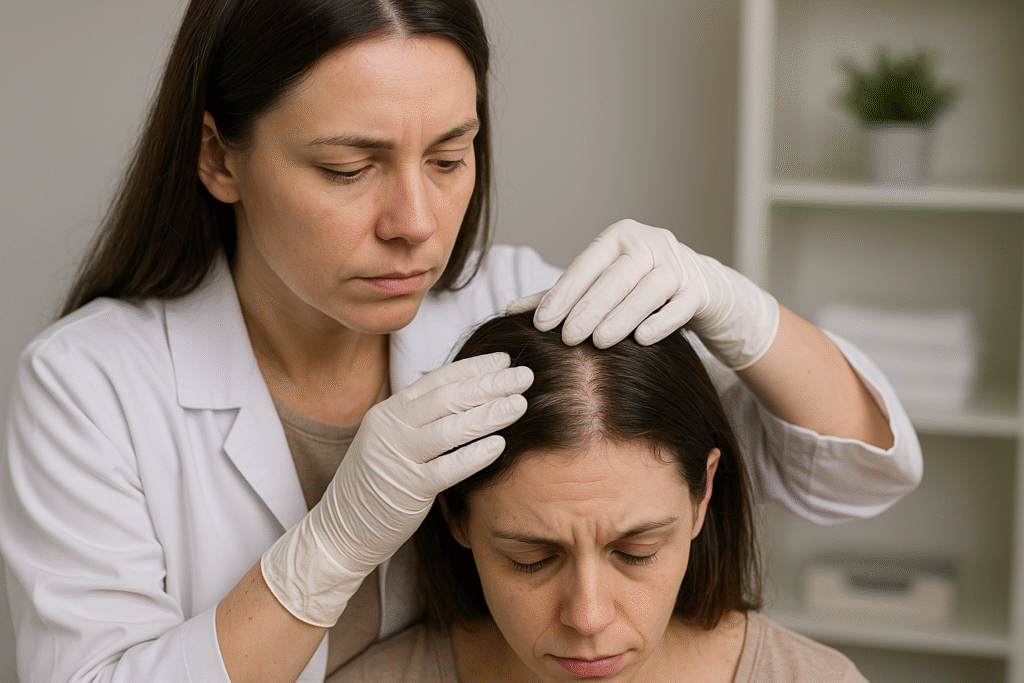
Her dermatologist, Dr. Farah Moustafa, director of laser and cosmetic dermatology at Tufts Medical Center, diagnosed her with telogen effluvium — a temporary hair loss condition triggered by physiological stress. In Saffran’s case, that stress was rapid weight loss due to GLP-1 medication use.
As Ozempic and similar drugs — known as GLP-1 receptor agonists — become more common, reports like Saffran’s are emerging across the country. A KFF survey published Friday found that 1 in 8 U.S. adults now use GLP-1 drugs for diabetes management, weight loss, or both — a 6% increase from mid-2024.
What Is Telogen Effluvium?
To understand how these medications can affect hair growth, experts point to the four stages of the hair cycle:
- Anagen (growth)
- Catagen (transition)
- Telogen (resting)
- Exogen (shedding)
Telogen effluvium occurs when an abnormally high percentage of follicles enter the resting phase, leading to diffuse shedding across the scalp.
“Any time people lose a significant amount of weight quickly, the body interprets it as stress,” said Dr. Aron Nusbaum, a dermatologist and hair restoration surgeon at the Miami Hair Institute. “That stress shifts hair follicles into a shedding phase.”
He explains that this process can be triggered by crash dieting, surgery, major illness, or metabolic changes — all of which can accompany GLP-1 drug use.
“Hair is not essential to survival,” added Dr. Anthony Rossi of Memorial Sloan Kettering Cancer Center. “When your body experiences stress, it redirects energy from nonessential functions, like hair growth, to vital organs.”
Weight Loss, Not the Drug Itself, Is the Main Culprit
Experts emphasize that the weight loss associated with GLP-1 drugs, rather than the medication itself, is the key driver of hair loss.
“Profound weight loss is the stressor,” Nusbaum said. “It’s not the chemical mechanism of the drug—it’s the speed and degree of fat and muscle reduction.”
The phenomenon mirrors what happens after bariatric surgery, according to Dr. Brian Wojeck, an obesity medicine specialist at Yale School of Medicine. “Patients often experience temporary shedding due to rapid metabolic shifts,” he said.
Wojeck added that nutritional deficiencies may worsen the problem. “Sudden changes in protein and vitamin intake can contribute to shedding,” he said. “Multivitamins may help, though data are limited.”
Malnutrition and Micronutrient Deficiency
Hair is made primarily of keratin, a protein that depends on nutrients such as iron, zinc, and vitamins B, D, and B-12 for renewal. Many people on GLP-1 drugs unintentionally consume fewer calories and proteins, leading to relative malnutrition.
Rossi says this has become common among people using GLP-1s for cosmetic weight loss, not medical need.
“People are using them in med spas and compounding clinics without supervision,” he warned. “They’re skipping meals, losing muscle mass, and not getting enough micronutrients for hair regeneration.”
To maintain healthy hair, experts recommend 1 gram of protein per kilogram of body weight daily — along with adequate iron and zinc intake.
Could Ozempic Trigger Genetic Hair Loss?
Some hair experts suspect a possible connection between GLP-1 drugs and androgenetic alopecia (pattern baldness) in genetically predisposed individuals.
“Rapid weight loss could unmask underlying male or female pattern hair loss,” said Spencer Kobren, founder of the American Hair Loss Association.
Androgenetic alopecia presents differently from telogen effluvium:
- Women typically see thinning at the frontal hairline.
- Men experience loss at the temples and crown.
However, data remain limited. “The literature doesn’t yet show a strong causal link,” Nusbaum noted. “But clinically, we are seeing an uptick in patients whose existing pattern hair loss worsened after starting GLP-1 therapy.”
Wojeck remains cautious: “The telogen effluvium mechanism is the best-described cause so far. Other explanations are still speculative.”
What the Drugmakers Say
Both Novo Nordisk (maker of Ozempic and Wegovy) and Eli Lilly (maker of Mounjaro and Zepbound) acknowledge hair loss as a known but uncommon side effect of GLP-1 treatment.
In clinical trials:
- Wegovy reported hair loss in 2.5% of adults, versus 1.0% with placebo.
- Hair loss was more frequent in patients who lost ≥20% of body weight.
- Zepbound trials showed 7.1% of women experienced hair loss, compared to 0.5% of men.
“These medications are powerful metabolic regulators,” a Novo Nordisk spokesperson told CNN. “Hair loss may relate to the degree of weight reduction rather than the compound itself.”
Treatment and Recovery
The good news, experts say, is that telogen effluvium is usually temporary. Once the body adjusts to its new metabolic state — typically within 3–6 months — hair regrowth often resumes.
“Once the stressor is removed, follicles re-enter the growth phase,” said Moustafa. “The key is patience and identifying underlying triggers.”
For faster recovery, physicians may prescribe oral or topical minoxidil, a proven hair-growth stimulant. In cases where patients must remain on GLP-1 therapy, Moustafa recommends nutritional counseling and dose adjustments.
“Lowering the medication dosage while optimizing protein intake can make a big difference,” she said.
Still, experts warn against self-diagnosing. “Without an accurate diagnosis, you won’t get the right treatment,” Nusbaum noted. Doctors often order blood tests to rule out anemia, thyroid imbalance, or vitamin deficiencies before confirming telogen effluvium.
Living With the Side Effect
Saffran, now adjusting her Ozempic dosage under Moustafa’s care, remains optimistic. “It’s frustrating, but I understand what’s happening,” she said. “If my hair takes a few months to grow back, that’s fine — my health comes first.”
Her doctor expects full regrowth. “She started with very dense hair,” Moustafa said. “There’s no sign of pattern baldness — this is purely stress-induced shedding, and it will resolve.”
For now, experts advise anyone using GLP-1 medications to monitor hair changes, maintain adequate nutrition, and consult a dermatologist if thinning persists beyond six months.
“These are real drugs with real biological effects,” Rossi said. “Hair loss may seem cosmetic, but for many patients it’s psychologically devastating. Understanding why it happens — and that it’s usually reversible — is key.”