
By Harshit, KYIV, Nov. 14, 2025 — 08:20 a.m. GMT
A massive wave of Russian drone and missile strikes battered the Ukrainian capital Kyiv overnight, killing at least four people and injuring dozens, in one of the largest coordinated assaults on the city in recent months.
Ukrainian President Volodymyr Zelensky condemned the attack as “vile and calculated,” saying that about 430 drones and 18 missiles were launched by Russian forces, damaging dozens of high-rise buildings, hospitals, and schools across the capital.
“Once again, Russia proves it fights not against soldiers but against civilians,” Zelensky said in a morning address. “Hundreds of drones, dozens of missiles, and zero humanity.”
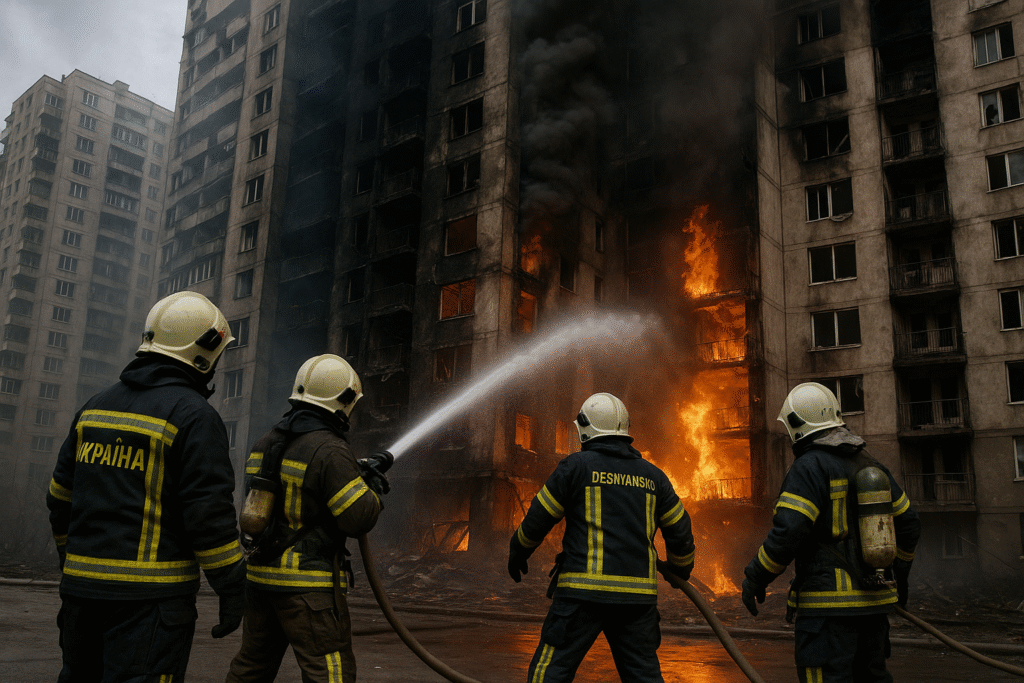
Emergency services said more than 40 people were rescued from damaged structures, including 14 from a burning apartment complex in the Desnyanskyi district, where one fatality was reported. A second victim was pulled alive from beneath the rubble.
Kyiv Under Fire: “It’s Loud in Kyiv”
The assault began shortly after midnight local time (22:01 GMT Thursday), triggering air raid sirens across the capital.
Tymur Tkachenko, head of Kyiv’s military administration, wrote on Telegram:
“It’s loud in Kyiv. Residential buildings came under attack in practically every district.”
Large explosions echoed through the city as debris rained down on streets and fires broke out in multiple neighborhoods. Emergency teams battled flames and rescued residents trapped inside collapsed buildings.
Mayor Vitali Klitschko confirmed that at least nine people were hospitalized, including one in extremely critical condition. He said the city’s heating and electricity networks suffered “serious damage,” and water supply disruptions were possible throughout Friday.
“Energy infrastructure has been hit hard,” Klitschko said. “Crews are working nonstop to restore power, heat, and water to affected areas.”
Hospitals, Schools Among Damaged Buildings
Ukraine’s emergency services said residential towers, a hospital, a school, and administrative buildings were hit in the overnight strikes.
Images showed apartment blocks with shattered facades, smoke billowing from top floors, and emergency personnel clearing wreckage amid snow-dusted streets.
Medical teams were deployed to all major fire sites, while rescue workers continued to sift through the rubble in Desnyanskyi and Solomianskyi districts on Friday morning.
AFP photographs captured security personnel standing amid charred buildings, with flames still visible in several upper floors as daylight broke over the capital.
Wider Strikes Across Ukraine
The Ukrainian Air Force said that several other regions, including Sumy, were also targeted by guided bombs and drones throughout the night.
In total, Ukrainian air defenses said they intercepted approximately 340 of the 430 drones, but several projectiles still struck residential zones and critical facilities.
The strikes came less than a week after a similar Russian offensive killed six people and damaged vital energy infrastructure, part of what Kyiv calls a deliberate campaign to cripple Ukraine’s winter heating systems.
“Every missile against our cities is proof of Russia’s terror,” Zelensky said. “We need more air defense, more sanctions, and zero tolerance for their energy profits.”
Ukraine Strikes Back: Fire at Russian Oil Port
In apparent retaliation, Ukraine launched a drone strike on the Russian Black Sea port of Novorossiysk overnight, targeting the Sheskharis oil refinery, one of Russia’s key export terminals.
Krasnodar Governor Veniamin Kondratyev confirmed that a major fire broke out at the refinery, injuring four people, including three ship crew members.
“The main oil depot and a container terminal were damaged,” Kondratyev said on Telegram.
Novorossiysk Mayor Andrei Kravchenko declared a state of emergency, halting all oil exports from the port as crews battled the blaze through Friday morning.
Reuters reported that several residential buildings near the refinery also sustained damage from falling debris.
The refinery is a crucial node in Russia’s Black Sea energy network, handling nearly 30% of crude exports through the region. Analysts say the attack is likely to impact short-term global oil supply chains.
Escalating Energy War
Moscow’s renewed strikes on Ukrainian energy infrastructure and Kyiv’s retaliatory attack on Russian oil facilities mark an escalation in the ongoing “energy war” that has defined much of the conflict’s winter phase.
Russia has repeatedly targeted power stations, pipelines, and heating plants, arguing they are used to “support Ukrainian military logistics.”
Ukraine, meanwhile, accuses Moscow of attempting to “freeze” its population into submission.
“Russia’s energy terror continues,” Zelensky said Friday. “Every blackout, every destroyed generator, every hospital without light — it’s all part of their plan to break us.”
The United Nations Office for the Coordination of Humanitarian Affairs (OCHA) warned that millions of Ukrainians remain without reliable access to heat and electricity as temperatures dip below freezing.
U.S. Sanctions and Western Response
The renewed escalation comes just days after U.S. President Donald Trump criticized slow progress in ceasefire negotiations with Russian President Vladimir Putin and announced a new round of sanctions on Russian oil exports.
Shortly afterward, Hungary — a NATO member — was granted a limited exemption from those sanctions to maintain energy stability, a move that drew condemnation from Kyiv.
“There must be no exceptions for Russian energy,” Zelensky said. “Every drop of Russian oil fuels their missiles.”
The European Union, meanwhile, called for an emergency meeting to discuss both the humanitarian crisis in Ukraine and the potential spillover effects of the Novorossiysk refinery fire on global markets.
On the Ground in Kyiv
By dawn on Friday, firefighters were still extinguishing hotspots across Kyiv’s left bank. Residents emerged from shelters to assess damage — shattered glass, overturned cars, and buildings left hollow by explosions.
“We haven’t slept for two nights,” said Olena Mykhailova, a 32-year-old resident of the Obolonskyi district. “The walls shook all night. My son keeps asking when it will stop.”
Emergency teams worked through the morning to restore power to hospitals and evacuation centers as residents queued for bottled water and food aid.
For many, the morning light brought not relief but exhaustion — and the grim realization that the war, once again, had arrived at their doorsteps.