
By Harshit
Anchorage, Alaska | November 13, 2025 | 09:15 PM AKST
A breathtaking display of the northern lights, or aurora borealis, lit up skies across the United States, Canada, and even parts of Australia last night, captivating millions of skywatchers. Traditionally visible only in the far northern latitudes — such as Scandinavia, Iceland, Greenland, Alaska, and northern Canada — the phenomenon astonished observers as far south as Texas, Florida, and southern California, marking one of the most widespread auroral events in recent years.
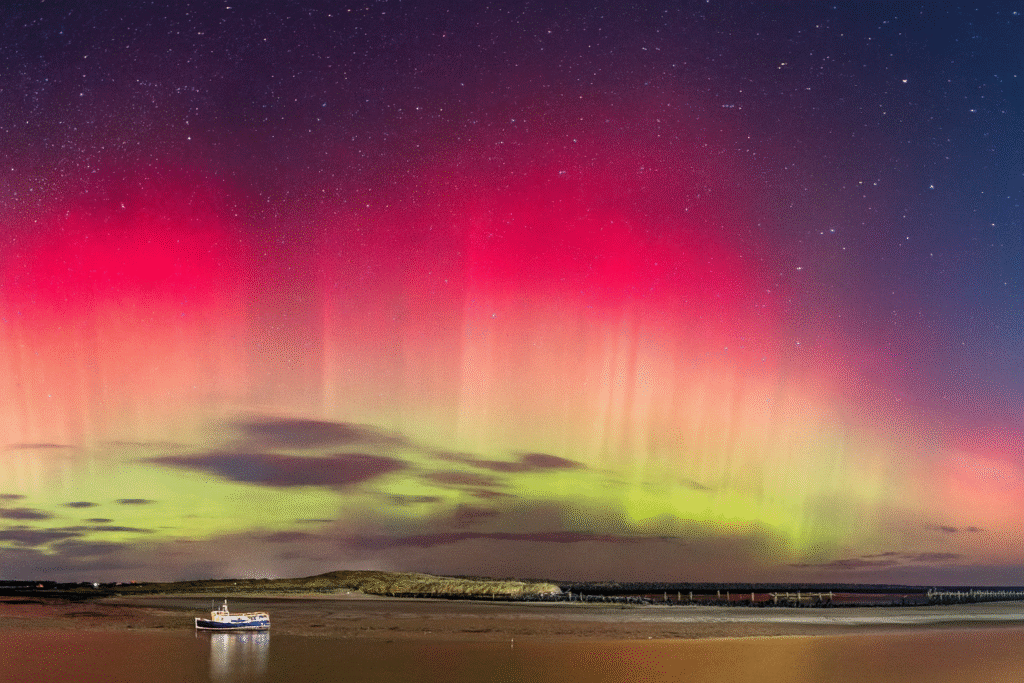
Social media was flooded with photographs and videos of vibrant green, pink, and violet waves sweeping across the night sky on November 12, as people from coast to coast marveled at the rare spectacle.
What Caused This Week’s Aurora Explosion
According to NASA, the northern lights are the result of geomagnetic storms, triggered when charged particles from the Sun collide with gases in Earth’s upper atmosphere. These solar eruptions — often linked to coronal mass ejections (CMEs) — interact with Earth’s magnetic field, exciting atmospheric atoms and producing the glowing curtains of color that ripple across the sky.
“When energetic particles from space collide with atoms and molecules in the atmosphere, they can cause the colorful glow that we call auroras,” NASA explained in a statement.
The hues vary depending on which gases are excited:
- Green comes from oxygen about 60 miles above Earth,
- Red from high-altitude oxygen,
- Blue and purple from nitrogen molecules.
Last night’s event was driven by a strong solar storm that reached Earth’s magnetosphere earlier this week. The storm was part of ongoing solar maximum activity, a peak in the Sun’s 11-year cycle that increases solar flares and CMEs, enhancing auroral visibility around the globe.
A Rare Southern Sight
Normally, auroral activity remains confined within the auroral oval, a ring-shaped region encircling the poles. However, when solar storms are especially intense, the oval expands dramatically — pushing the lights farther south than usual.
This time, residents from New York and Illinois to Texas and Florida caught glimpses of the celestial show. Reports also came from New Mexico, Oregon, Washington, and Colorado, as well as several locations in Canada and even Tasmania in the Southern Hemisphere.
“The last time we saw auroras this far south was during a major geomagnetic storm in 2003,” said Bill Murtagh, program coordinator at NOAA’s Space Weather Prediction Center (SWPC). “It’s an extraordinary reminder of how dynamic space weather can be.”
When Will the Northern Lights Return?
Unfortunately, NOAA forecasters say it’s uncertain when the next widespread display will occur.
“There are so many uncertainties, it makes it difficult to predict,” Murtagh told USA TODAY. “We are decades behind the forecast capabilities of our colleagues in meteorology.”
While smaller auroral events happen regularly, nationwide visibility like this week’s is rare — typically tied to powerful solar storms that strike Earth directly. NOAA currently predicts low to moderate geomagnetic activity for the rest of November, but additional eruptions from the Sun could change that outlook at any time.
The Space Weather Prediction Center continues to monitor solar flare data in real time, updating forecasts daily.
How to See the Northern Lights
If you missed this week’s dazzling display, there’s still a chance to prepare for the next one. Experts from NOAA recommend two simple strategies for successful aurora viewing:
1. Choose a High, Dark Vantage Point
Find an elevated location away from city lights — such as a rural hilltop, open field, or mountain ridge. Even if the aurora is occurring hundreds of miles north, the glow may still be visible along the horizon under clear skies.
“Given the right vantage point, say on top of a hill in the northern hemisphere with an unobstructed view toward the north, a person can see aurora even when it is 1,000 kilometers (600 miles) further north,” NOAA notes.
2. Look Between 10 PM and 2 AM
Auroras are best seen late at night when skies are darkest. Light pollution — from cities, headlights, or even a bright full moon — can significantly reduce visibility.
“The best aurora is usually within an hour or two of midnight,” NOAA reports. “Displays can occur in the evening or early morning, but they’re typically less active and less vibrant.”
Why the Northern Lights Matter
Beyond their visual beauty, auroras are a powerful reminder of Earth’s connection to the Sun. Geomagnetic storms that cause auroras can also disrupt satellite communications, GPS systems, and power grids, making space weather monitoring a vital part of modern infrastructure defense.
For scientists, each major auroral event is an opportunity to study the interaction between solar particles and Earth’s magnetosphere, improving prediction models for future storms.
“Every aurora tells us something about the Sun–Earth relationship,” said Murtagh. “They’re not just spectacular — they’re scientifically valuable.”
A Night to Remember
From shimmering skies over St. Mary’s Lighthouse in Whitley Bay, England, to glowing green arcs over the Great Lakes and Rocky Mountains, the November 12 auroras will be remembered as one of the most widespread in recent history.
For many first-time viewers in the U.S. South, it was a once-in-a-lifetime experience — proof that even the night sky can surprise us with beauty from 93 million miles away.