
By Harshit
Montpellier, France | November 13, 2025 | 02:45 AM CET
A groundbreaking new study from Stellenbosch University in South Africa and the Montpellier Cancer Institute (IRCM) in France has revealed a crucial connection between microclots and neutrophil extracellular traps (NETs) in patients suffering from Long COVID. The findings shed light on one of the most persistent medical mysteries of the pandemic — why some patients experience ongoing fatigue, brain fog, and cardiovascular issues months after infection.
Using a combination of advanced imaging techniques and artificial intelligence (AI) tools, the researchers have identified how abnormal blood clots interact with immune system structures, potentially driving the long-term symptoms of COVID-19.
What the Researchers Found
Through detailed analyses of blood plasma samples from Long COVID patients, the study found significant elevations in biomarkers associated with both microclots and NETs, compared with healthy individuals.
Even more strikingly, scientists observed that these two elements — microclots and NETs — were structurally intertwined, forming dense, sticky clusters that may block tiny blood vessels and restrict oxygen flow throughout the body.
“This finding suggests the existence of underlying physiological interactions between microclots and NETs that, when dysregulated, may become pathogenic,” explained Dr. Alain Thierry, senior researcher at IRCM and INSERM Montpellier.
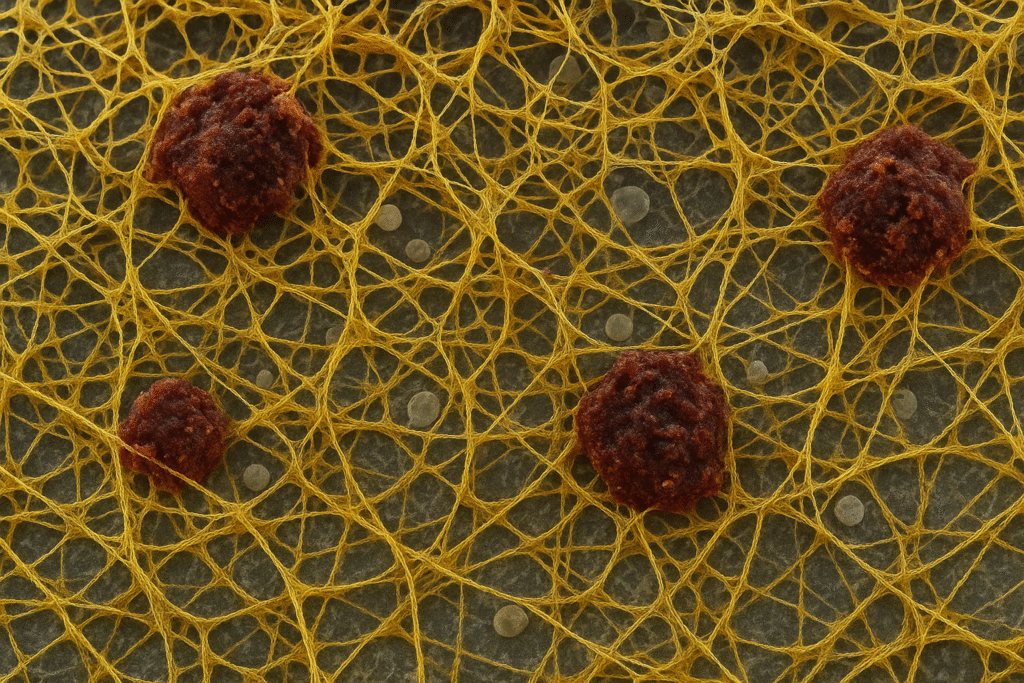
Microscope images show these microclots as dense, fluorescent tangles: green regions representing sticky protein networks, and red and blue patches showing trapped immune cell material. These clumps, scientists say, could explain the chronic fatigue, breathlessness, and brain fog seen in many Long COVID cases.
Understanding Microclots and NETs
Microclots are small, abnormal clusters of blood-clotting proteins that circulate in the bloodstream. First identified in 2021 by Professor Resia Pretorius of Stellenbosch University, microclots are now recognized as potential markers of post-COVID blood and vascular disorders.
Neutrophil extracellular traps (NETs), on the other hand, are DNA-based webs released by white blood cells called neutrophils during an immune response — a process known as NETosis. These traps help capture and neutralize pathogens but can also become harmful when produced in excess.
“While NETs are part of our defense system, too many of them can trigger widespread inflammation and clot formation,” said Dr. Thierry. “This is something we observed not only in severe COVID-19 cases but now in Long COVID as well.”
Excess NET production has previously been linked to autoimmune diseases, diabetes, arthritis, and cancer, and may contribute to the prolonged inflammation that defines Long COVID.
How Microclots and NETs Work Together
Using imaging flow cytometry and fluorescence microscopy, researchers examined plasma samples and confirmed that NETs often become embedded within microclots, forming hybrid structures that resist natural breakdown.
This combination may make microclots more durable and more difficult to dissolve, a process that interferes with blood flow in the smallest capillaries — especially in the brain, lungs, and muscles.
“This interaction could render microclots more resistant to fibrinolysis, promoting their persistence in circulation and contributing to chronic microvascular complications,” said Prof. Pretorius.
In essence, NETs may act like a biological scaffold, stabilizing microclots and turning them into long-lasting blockages that limit oxygen delivery to tissues — a potential explanation for the persistent fatigue, chest pain, and cognitive symptoms that characterize Long COVID.
Artificial Intelligence Unlocks Diagnostic Clues
To analyze the complex web of biomarkers linked to microclots and NETs, the research teams employed machine learning algorithms capable of distinguishing Long COVID patients from healthy controls with high accuracy.
AI models were trained to detect subtle biomarker combinations and patterns invisible to the human eye. The results could pave the way for new diagnostic tools, allowing doctors to identify Long COVID through a simple blood test.
“The integration of AI allows us to pinpoint the most informative biomarker combinations,” the study authors wrote. “This opens the door to more precise diagnostics and personalized treatment approaches.”
Implications for Treatment
The discovery of a structural and functional link between microclots and NETs provides valuable insight into why Long COVID persists in some patients long after the virus has left their system.
By targeting the thrombo-inflammatory feedback loop between these two mechanisms, researchers believe it may be possible to develop therapies that reduce clot formation, restore blood flow, and alleviate chronic symptoms.
Potential treatment strategies could include:
- Anti-clotting medications that target microclots,
- Drugs that inhibit excessive NET formation, or
- Therapies that enhance fibrinolysis (the body’s natural clot-dissolving process).
The Bigger Picture: Understanding Long COVID
Since early 2020, millions worldwide have reported symptoms lasting months beyond their initial COVID-19 infection. Commonly known as Long COVID or Post-Acute Sequelae of SARS-CoV-2 infection (PASC), it affects multiple organs and remains poorly understood.
This new research offers a biological explanation that links vascular damage, immune dysfunction, and chronic inflammation. It also suggests that Long COVID shares similarities with other post-viral syndromes, including chronic fatigue syndrome and dysautonomia, where microcirculatory problems are also observed.
“By combining advanced imaging and machine learning, we’ve taken a major step toward unraveling the biology behind Long COVID,” said Pretorius. “Our goal is to use this knowledge to create diagnostic and therapeutic tools that help patients recover.”
A Collaborative Step Toward Answers
The study, published by Stellenbosch University and INSERM Montpellier, marks one of the most comprehensive investigations into the microvascular effects of Long COVID to date. It also highlights the value of international scientific collaboration, integrating expertise from hematology, immunology, computational biology, and AI.
As research continues, the team plans to expand its dataset, test interventions that reduce microclot and NET activity, and collaborate with clinical centers to evaluate treatment outcomes.
A Path Forward
While the pandemic’s acute phase has passed, Long COVID continues to affect millions globally. The discovery of the microclot-NET interaction gives scientists a clear target for diagnosis and therapy — a potential turning point in managing the lingering effects of COVID-19.
“Understanding how microclots and NETs sustain inflammation may finally explain why recovery is so prolonged for some patients,” said Pretorius. “This could be the key to unlocking effective treatments for Long COVID and related chronic conditions.”