
By Harshit
DUNDEE, Nov. 11 —
In what experts are calling a groundbreaking moment for global medicine, doctors from Scotland and the United States have successfully performed the world’s first remote robotic stroke procedure on a human body — a milestone that could redefine emergency stroke treatment worldwide.
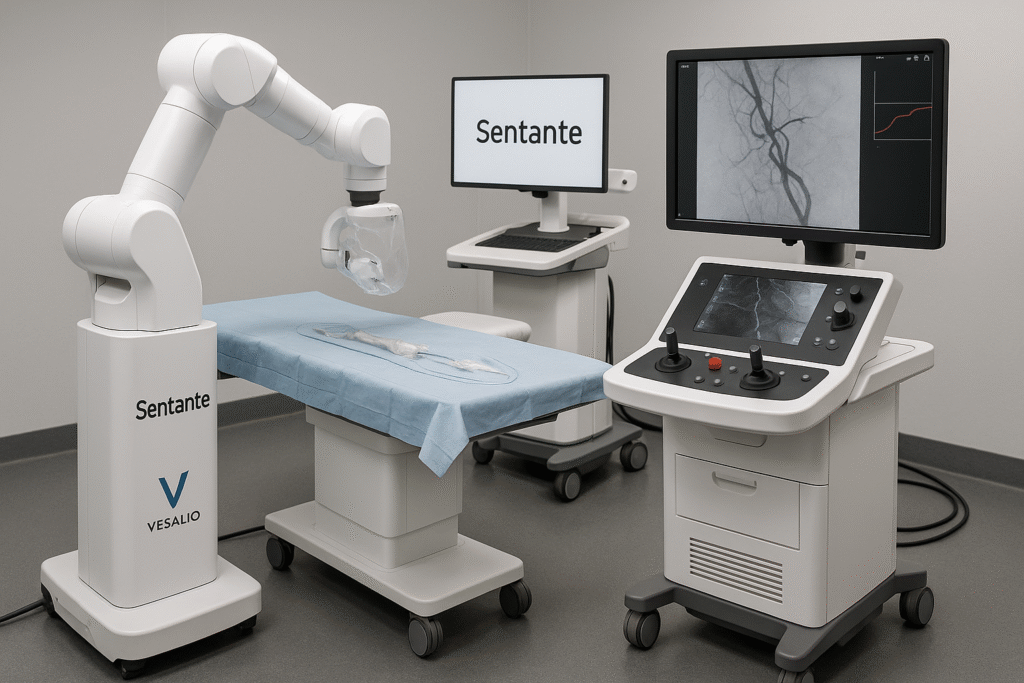
The pioneering operation, known as a remote thrombectomy, was carried out by Professor Iris Grunwald of the University of Dundee and neurosurgeon Dr. Ricardo Hanel from Florida, using advanced robotics developed by Lithuanian firm Sentante.
Prof. Grunwald conducted the first test from Dundee’s Ninewells Hospital, operating on a human cadaver housed at the University of Dundee’s medical facility. Hours later, Dr. Hanel performed a second surgery from Jacksonville, Florida — over 4,000 miles (6,400 km) away — marking the world’s first transatlantic robotic stroke operation.
“This felt like witnessing the first glimpse of the future,” said Prof. Grunwald. “Where previously this was thought to be science fiction, we demonstrated that every step of the procedure can already be done.”
A Game-Changer for Stroke Treatment
Thrombectomy — the surgical removal of blood clots that block arteries in the brain — is a life-saving but highly time-sensitive procedure. For every six-minute delay in treatment, a patient’s chances of recovery drop by 1%. Yet only a small fraction of stroke patients worldwide receive this treatment, largely due to the shortage of trained specialists and limited access in rural regions.
“This technology could rebalance the inequity in stroke care,” said Juliet Bouverie, chief executive of the UK’s Stroke Association, calling the achievement “a remarkable innovation.”
She added, “For too long, people living in remote and rural areas have been deprived of access to thrombectomy. Robotics like this could finally change that.”
How the Technology Works
An ischemic stroke occurs when a blood clot blocks an artery leading to the brain, cutting off oxygen and causing brain cells to die. In a traditional thrombectomy, a specialist uses catheters and fine wires inserted through the patient’s arteries to remove the clot.
In this new method, a robot mimics the specialist’s movements in real time, guided remotely through secure, high-speed connectivity.
Using the Sentante robotic system, a surgeon located anywhere in the world can manipulate catheters as if they were physically in the operating room. A clinician beside the patient connects the instruments, while the remote surgeon operates via precise hand controls.
During the Dundee experiment, cadavers were connected to a circulatory system using synthetic fluid that mimics human blood. Both Prof. Grunwald and Dr. Hanel could view live X-ray imaging and track the instruments’ progress inside the arteries.
“The lag was only 120 milliseconds — literally the blink of an eye,” said Dr. Hanel. “To operate from the U.S. to Scotland with that level of precision is truly remarkable.”
Tech companies NVIDIA and Ericsson partnered with Sentante to provide the high-speed connectivity and real-time video feedback required for such delicate remote operations.
Bridging Global Gaps in Stroke Care
According to Public Health Scotland, there were 9,625 ischemic strokes recorded in Scotland last year. Of those, only 212 patients — just 2.2% — received a thrombectomy, while the majority were treated with clot-busting drugs. Similar trends are seen across the UK, where just 3.9% of stroke patients received the procedure in 2024.
Prof. Grunwald, who also serves as Vice President of the World Federation for Interventional Stroke Treatment, believes robotic systems could revolutionize stroke care by connecting experts to patients instantly, regardless of geography.
“The treatment is extremely time-sensitive,” she explained. “This technology provides a new way where you’re not depending on where you live — saving the valuable minutes when your brain is otherwise dying.”
Currently, only three hospitals in Scotland — Dundee, Glasgow, and Edinburgh — offer thrombectomy procedures. For patients outside those areas, the delay in reaching a specialist can mean the difference between recovery and lifelong disability.
Next Steps and Global Implications
Both surgeries were performed successfully last month under controlled conditions, using donated cadavers preserved within the past three years. The next stage, researchers say, will be to move toward clinical trials on living patients sometime in 2026.
“This was the first time that we could perform the entire mechanical thrombectomy procedure in a real human body to show that all steps are possible,” said Prof. Grunwald.
Sentante’s chief executive Edvardas Satkauskas said the team’s success was “beyond what we imagined.”
“Sometimes, the future is closer than we think,” he said.
Medical researchers worldwide are now calling the experiment a proof of concept that could one day allow stroke specialists to operate remotely from major hospitals, instantly assisting smaller clinics across continents. If approved, the technology could dramatically reduce global stroke mortality and bring expert-level care to underserved regions for the first time.