
By Harshit, WASHINGTON, Nov. 10, 2025 — 11:30 a.m. EDT
In a major relief for LGBTQ Americans, the U.S. Supreme Court on Monday declined to revisit its historic 2015 decision that legalized same-sex marriage nationwide, choosing not to hear an appeal from Kim Davis, the former Kentucky county clerk who refused to issue marriage licenses to gay couples.
The decision, announced without explanation, leaves intact the Obergefell v. Hodges precedent — a cornerstone ruling of modern civil rights — and marks a rare moment of restraint from a conservative-leaning court that has overturned other long-standing constitutional rights, including abortion under Roe v. Wade in 2022.
“Today, love won again,” said Kelley Robinson, president of the Human Rights Campaign, the nation’s largest LGBTQ+ advocacy group. “When public officials take an oath to serve, that promise extends to everyone — including LGBTQ+ people. The Supreme Court made clear that refusing to respect the rights of others has consequences.”
A Test for the Court — and Its Legacy
The case stemmed from Davis’s refusal, as clerk of Rowan County, Kentucky, to issue marriage licenses after Obergefell recognized same-sex marriage as a constitutional right. Davis claimed her religious beliefs prevented her from signing such licenses, even for heterosexual couples, to avoid discrimination accusations.
Her defiance made national headlines in 2015. She was sued by several couples, jailed briefly for contempt of court, and ultimately ordered to pay $360,000 in damages and legal fees.
Davis appealed to the Supreme Court, urging it to “reconsider Obergefell” and arguing that her First Amendment rights shielded her from liability. The 6th U.S. Circuit Court of Appeals rejected that argument earlier this year, ruling that she had violated her oath as a public official.
The Supreme Court’s refusal to hear the case means the lower court ruling stands — and that Obergefell remains intact, at least for now.
A Decade After Obergefell, the Stakes Remain High
The Obergefell ruling, authored by Justice Anthony Kennedy, established marriage equality as a fundamental right under the Constitution. It declared that “no union is more profound than marriage, for it embodies the highest ideals of love, fidelity, devotion, sacrifice, and family.”
The decision sparked nationwide celebrations, with same-sex couples marrying outside courthouses and the White House illuminated in rainbow colors. Since then, nearly 600,000 same-sex marriages have been performed in the U.S., according to UCLA’s Williams Institute.
Yet for many advocates, fears that the ruling could be overturned have grown since Roe v. Wade was reversed in 2022. The court now has a 6–3 conservative majority, and two key justices from the Obergefell majority — Kennedy and Ruth Bader Ginsburg — have since left the bench, replaced by Justices Brett Kavanaugh and Amy Coney Barrett.
Justices Clarence Thomas, Samuel Alito, and John Roberts, all dissenters in the 2015 ruling, remain on the bench today.
Conservative Voices Cautious but Divided
Despite deep ideological divides, recent signals from conservative justices suggested limited appetite to revisit marriage equality.
Justice Barrett told The New York Times last month that there were “very concrete reliance interests” tied to same-sex marriage — meaning that millions of Americans have built families and legal rights based on the precedent.
Justice Alito, who has previously criticized Obergefell, nevertheless described it as a “precedent entitled to the respect of stare decisis,” the doctrine that courts should uphold prior rulings unless there is a compelling reason to overturn them.
Still, LGBTQ advocates remain wary. In the past year, the Supreme Court has allowed several Trump administration policies affecting transgender Americans to stand — including bans on gender-affirming care for minors, restrictions on military service, and passport rules requiring biological sex markers.
“Each of these rulings chips away at the dignity of LGBTQ Americans,” said Sarah Warbelow, legal director for the Human Rights Campaign. “That’s why reaffirming marriage equality today is so important.”
Kim Davis: From County Clerk to Culture War Symbol
Kim Davis’s actions in 2015 transformed her into a lightning rod in America’s ongoing battle over religion and civil rights.
Citing her Apostolic Christian beliefs, she refused to issue marriage licenses to all couples following the Obergefell decision. Her stance drew praise from evangelical conservatives but condemnation from civil rights groups and even some within her own state.
After her jailing, Davis became a cause célèbre among religious conservatives, meeting with Pope Francis during his 2015 U.S. visit and later running unsuccessfully for reelection.
In court filings, Davis’s attorneys argued that the lawsuits against her violated her free exercise of religion, saying she was “acting consistent with God’s law, not defying the rule of law.”
Federal courts disagreed, emphasizing that her role as a government officer required her to apply the law equally, regardless of her faith.
“Public officials are free to worship as they please,” wrote U.S. District Judge David Bunning, who ordered her detention at the time. “But they cannot use their religion to deny others their constitutional rights.”
LGBTQ Advocates Breathe a Sigh of Relief
Mary Bonauto, the civil rights lawyer who argued Obergefell before the court a decade ago, hailed Monday’s decision as a reaffirmation of equality.
“The only thing that’s changed since 2015 is that Americans have seen marriage equality strengthen families, communities, and our economy,” she said. “This is a victory not just for LGBTQ couples but for all who believe in fairness under the law.”
Across social media, couples celebrated with hashtags like #LoveStillWins and #ObergefellForever, recalling where they were when the original decision was announced.
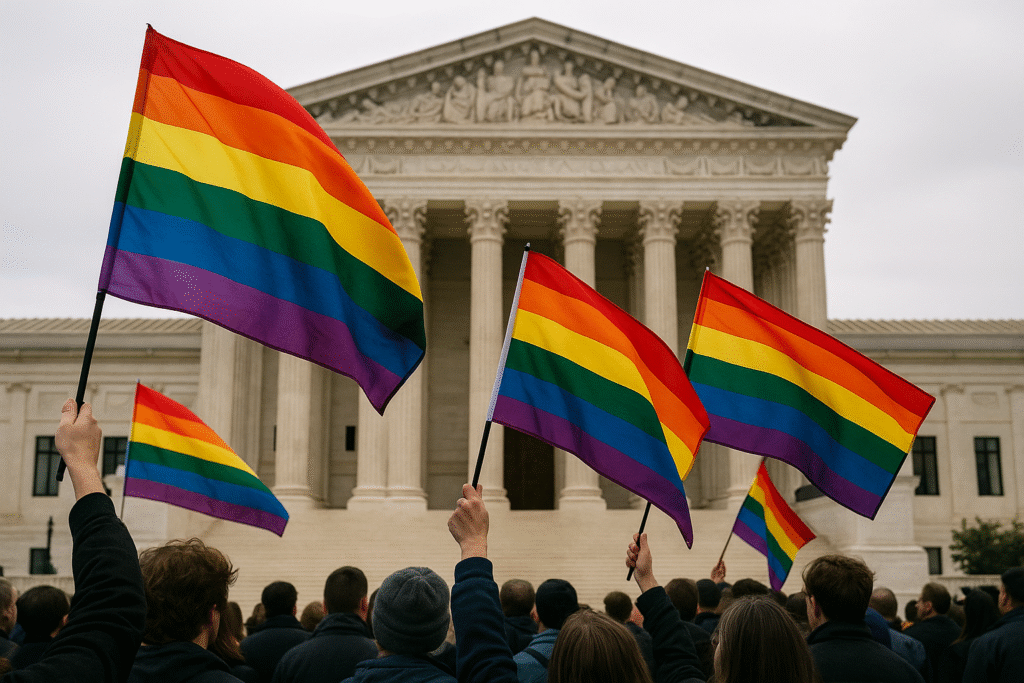
Outside the Supreme Court, activists waved rainbow flags in the chilly November air, chanting, “Love is law!”
What Comes Next
While the court’s decision not to hear the Davis case preserves marriage equality, it does not close the door on future challenges. Should another case emerge raising new legal questions about Obergefell, the justices could choose to revisit the issue.
For now, however, the Supreme Court’s message is clear: the right to marry — regardless of gender — remains the law of the land.
“Millions of Americans can breathe a sigh of relief,” Bonauto said. “All families deserve equal rights, equal dignity, and equal recognition under our Constitution.”