
By Harshit, LONDON, Nov. 6, 2025
A new astronomical study has provided some of the strongest evidence yet that aging stars may be actively destroying the giant planets orbiting closest to them. The research, conducted by scientists at University College London (UCL) and the University of Warwick, reveals that as stars evolve and expand into red giants, many nearby massive planets do not survive the transformation.
The findings, published in the Monthly Notices of the Royal Astronomical Society, shed new light on what could happen to planetary systems — including our own — when stars run out of hydrogen fuel and grow dramatically in size.
What Happens When Stars Age
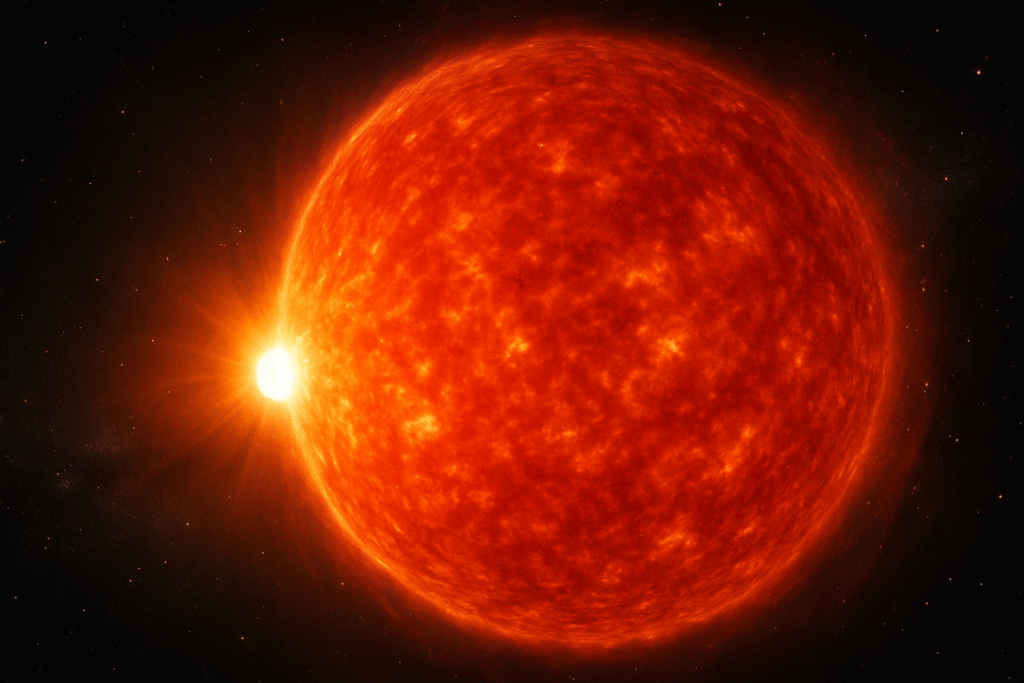
Stars like our Sun spend most of their lives in what scientists call the main sequence phase, steadily burning hydrogen in their cores. But once the hydrogen supply begins to run out, the star cools, expands, and transitions into a red giant. This swollen star can become hundreds of times its original size, changing the structure and fate of nearby planetary systems.
For the Sun, this transformation is expected to occur in about five billion years.
Searching for Planets Around Evolving Stars
To understand how this transformation affects orbiting planets, the research team analyzed data from almost 500,000 stars that had recently entered the post-main sequence phase — the early stages of expansion into red giants.
Using observations from NASA’s Transiting Exoplanet Survey Satellite (TESS), the researchers looked for slight dips in starlight caused by planets passing in front of their stars. From an initial pool of more than 15,000 possible signals, they narrowed the results down to 130 close-orbiting giant planets and planet candidates, including 33 new discoveries.
These planets all orbit their stars very closely, completing one full orbit in 12 days or fewer. This makes them especially vulnerable as their stars expand.
Evidence of Planetary Destruction
When the scientists compared stars at different stages of evolution, a clear pattern emerged:
The more evolved the star, the fewer close-orbiting giant planets remained.
Lead author Dr. Edward Bryant explained:
“This is strong evidence that as stars evolve, they can quickly cause planets to spiral inward and be destroyed. The tidal forces involved appear far more efficient than what many models previously suggested.”
This destruction occurs because as the star swells, gravitational interactions — known as tidal forces — intensify.
Dr. Bryant described the process:
“Just as the Moon pulls Earth’s oceans to create tides, a planet pulls on its star. But as the star grows, these tidal interactions slow the planet down, causing its orbit to decay. Eventually, the planet spirals inward and is consumed.”
Some planets may break apart before reaching the star, while others plunge directly into the stellar atmosphere.
What This Means for the Solar System
Co-author Dr. Vincent Van Eylen noted that these findings offer insight into the long-term fate of our own planets:
“In a few billion years, our Sun will become a red giant. Earth is farther out, so it may survive physically — but conditions would no longer support life.”
However, Mercury, Venus, and possibly Earth could be swallowed entirely, depending on how much the Sun expands.
Gas giants like Jupiter and Saturn are far enough away to likely avoid destruction, but smaller inner planets closer to the Sun may not be as fortunate.
Sharp Decline in Surviving Planets
The study shows a steep drop in the number of close-orbiting giant planets around stars more advanced in their post-main sequence evolution:
| Star Stage | Giant Planet Occurrence Rate |
|---|---|
| Early post-main sequence | ~0.35% (similar to ordinary stars) |
| Full red giant expansion | ~0.11% (major decline) |
This sharp decrease strongly supports the idea that many planets do not survive their star’s expansion.
Next Steps: Confirming Which Planets Will Fall
To confirm whether the objects identified are true planets or heavier brown dwarfs, researchers will now measure their masses by detecting subtle “stellar wobbles” caused by gravitational pull.
“Once we have the masses,” Dr. Bryant said, “we can determine how fast planets are spiraling inward and how soon they may be destroyed.”
This research marks a significant step toward understanding the long-term evolution of planetary systems, including our own.