
By Harshit
LONDON, Nov. 6
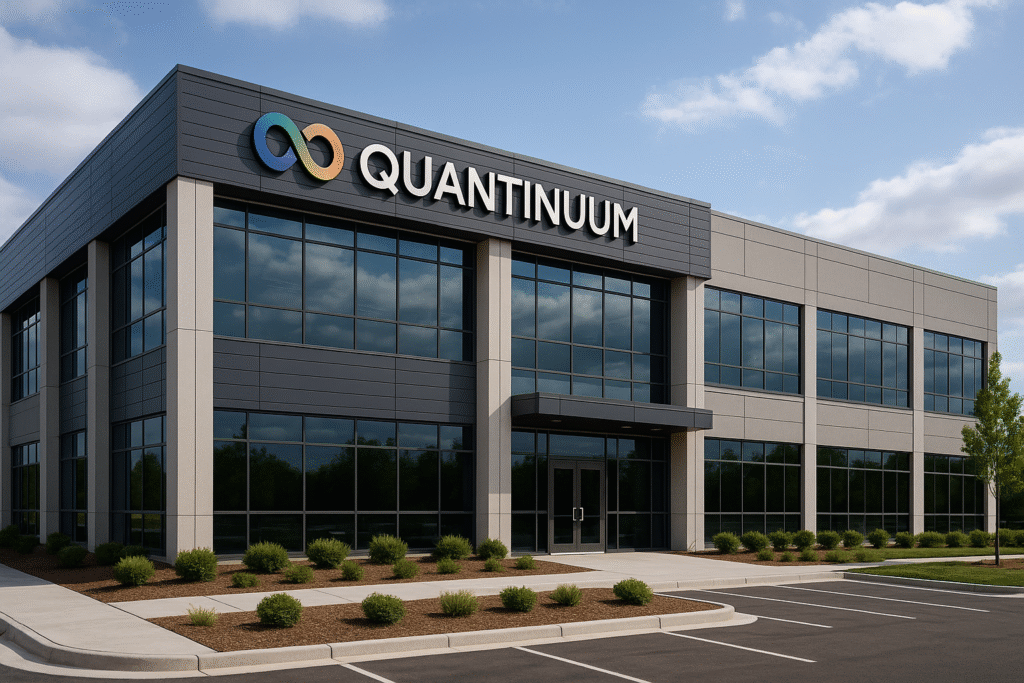
Quantinuum, the UK- and US-based quantum computing firm valued at around $10 billion, announced the launch of its new quantum computer Helios this week—describing it as the “world’s most accurate quantum computer.” The unveiling marks a notable moment in the industry’s transition from theoretical promise to early commercial deployment, as companies across pharmaceuticals, finance, aerospace, and materials science begin evaluating quantum systems for real-world applications.
Helios is a general-purpose quantum computer, engineered to support a wide range of computational workloads rather than niche or highly specialized research tasks. Quantinuum executives say the system is built for enterprise adoption, reflecting what industry analysts describe as the next phase of quantum computing: moving from laboratory demonstrations toward market-ready tools and use cases.
At the core of Helios is its record-high fidelity—a measurement that indicates how accurately a quantum computer performs operations while minimizing errors, one of the field’s greatest technical challenges. According to performance data shared by the company, Helios demonstrates the highest operational fidelity currently available in any comparable commercial system. High fidelity is crucial for scaling quantum computing toward complex, large-scale problem solving; systems with lower accuracy require significantly more error correction and are harder to program effectively.
Beyond performance, Quantinuum has also emphasized accessibility and developer usability. Helios is compatible with a new Python-based programming language named Guppy, which enables developers to combine quantum and classical computing resources within the same programming environment. The company describes Guppy as a bridge for software engineers unfamiliar with quantum mechanics who want to integrate quantum algorithms into broader computational workflows.
“The next computing inflection point starts today,” said Dr. Rajeeb Hazra, president and chief executive of Quantinuum. “For the first time, enterprises can access a highly accurate general-purpose quantum computer to drive real-world impact, transforming how industries innovate—from drug discovery to finance to advanced materials.”
One of the company’s major focus areas is the intersection of quantum computing and generative artificial intelligence. Quantinuum is developing methods to use quantum systems to produce novel datasets—data that can then be used to train or refine generative AI models. Hazra has previously stated that quantum-generated data represents a breakthrough on the scale of the initial release of ChatGPT, allowing models to learn patterns and behaviors that classical computers struggle to simulate.
Industry observers note that the integration of quantum computing with generative AI could eventually reshape optimization, molecular modeling, climate modeling, and cybersecurity. However, the timeline for widespread deployment remains uncertain, with many companies in early experimentation phases.
Quantinuum is also expanding its partnership with NVIDIA, a major supplier of AI acceleration hardware. Under the collaboration, Helios will interoperate with NVIDIA’s computing platforms to develop domain-specific applications for sectors such as pharmaceuticals, material science, and national defense. The partnership may allow hybrid AI-quantum workflows in which NVIDIA GPUs handle large-scale machine learning tasks while Helios performs quantum-specific simulation or optimization routines.
Founded in Cambridge and now operating across the UK and United States, Quantinuum is regarded as one of the few companies attempting to build both hardware and software ecosystems for quantum computing. Its approach differs from that of companies focusing exclusively on quantum processors or cloud-accessible research platforms.
While the company says enterprise adoption is already underway, analysts caution that the commercial quantum sector remains in an early stage. Barriers include cost, limited developer familiarity, and the ongoing challenge of scaling from high-accuracy systems to fault-tolerant, industrial-scale quantum architectures. Even so, the release of Helios is viewed as a step forward in demonstrating that high-fidelity quantum systems can be made accessible beyond research labs.
As quantum computing continues moving toward commercialization, Helios will likely serve as a test case for whether enterprises are prepared—and willing—to integrate quantum workflows into their technological stacks.