
By Harshit, LOS ANGELES, NOVEMBER 3 / 6:16 AM EDT
When the Los Angeles Dodgers signed Japanese ace Yoshinobu Yamamoto to a staggering 12-year, $325 million contract before the 2024 MLB season, critics questioned whether any pitcher—especially one who had never thrown a single pitch in the Major Leagues—could possibly live up to that price tag. But by the early hours of November 2, 2025, Yamamoto didn’t just justify the investment; he transcended it. His Game 7 heroics against the Toronto Blue Jays etched his name among the greatest postseason performances in baseball history.
From Tokyo to the Top: The Making of a Star
The Dodgers took a massive gamble when they brought Yamamoto over from Japan’s Nippon Professional Baseball League. They believed his control, durability, and mental toughness could translate to the major leagues. And through one of the most grueling postseason runs imaginable, the 27-year-old right-hander exceeded every expectation.
Facing elimination in Game 6 at a deafening Rogers Centre, Yamamoto silenced the Blue Jays’ offense with six innings of brilliance, allowing just one run and five hits while striking out six. That victory forced the decisive Game 7 — and set the stage for one of the most remarkable pitching efforts ever seen on a baseball diamond.
Game 7: Heroics on 24 Hours’ Rest
Barely a day after throwing 90 pitches, Yamamoto took the mound again in relief, with the Dodgers’ season hanging in the balance. The Blue Jays were on the verge of winning their first title in 32 years and had two runners on base when Yamamoto entered the game in the bottom of the ninth.
On his second pitch, he hit Alejandro Kirk, loading the bases with one out. The Rogers Centre roared as the tension built — one hit could have ended the Dodgers’ dynasty hopes. Instead, Yamamoto bore down.
He forced a ground ball to shortstop Miguel Rojas, who fired home to catch Isiah Kiner-Falefa by inches. Moments later, Yamamoto induced a pop fly from Ernie Clement, ending the inning and deflating the Blue Jays’ crowd.
In the 10th inning, Yamamoto retired all three batters in order. Then came the 11th — the moment legends are made of. After allowing a double to Vladimir Guerrero Jr. and a walk to Addison Barger, he found himself again in deep trouble. With one out and runners on the corners, he delivered one of the nastiest splitters of his career, shattering Alejandro Kirk’s bat and turning a series-clinching double play.
It was his third win of the World Series — something no pitcher had done since Randy Johnson in 2001.
Unmatched Grit and Historical Feats
Yamamoto’s combined postseason numbers read like a fantasy: a 1.45 ERA, a .143 opponent batting average, and performances in nearly every high-leverage moment the Dodgers faced. Over the course of the World Series, he pitched a complete-game victory in Game 2, a six-inning gem in Game 6, and then 2⅔ scoreless innings of relief in Game 7 on almost no rest.
His mental and physical endurance stunned analysts and teammates alike. Dodgers catcher Will Smith, who caught every inning of Yamamoto’s masterclass, said:
“He was the MVP of this series. That was incredible. I told him, ‘If you can give one, we can win.’ He gave us three.”
Even Dodgers manager Dave Roberts, typically measured in his praise, could barely contain his emotion after the final out.
“Yamamoto’s the GOAT!” Roberts shouted on the Fox broadcast — calling him the “Greatest of All Time.”
A Nod to Baseball’s Greatest
By any measure, Yamamoto’s World Series performance belongs alongside those of Bob Gibson (1968), Christy Mathewson (1905), Mickey Lolich (1968), and Randy Johnson (2001). Few pitchers have ever been asked to do what he did — and even fewer have succeeded.
Pitching on such little rest defies modern logic. Starters are conditioned to work every fifth day, following a regimented recovery cycle. But Yamamoto’s willingness to volunteer for relief duty in the most pressurized situation imaginable showcased an old-school toughness rarely seen in today’s analytics-driven era.
Humility Amid Glory
Despite his heroics, Yamamoto remained characteristically humble when awarded the World Series MVP trophy.
“I did everything I was supposed to do, and I’m so happy that I was able to win this with these teammates,” he said through an interpreter.
His humility only adds to his legend. In an age when metrics define performance, Yamamoto reminded the world that greatness still depends on heart, endurance, and an unshakable belief in one’s team.
The Beginning of a Dynasty
The Dodgers’ second consecutive championship cements their place as baseball’s new powerhouse — but it also signals the dawn of a new era for Yamamoto. From Tokyo to Los Angeles, from a $325 million gamble to a World Series MVP, he has proven not only that he belongs in the majors but that he can dominate its biggest stage.
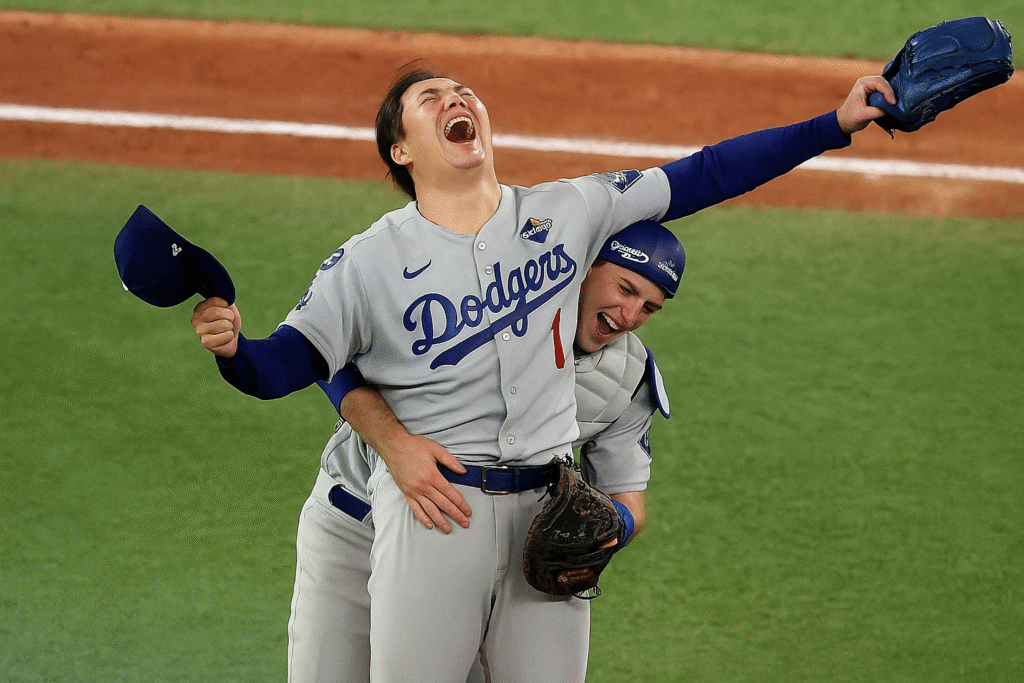
As confetti rained down and his teammates lifted him high, Yoshinobu Yamamoto stood smiling — calm, composed, and immortalized. He had not just justified the money; he had become priceless.