
By Harshit, KINGSTON, Oct. 31, 2025 6 AM EDT
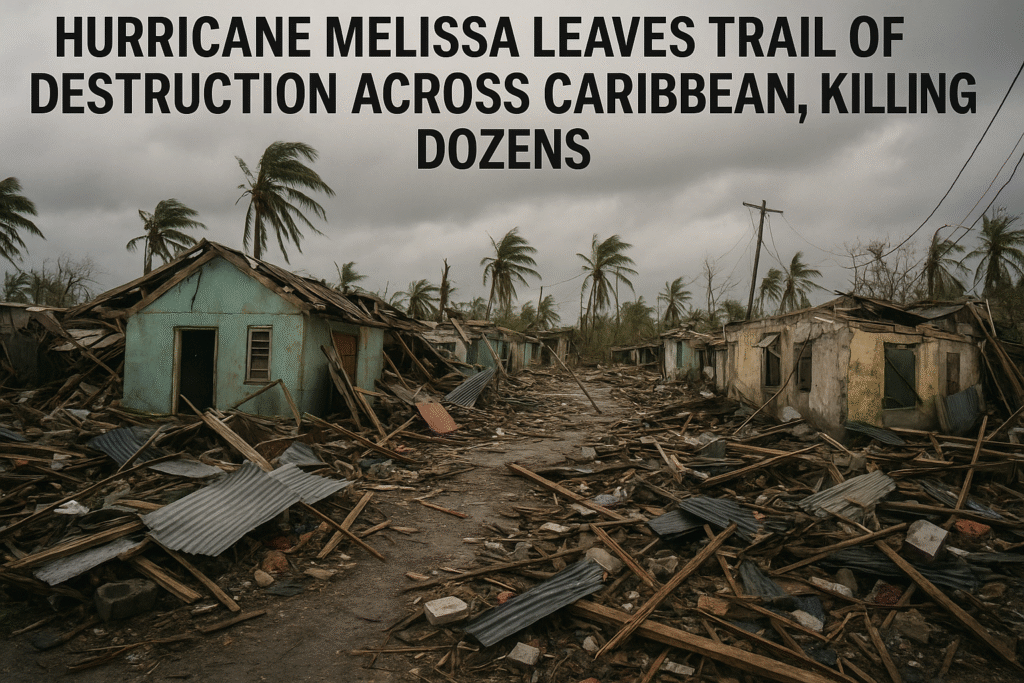
At least 19 people have been killed in Jamaica and 30 more in Haiti as Hurricane Melissa, one of the most powerful storms ever to hit the Caribbean, carved a deadly path across the region this week. With large parts of Jamaica flattened, homes swept away, and infrastructure paralyzed, search and rescue operations are ongoing as international aid begins to flow into the worst-affected zones.
Jamaica in Crisis: “Entire Communities Flattened”
Information Minister Dana Morris Dixon said on Thursday that western Jamaica has suffered “devastating” damage, with some entire communities “marooned” and “flattened.” Electricity remains cut across most of the island, and thousands of residents are struggling to survive amid shortages of food, water, and shelter.
“There are parts of the country that have been without water for several days,” Dixon said. “Food is growing increasingly scarce, and we are racing against time to reach those who are trapped.”
Satellite images reveal that nearly all buildings in some Jamaican villages were completely destroyed by the hurricane’s 185 mph (295 km/h) winds. Roads remain blocked by fallen trees and debris, cutting off western parishes such as Westmoreland and Hanover from relief supplies.
From the storm-ravaged town of White House, resident Trevor ‘Zyanigh’ Whyte told the BBC that “words can’t explain how devastating” the storm has been. “No one is able to get through to their loved ones. Every tree is on the road… you can’t get too far with the cars, not even a bicycle,” he said.
Aid Efforts Underway, But Logistics Hampered
Kingston’s Norman Manley International Airport has largely resumed operations, allowing international aid flights to land. However, smaller regional airports closer to the most devastated regions remain partially functional.
Relief agencies and the Jamaican Defence Force are transporting aid by road where possible, but many routes remain impassable. The World Food Programme (WFP) said it is coordinating logistics, cash transfers, and emergency supplies across Jamaica, Haiti, Cuba, and the Dominican Republic.
The U.S. State Department announced it is deploying a disaster response team to assist with search and rescue operations and distribute food, medical supplies, hygiene kits, and temporary shelters. The UK government pledged an additional £5 million ($6 million) in humanitarian supplies, including shelter kits and solar-powered lanterns for those without electricity — on top of £2.5 million ($3.36 million) already committed earlier this week.
The Foreign Office is also preparing evacuation flights for stranded British nationals unable to leave on commercial airlines.
Haiti Suffers Severe Flooding, Dozens Killed
In neighboring Haiti, officials reported at least 30 deaths, most of them in Petit-Goave, where a river burst its banks and swept through residential areas. Thousands of homes were submerged or destroyed, and authorities warned that the death toll could rise as rescuers reach more remote communities.
Around 15,000 people are now sheltering in more than 120 emergency centers, according to Gregoire Goodstein, interim UN humanitarian coordinator for Haiti. Communication lines remain down in several departments, complicating efforts to assess the full scale of the destruction.
Cuba Evacuates Millions as Storm Passes
In Cuba, the UN’s resident coordinator, Francisco Pichon, said that more than 3 million people were exposed to life-threatening conditions as Melissa moved northward. Cuban authorities successfully evacuated 735,000 residents, preventing fatalities so far, but nearly 240 communities remain cut off due to flooding and landslides.
Damage assessments are ongoing, with extensive power outages reported in eastern provinces. The Cuban government said it was working to restore transportation links and reopen key roads blocked by debris.
International Response Grows
Governments, humanitarian agencies, and individuals worldwide have pledged to support the storm-hit nations. The World Food Programme, Red Cross, and UNICEF are mobilizing joint operations to deliver food, water, and medical assistance.
The U.S. Agency for International Development (USAID) said it would coordinate with Caribbean governments to ensure “rapid delivery of life-saving assistance” while maintaining transparency in aid distribution.
UN Secretary-General António Guterres expressed solidarity with the victims, calling the devastation “a stark reminder of the growing ferocity of tropical storms in a warming climate.”
Bermuda Braces for Impact
As Jamaica, Haiti, and Cuba began recovery efforts, Bermuda prepared for Hurricane Melissa’s approach. The Bermuda Weather Service forecasted that the storm would reach the British territory as a Category 2 hurricane late Thursday night.
Government offices and all schools were ordered closed until Friday afternoon. A government alert urged residents to stay off the roads until the official “All Clear” was issued to allow emergency crews to clear debris.
A Region Reeling
Melissa made landfall in Jamaica as a Category 5 hurricane on Tuesday — the strongest storm to strike the island in decades. The combination of wind speeds near 185 mph, torrential rain, and storm surges left the Caribbean reeling from what many fear will become one of the costliest natural disasters in recent history.
For now, officials warn that recovery could take months, if not years. “We are a resilient nation,” said Minister Dixon, “but this is unlike anything we’ve faced in our lifetime.”